Why Proof of Address Matters in the Digital World
In an increasingly digital business environment, verifying someone's identity is no longer limited to checking a passport or national identity card. Companies, financial institutions, online platforms and service providers also need to establish where their customers actually live. This is where a Proof of Address becomes essential.
But what is a Proof of Address, why do businesses request it, and how can individuals obtain an official document that confirms their residential address?
A Proof of Address is an official or accepted document that demonstrates a person's current residential address. It is commonly required when opening a bank account, registering for financial services, completing Know Your Customer (KYC) procedures, applying for certain services, or verifying an account on an online platform.
As identity fraud, account manipulation and document forgery become increasingly sophisticated, reliable address verification is an important part of modern digital security. Businesses must ensure that the information provided by customers is genuine, current and consistent with their identity documents.
This guide explains everything you need to know about Proof of Address documents, accepted verification methods, how to obtain them, common problems and the growing importance of AI-powered document verification.
What Is a Proof of Address?
A Proof of Address is a document used to confirm that an individual lives at a particular residential address.
It usually contains the following information:
- The full legal name of the individual.
- The current residential address.
- The name of the organization or authority issuing the document.
- An issue date or billing period.
- Additional identifying information, such as an account number or official reference.
The purpose is to establish a connection between an individual and a specific physical address. For example, when someone applies for a bank account, the financial institution may request a recent electricity bill or an official government registration document. The document helps establish whether the applicant genuinely resides at the address stated in the application.
It is important to understand that a Proof of Address is not the same as proof of identity. A passport or national ID card primarily establishes who a person is. A Proof of Address establishes where that person lives. Both documents can be necessary to complete a comprehensive identity verification process.
The exact requirements depend on the country, the organization requesting verification and the purpose of the application.
Why Do Companies Require Proof of Address?
Address verification is an important security measure across many industries. Businesses need reliable customer information to meet regulatory requirements, prevent fraud and maintain trustworthy digital services.
There are several reasons why companies request Proof of Address documents.
Banking and Financial Services
Banks and financial institutions frequently request proof of residential address when customers open accounts, apply for loans or access specific financial services.
Address verification can form part of their customer due diligence procedures and help financial institutions understand who they are doing business with. In regulated environments, identity and address information may contribute to broader anti-money laundering (AML) and customer verification processes.
Know Your Customer (KYC) Compliance
Know Your Customer procedures are designed to help organizations establish and verify customer identities.
Depending on the applicable regulations and risk assessment, KYC procedures may include:
- Identity document verification.
- Residential address verification.
- Date of birth confirmation.
- Document authenticity checks.
- Risk-based customer screening.
- Ongoing monitoring where required.
Proof of Address can therefore represent an important component of a broader KYC framework.
However, it should not be confused with a complete AML compliance solution. Businesses must consider all applicable legal and regulatory obligations.
Online Platforms and Digital Services
Online marketplaces, dating platforms, gaming services, financial applications and subscription-based businesses increasingly rely on digital onboarding.
In some situations, these platforms need to establish whether a customer is providing genuine personal information. Address verification can help identify suspicious registrations, duplicate accounts and inconsistencies between submitted information and supporting documents.
It is particularly relevant when platforms operate internationally and must manage different customer identification requirements.
Fraud Prevention and Account Security
Fraudsters may use stolen identities, manipulated documents or false personal information to create accounts.
Checking an address document against other submitted information can help businesses identify potential inconsistencies. For example, a customer might submit an identity document containing one name while the address document contains a different name or an outdated address.
Automated verification systems can identify these discrepancies and send questionable applications for additional review.
Which Documents Can Be Used as Proof of Address?
One of the most common questions is which documents are accepted as valid Proof of Address.
There is no universal list. Different banks, companies and government authorities have different requirements.
Nevertheless, several document types are widely accepted.
Utility Bills
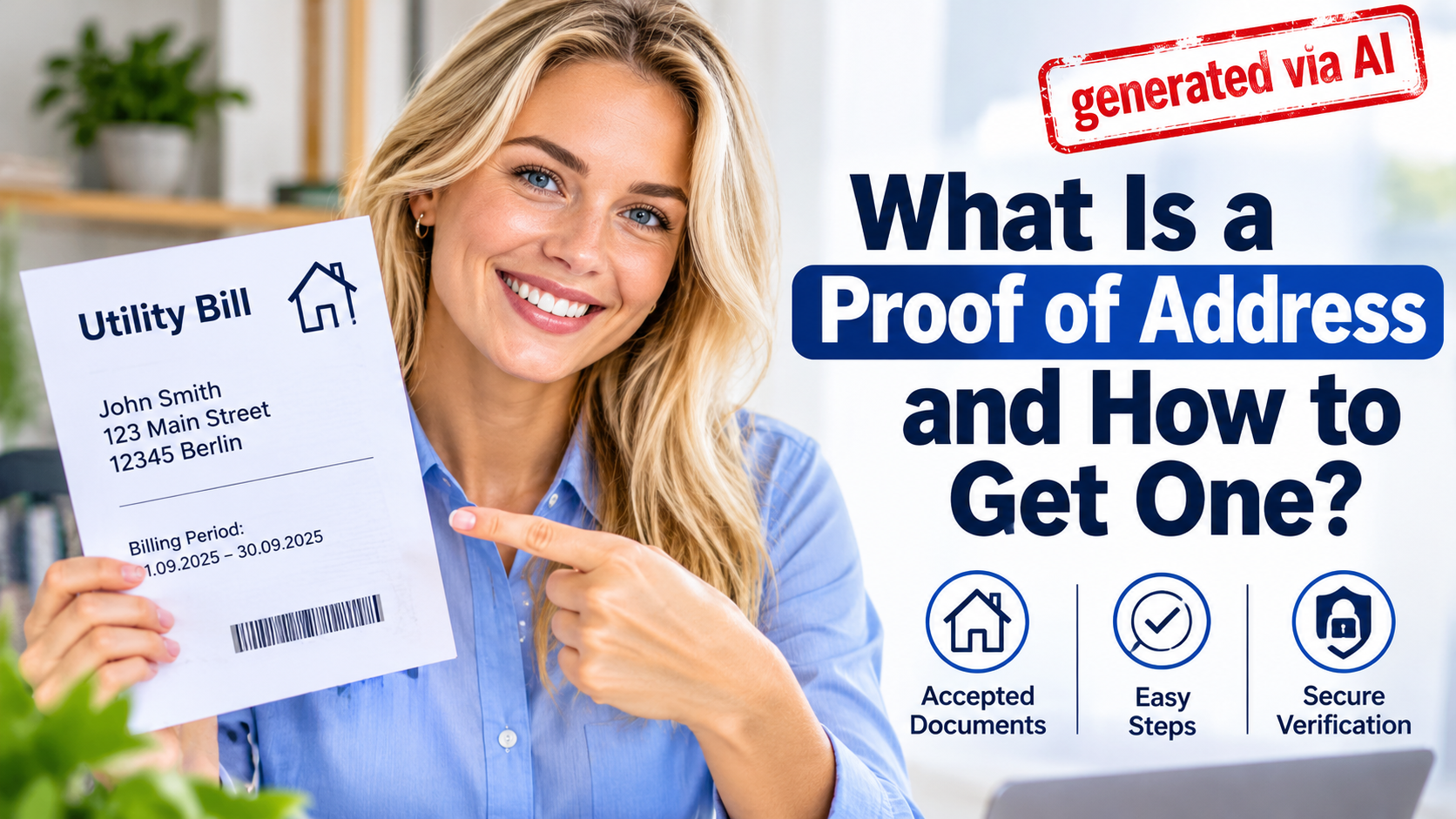
Utility bills are among the most commonly requested address verification documents.
Examples include:
- Electricity bills.
- Gas bills.
- Water bills.
- Landline telephone bills.
- Internet service bills.
These documents typically contain the customer's name, residential address, issuing company and billing date.
Many organizations require utility bills to be relatively recent, often issued within the previous three months. However, this is not a universal rule.
Bank Statements
A bank statement can also serve as Proof of Address if it displays the account holder's name and current residential address.
Depending on the institution, accepted documents may include:
- Monthly bank statements.
- Official account statements.
- Statements from regulated financial institutions.
- Certain credit card statements.
Downloaded PDF statements may be accepted by organizations that support digital verification.
Government-Issued Documents
Official documents issued by government authorities can provide strong evidence of residential address.
Examples include:
- Tax assessment notices.
- Official residence registration certificates.
- Government correspondence.
- Social security correspondence.
- Official municipal documents.
In Germany, for example, a Meldebescheinigung can confirm a person's registered residential address.
Depending on the purpose, a registration certificate may be accepted as Proof of Address by banks, service providers and other organizations.
Rental Agreements and Housing Documents
A rental agreement can demonstrate a connection between an individual and a residential property.
However, not every organization accepts rental contracts as sufficient Proof of Address.
Some providers prefer documents showing that the person currently receives correspondence at the address.
Other possible documents include official housing statements or property-related correspondence.
Insurance Documents
Certain insurance documents may also be accepted.
Examples include:
- Health insurance correspondence.
- Home insurance documents.
- Official insurance statements.
- Documents from recognized insurance providers.
Acceptance depends on the issuing organization and the requirements of the company requesting verification.
Other Accepted Documents
Some organizations may accept additional documents, including:
- Official university correspondence.
- Pension statements.
- Residence permits containing an address, where applicable.
- Local authority certificates.
- Documents issued by recognized public institutions.
Before submitting any document, applicants should always check the requesting organization's specific requirements.
How to Get a Proof of Address: Step-by-Step Guide
Obtaining a Proof of Address is usually straightforward, provided that the individual has access to official correspondence or registration documents.
The following steps explain how to obtain one.
Step 1: Identify the Required Document
First, determine which document the requesting organization accepts.
For example, a bank may accept a recent utility bill or bank statement, while another financial service provider may require an official government document.
Check the following details:
- Which document types are accepted?
- How recent must the document be?
- Must it contain your full legal name?
- Does it need to show your complete residential address?
- Are digital PDF documents accepted?
- Are screenshots or photographs permitted?
Understanding these requirements before submitting an application can prevent unnecessary delays.
Step 2: Request an Official Document
If you do not already have an appropriate document, contact the relevant issuing organization.
Depending on your situation, you can:
- Download a bank statement through online banking.
- Request a new utility bill.
- Contact your insurance provider.
- Request official correspondence from a government authority.
- Obtain a residence registration certificate from your local municipality.
In Germany, individuals can generally request a Meldebescheinigung from their responsible registration authority (Bürgeramt or Einwohnermeldeamt), subject to local procedures.
Step 3: Check the Information
Before submitting the document, make sure that all relevant information is correct.
Pay particular attention to:
- Your full name.
- Street and house number.
- Postal code.
- City and country.
- Issue date.
- Document legibility.
The information should correspond with the details provided during the registration process.
Even small differences, such as an outdated apartment number or an alternative spelling of a name, can trigger additional verification.
Step 4: Submit the Document Securely
Most modern organizations offer digital submission methods.
Depending on the service, applicants may be able to upload:
- A PDF document.
- A photograph of a printed document.
- A scanned copy.
- An image captured directly through a mobile application.
Only submit documents through official and secure channels.
Avoid sending sensitive personal documents through unsecured email or unknown third-party websites.
Step 5: Wait for Verification
After submission, the organization checks whether the document meets its requirements.
The verification process may involve manual review or automated document recognition.
Some systems can extract information using Optical Character Recognition (OCR), compare names and addresses, and identify potential signs of manipulation.
If additional information is required, the applicant may be asked to provide another document.
Can You Get a Proof of Address Online?
Yes. In many countries, obtaining or downloading a Proof of Address online is possible.
Digital banking, online government services and electronic billing have made address verification considerably more convenient.
Common digital options include:
Online banking: Many banks allow customers to download official account statements containing their registered residential address.
Utility provider portals: Electricity, gas and internet providers frequently provide digital invoices that can be downloaded as PDF documents.
Government portals: Some authorities offer digital access to registration certificates, tax notices or other official correspondence.
Insurance platforms: Customers may be able to download official insurance statements directly from their provider's website.
However, a digital document is not automatically accepted by every organization.
Some verification providers require an original PDF rather than a screenshot. Others may request a document with a verifiable electronic signature or additional issuer information.
The important distinction is between obtaining a document digitally and ensuring that the document meets the recipient's verification standards.
What Makes a Proof of Address Valid?
A document may look official but still fail a verification process. Businesses therefore need to evaluate several characteristics before accepting it.
Document Authenticity
The document should originate from a legitimate issuing organization.
A manipulated PDF, edited photograph or fabricated utility bill should not be accepted as reliable evidence.
Current Information
The address must reflect the applicant's current residential situation.
An outdated statement may no longer provide sufficient evidence, even if it was originally authentic.
Consistent Personal Information
The name and address should match the information submitted during registration.
Where differences exist, organizations may request supporting explanations or additional documentation.
Readability and Completeness
All important information must be visible.
Documents with cropped addresses, missing dates, blurred text or incomplete pages may require resubmission.
Issuer Recognition
The issuing organization should be identifiable. The document should contain sufficient information to establish where it originated.
These characteristics help create a more reliable address verification process.
Common Reasons Why Proof of Address Verification Fails
Address verification can fail for several reasons.
Understanding the most frequent problems helps applicants avoid unnecessary delays.
- Outdated documents
A utility bill or bank statement may be older than the period accepted by the organization.
- Different names
The submitted document may contain a shortened name, maiden name or another variation that does not match the identity document.
- Incorrect residential address
The address may be incomplete or contain an outdated apartment number, postal code or street name.
- Poor image quality
Blurry photographs, reflections, shadows and cropped documents can prevent automated systems from extracting information correctly.
- Manipulated documents
Digital editing tools can be used to change names, dates, account details or addresses.
- Unsupported document types
Not every organization accepts rental agreements, mobile phone invoices or screenshots as Proof of Address.
- Temporary or shared accommodation
Individuals living in shared accommodation, student housing or temporary residences may have difficulty obtaining documents in their own names.
In these cases, the requesting organization should explain which alternative documents or verification procedures are available.
The Role of AI in Modern Proof of Address Verification
Traditional document verification often relied heavily on manual inspection.
Employees reviewed submitted documents, compared personal details and attempted to identify suspicious characteristics.
While manual checks remain important, they can become expensive and time-consuming when businesses process thousands of customer applications.
This is where Artificial Intelligence (AI) and automated document verification can provide significant advantages.
Modern AI-powered verification systems can support businesses in several areas.
Automated Document Recognition
AI-based document recognition can help identify different types of documents.
For example, a system may distinguish between a bank statement, electricity bill, insurance document or government-issued certificate.
This allows businesses to apply document-specific verification rules.
OCR and Data Extraction
Optical Character Recognition enables software to extract text from uploaded documents.
An automated system can identify:
- Full names.
- Residential addresses.
- Postal codes.
- Issue dates.
- Account references.
- Issuing organizations.
The extracted information can then be compared with the data submitted by the customer.
Manipulation and Forgery Detection
Document manipulation is an increasing concern for digital businesses.
AI-assisted document analysis can help identify suspicious visual inconsistencies, unusual formatting, altered text regions and other potential indicators of tampering.
Depending on the technology used, additional image-forensic methods can help detect irregularities in digital documents.
However, no automated system can guarantee the detection of every sophisticated forgery.
Automated Consistency Checks
One particularly useful function is the comparison of information across multiple documents.
For example, a customer might submit:
- A passport.
- A bank statement.
- A utility bill.
An automated verification workflow can compare the names and other relevant information across these documents.
If discrepancies are detected, the application can be flagged for further investigation.
Faster Digital Onboarding
Automated verification can reduce the time employees spend reviewing routine applications.
Instead of manually examining every document, verification teams can concentrate on applications that require additional attention.
This can improve operational efficiency while supporting consistent verification procedures.
Proof of Address and KYC: Why Both Are Important
Proof of Address is frequently associated with Know Your Customer requirements.
However, businesses should understand that identity verification and address verification serve different purposes.
Identity verification establishes whether a person is who they claim to be.
Address verification establishes whether the declared residential address is supported by acceptable evidence.
Together, these checks can provide a more complete picture of a customer's identity.
For financial institutions, fintech providers, online marketplaces and other regulated or security-sensitive services, this distinction is particularly important.
A person might possess a genuine passport but submit a manipulated utility bill.
Equally, someone might provide an authentic bank statement that does not belong to the person opening the account.
A comprehensive verification process should therefore consider document authenticity, personal information consistency and the overall risk profile.
Businesses should also ensure that their verification procedures comply with applicable privacy and data protection legislation, including the General Data Protection Regulation (GDPR), where relevant.
Only necessary information should be collected and processed, with appropriate security measures and retention policies.
Special Challenges for International Customers
Address verification becomes more complicated when businesses operate internationally.
Different countries use different document formats, languages, address structures and administrative systems.
For example:
- Germany uses official residence registration certificates known as Meldebescheinigungen.
- The United Kingdom commonly uses council tax bills, utility bills and bank statements.
- The United States may use bank statements, utility bills, government correspondence and other accepted documents.
- Other European countries may provide official municipal certificates or electronic government documents.
A document that is commonly accepted in one country may not be recognized by a service provider in another.
International companies therefore need flexible verification processes that support different document categories and regional requirements.
AI-powered document recognition can help businesses process documents from multiple countries, provided that their systems are trained and configured to recognize the relevant formats.
Human review should remain available for unusual documents, uncertain results and exceptional cases.
How Businesses Can Improve Their Address Verification Process
Organizations that require Proof of Address should establish clear and consistent verification procedures.
A well-designed process should combine technology, operational guidelines and appropriate human oversight.
Important recommendations include:
Define accepted document types. Clearly communicate which documents customers can submit and which requirements apply.
Set document validity periods. Establish transparent rules regarding how recent a document must be.
Use automated document recognition. OCR and AI-supported analysis can help reduce manual workload.
Compare submitted information. Check whether the name and address match the customer's application and other supporting documents.
Identify potential manipulation. Use document integrity checks and additional review procedures to investigate suspicious submissions.
Protect customer information. Apply appropriate access controls, encryption, data minimization and retention policies.
Provide alternative verification methods. Make reasonable provisions for customers who cannot obtain standard utility bills or bank statements.
Maintain human oversight. Automated systems should support informed decisions rather than automatically determine every exceptional case.
By combining these measures, organizations can create a more efficient and trustworthy customer onboarding experience.
The Future of Digital Address Verification
The demand for reliable digital identity verification is expected to remain an important part of the development of online services.
As more businesses move their customer onboarding processes online, traditional paper-based verification methods are increasingly complemented by digital alternatives.
Artificial Intelligence, machine learning, document recognition and identity verification technologies are contributing to this transformation.
Future verification processes may increasingly combine several technologies:
- AI-powered document classification.
- Advanced OCR and data extraction.
- Automated document authenticity analysis.
- Digital identity wallets.
- Electronic government certificates.
- Secure data-sharing mechanisms.
- Cross-document consistency checks.
European digital identity initiatives, including the European Digital Identity Wallet framework, are also creating new opportunities for individuals to share verified identity information digitally.
These developments could make it easier for customers to prove their identity and residential information without repeatedly uploading traditional paper documents.
Nevertheless, technology must be implemented responsibly.
Data protection, transparency, accuracy and appropriate human oversight will remain essential factors in building customer trust.
Why Reliable Address Verification Is Essential for Digital Businesses
For companies operating online, customer trust is one of their most important assets.
Fake identities, manipulated documents and misleading registration information can create financial, operational and reputational risks.
A reliable Proof of Address verification process helps organizations establish whether customer information is consistent and supported by appropriate documentation.
This is particularly relevant for:
- Banks and fintech companies.
- Online marketplaces.
- Dating and social networking platforms.
- Gaming and entertainment providers.
- Insurance companies.
- Digital service providers.
- Online recruitment and freelancer platforms.
Each business has different verification requirements, but the underlying objective remains similar: establish trust without creating unnecessary barriers for legitimate customers.
Modern AI-powered verification solutions can support this objective by combining document recognition, information extraction and automated consistency checks.
For companies processing large numbers of registrations, these technologies can help create scalable verification workflows.
Conclusion: Proof of Address Is More Than Just a Document
A Proof of Address is an essential document for many everyday and business-related processes. Whether opening a bank account, applying for financial services, registering on an online platform or completing a KYC procedure, individuals may need to demonstrate where they currently live.
Obtaining one is usually straightforward. Utility bills, bank statements, government correspondence and official residence registration certificates are among the most commonly accepted options.
However, the real challenge for businesses is not simply collecting these documents. It is determining whether they are authentic, current and consistent with the information provided by the customer.
As digital fraud becomes more sophisticated, manual document inspection alone may no longer be sufficient for organizations handling large volumes of applications.
AI-powered document recognition and automated verification technologies can help identify inconsistencies, extract relevant information and support more efficient onboarding procedures.
Solutions such as airis:ident demonstrate how AI-based analysis can contribute to modern digital security and document verification workflows.
Ultimately, effective address verification is about creating a balance between security, regulatory responsibility and customer convenience. Businesses that invest in reliable verification processes can strengthen trust, reduce potential fraud risks and build safer digital services.