
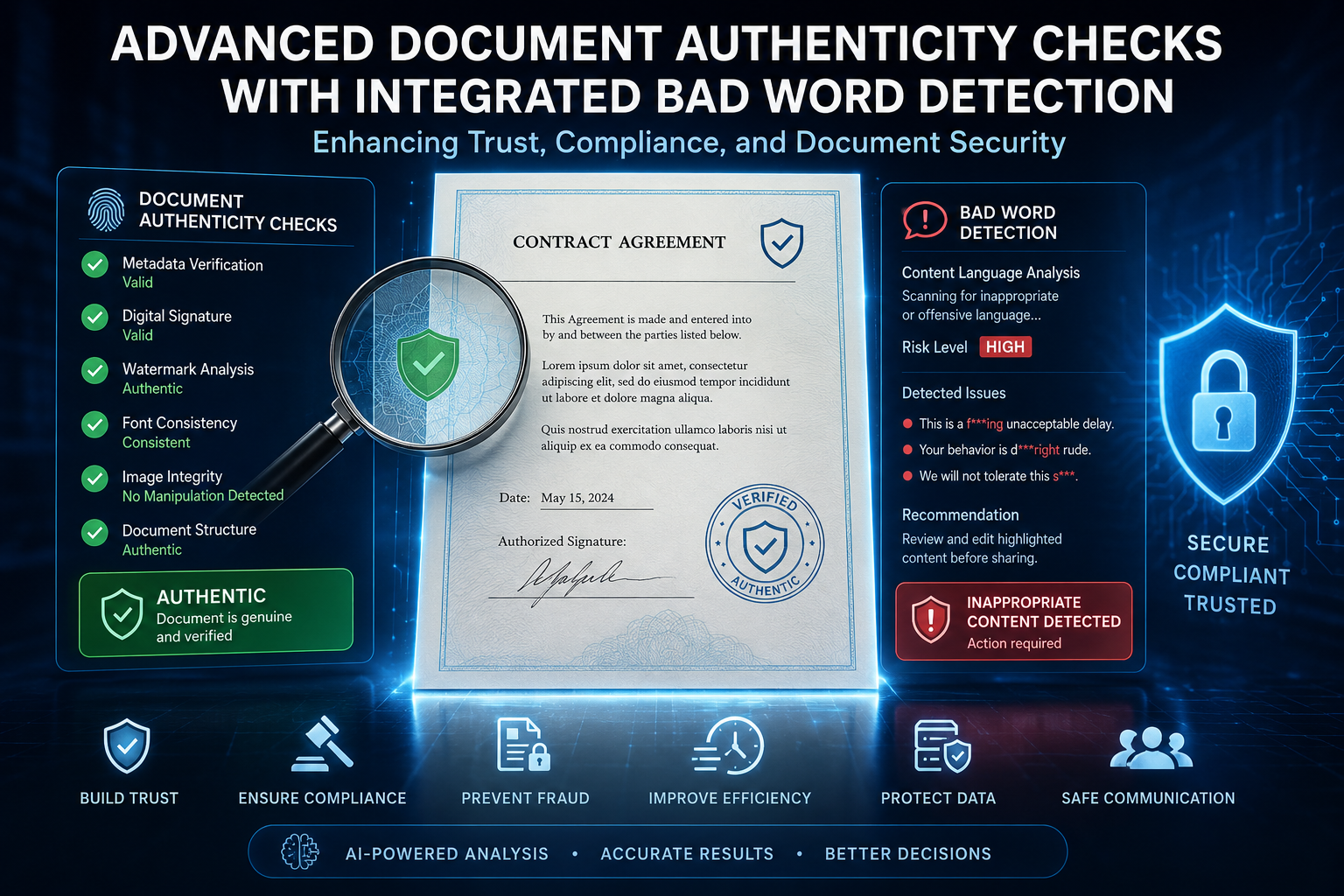
Advanced Document Authenticity Checks with Integrated Bad Word Detection: Enhancing Trust, Compliance, and Document Security
Artificial Intelligence is transforming document security by combining advanced document authenticity verification with intelligent bad word detection, enabling organizations to improve compliance, reduce fraud, and maintain professional communication standards.
As organizations continue to digitize business processes, the number of electronic documents exchanged every day has reached unprecedented levels. Contracts, invoices, certificates, employee records, legal agreements, financial statements, insurance claims, academic transcripts, and customer correspondence are increasingly managed in digital formats. While digital transformation improves efficiency and accessibility, it also introduces new security and compliance challenges.
Businesses must ensure that documents are authentic, have not been manipulated, comply with internal policies, and contain appropriate language before they are shared, archived, or processed. Artificial Intelligence (AI) is addressing these challenges by combining advanced document authenticity checks with integrated bad word detection, creating a comprehensive solution for document verification and content quality assurance.
Rather than relying on multiple disconnected tools, organizations can now leverage AI-powered platforms that simultaneously analyze document integrity and evaluate textual content. This integrated approach enhances trust, strengthens regulatory compliance, protects organizational reputation, and streamlines document workflows.
The Growing Need for Intelligent Document Verification
Digital documents have become the foundation of modern business operations. Every day, organizations exchange sensitive information across departments, countries, and industries. However, the increase in digital documentation has also created new opportunities for fraud, unauthorized modifications, inappropriate content, and compliance violations.
Traditional manual verification processes are often time-consuming, inconsistent, and difficult to scale. Human reviewers may overlook subtle alterations, metadata inconsistencies, or problematic language, particularly when processing thousands of documents each day.
AI-powered document authenticity checks significantly reduce these risks by automatically analyzing multiple aspects of a document within seconds while simultaneously identifying potentially offensive, discriminatory, abusive, or otherwise inappropriate language through integrated bad word detection.
What Are Advanced Document Authenticity Checks?
Document authenticity verification uses artificial intelligence, computer vision, optical character recognition (OCR), machine learning, and metadata analysis to determine whether a document appears genuine and internally consistent.
Modern AI systems evaluate numerous characteristics, including:
- Document structure
- Font consistency
- Layout alignment
- Metadata integrity
- Digital signatures
- Watermarks
- Embedded security elements
- Image manipulation indicators
- Copy-and-paste anomalies
- Editing traces
- Date consistency
- Cross-field validation
Rather than relying on a single indicator, AI combines hundreds of individual signals to generate a comprehensive authenticity assessment.
This enables organizations to identify suspicious documents before they enter critical business processes.
The Role of Integrated Bad Word Detection
Authenticity alone does not guarantee that a document is suitable for business use. Organizations must also ensure that content meets communication standards, regulatory requirements, and internal policies.
Integrated bad word detection automatically analyzes document text for:
- Offensive language
- Hate speech
- Harassment
- Profanity
- Discriminatory expressions
- Threatening language
- Inappropriate workplace communication
- Policy violations
- Brand-damaging terminology
- Custom organization-specific prohibited terms
AI-based language analysis goes beyond simple keyword matching. Modern natural language processing (NLP) models consider context, grammar, and surrounding text to reduce false positives and better distinguish between legitimate discussion and inappropriate usage.
This capability is especially valuable for organizations handling customer communications, legal documentation, human resources records, educational materials, and collaborative business documents.
Combining Authenticity Verification and Content Analysis
Traditionally, authenticity verification and content moderation required separate software solutions. Integrating both capabilities into a single AI-powered platform provides several operational advantages.
A unified workflow allows organizations to:
- Verify document integrity
- Detect unauthorized modifications
- Analyze metadata
- Review textual appropriateness
- Identify policy violations
- Generate compliance reports
- Flag documents requiring human review
This reduces operational complexity while improving consistency across document management processes.
Supporting Regulatory Compliance
Many industries operate under strict regulatory frameworks that require organizations to maintain accurate records and ensure appropriate communications.
Integrated AI solutions support compliance initiatives by helping organizations:
- Detect suspicious document alterations
- Maintain audit trails
- Enforce communication policies
- Reduce regulatory risk
- Improve documentation quality
- Support internal governance procedures
While AI does not replace legal or compliance professionals, it provides an efficient first layer of automated review that enables experts to focus on higher-risk cases.
Improving Workplace Communication
Internal documents shape organizational culture. Reports, emails, employee evaluations, training materials, and collaborative documents should reflect professional communication standards.
Integrated bad word detection assists organizations by identifying potentially problematic language before documents are finalized or distributed.
Human Resources departments benefit from automated screening of:
- Employee documentation
- Performance reviews
- Workplace incident reports
- Training materials
- Internal communications
By promoting respectful language, organizations can reduce misunderstandings and foster a more inclusive workplace environment.
AI-Powered Fraud Detection
Document fraud continues to evolve as digital editing tools become more sophisticated.
AI-powered authenticity checks can identify indicators such as:
- Inconsistent fonts
- Altered dates
- Modified signatures
- Manipulated logos
- Image splicing
- Metadata discrepancies
- Suspicious formatting
- Duplicate document elements
These capabilities help organizations identify potentially fraudulent documents earlier in the review process, reducing financial and operational risk.
Enhancing Customer Trust
Customers expect organizations to protect sensitive information while maintaining professional standards.
When businesses implement advanced document verification systems, they demonstrate a commitment to:
- Data integrity
- Secure document handling
- Professional communication
- Quality assurance
- Transparent processes
Greater confidence in document quality can strengthen customer relationships and reinforce brand credibility.
Applications Across Industries
Advanced document authenticity checks with integrated bad word detection provide value across numerous sectors.
Financial Services
Banks, lenders, and insurance providers process large volumes of sensitive documentation.
AI assists by verifying:
- Loan applications
- Identity documents
- Financial statements
- Insurance claims
- Customer correspondence
Simultaneously, language analysis helps ensure communications remain professional and compliant with organizational policies.
Healthcare
Healthcare organizations manage patient records, referral letters, consent forms, and administrative documentation.
AI can support document workflows by identifying formatting inconsistencies, potential alterations, and inappropriate language in internal documentation while helping maintain consistent administrative standards.
Human Resources
Recruitment and employee management involve significant document processing.
Organizations can verify:
- Employment contracts
- Performance evaluations
- Policy acknowledgments
- Training documentation
- Internal communications
Integrated language screening supports respectful and policy-compliant workplace documentation.
Education
Educational institutions process transcripts, certificates, recommendation letters, disciplinary records, and research documentation.
AI verification helps identify suspicious modifications while language analysis supports professional communication throughout administrative processes.
Government
Government agencies manage large volumes of official documentation requiring high levels of integrity and accountability.
Integrated AI solutions improve document review efficiency while supporting consistent communication standards across departments.
Machine Learning Continuously Improves Accuracy
One of AI’s greatest strengths is its ability to learn from new information.
Machine learning models continuously improve through exposure to:
- Authentic document templates
- Newly identified fraud techniques
- Industry-specific terminology
- Updated compliance rules
- Organizational writing standards
As more verified documents become available, AI systems become increasingly accurate at identifying both authenticity issues and inappropriate language patterns.
Customizable Policy Enforcement
Every organization has unique communication requirements.
Modern AI platforms allow administrators to create customized detection rules for:
- Restricted terminology
- Confidential project names
- Industry-specific compliance requirements
- Brand guidelines
- Internal vocabulary standards
- Sensitive language categories
This flexibility enables organizations to tailor content analysis according to their operational needs rather than relying solely on generic profanity lists.
Faster Document Processing
Manual review remains essential for high-risk cases, but AI dramatically reduces the workload.
Automated systems can process thousands of documents within minutes, allowing reviewers to focus on exceptions rather than routine verification.
Benefits include:
- Reduced processing time
- Lower operational costs
- Improved consistency
- Faster customer response times
- Increased productivity
Organizations gain greater efficiency without sacrificing document quality.
Secure Integration with Existing Systems
Modern AI verification platforms are designed to integrate seamlessly into existing enterprise environments.
Common integrations include:
- Document Management Systems (DMS)
- Enterprise Content Management (ECM)
- Customer Relationship Management (CRM)
- Enterprise Resource Planning (ERP)
- Human Resource Information Systems (HRIS)
- Cloud storage platforms
- Workflow automation solutions
This minimizes disruption while enhancing existing document processes.
Privacy and Responsible AI
Organizations implementing AI document verification must also prioritize privacy and responsible AI practices.
Best practices include:
- Encryption of stored documents
- Role-based access controls
- Secure audit logging
- Transparent AI decision reporting
- Human oversight for critical decisions
- Compliance with applicable privacy regulations
- Regular model validation
Responsible implementation ensures that AI enhances decision-making without replacing appropriate human judgment.
Future Innovations
The next generation of document verification technology is expected to incorporate even more advanced capabilities.
Emerging innovations may include:
- Multimodal AI analysis combining text and visual elements
- Advanced handwriting verification
- Blockchain-based document provenance
- Real-time collaboration monitoring
- Context-aware policy enforcement
- Cross-document consistency analysis
- Explainable AI reporting
- Continuous compliance monitoring
These technologies will further strengthen document integrity while simplifying regulatory compliance.
Building a More Trusted Digital Future
As digital ecosystems continue to expand, organizations must balance efficiency with security and accountability. Documents are no longer static files—they are critical assets that support business decisions, regulatory obligations, and customer relationships.
Advanced document authenticity checks combined with integrated bad word detection represent a comprehensive approach to modern document governance. By automatically verifying integrity and reviewing language quality within a single workflow, organizations can reduce fraud, improve compliance, enhance operational efficiency, and maintain professional communication standards.
Importantly, these AI-powered systems are designed to augment human expertise rather than replace it. Security professionals, compliance officers, legal teams, and document reviewers remain responsible for final decisions, while AI accelerates routine analysis and highlights areas that require closer attention.
Conclusion
Artificial Intelligence is reshaping the future of document security by bringing together authenticity verification and intelligent language analysis in one integrated platform. This combination allows organizations to protect sensitive information, identify potential document manipulation, enforce communication policies, and support regulatory compliance more effectively than ever before.
Whether deployed in finance, healthcare, education, government, legal services, or enterprise environments, AI-powered document authenticity checks with integrated bad word detection help organizations build greater trust in their digital workflows. As machine learning continues to evolve, these solutions will become even more accurate, adaptable, and valuable for businesses seeking secure, efficient, and responsible document management.
Organizations that embrace these technologies today position themselves for a future where document integrity, professional communication, and regulatory compliance work together to create safer, more transparent, and more trustworthy digital operations.