

Using ID Verification to Have a Parental Control Keyword List: The Complete Guide to Safer Online Experiences for Families
Learn how ID verification enhances parental control keyword lists to create safer online environments. Discover best practices, compliance considerations, AI moderation strategies, and privacy-first approaches.
Using ID Verification to Have a Parental Control Keyword List
As children spend more time online than ever before, parents, educators, and digital platforms face an increasingly difficult challenge: protecting minors from harmful content while preserving access to educational, creative, and age-appropriate information.
Traditional parental controls have relied heavily on keyword filtering, website blocking, and time restrictions. While these tools remain valuable, they often struggle to distinguish between different age groups and contexts. A search for “violence” may refer to a history assignment, a news report, or genuinely harmful material. Likewise, a teenager and a young child require very different levels of online protection.
This is where ID verification is transforming digital safety. By securely confirming a user’s age or age group, organizations can build dynamic parental control keyword lists that adapt to each user’s level of maturity. Instead of applying the same restrictions to everyone, platforms can deliver personalized, privacy-conscious protection that is more accurate, more flexible, and more effective.
In this guide, we explain how using ID verification to have a parental control keyword list improves online safety, strengthens compliance, and enhances the overall user experience.
What Is an ID Verification-Based Parental Control System?
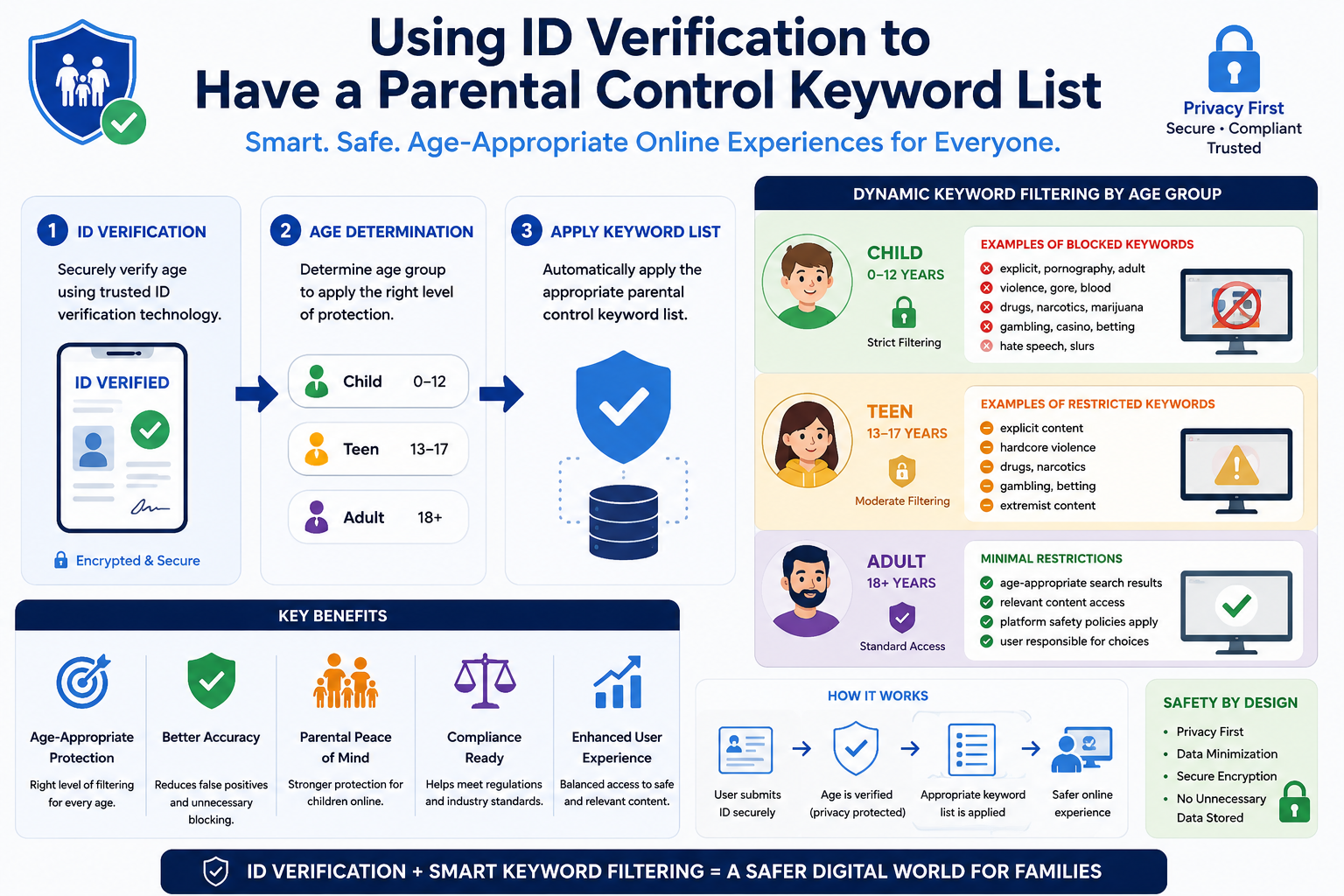
An ID verification-based parental control system uses age verification technologies to determine whether a user is a child, teenager, or adult before applying content filtering rules.
Unlike traditional parental controls that rely solely on device settings or manually configured restrictions, this approach enables platforms to apply different keyword lists and moderation policies based on verified age information.
For example:
- A seven-year-old may have searches related to explicit violence or gambling blocked.
- A fifteen-year-old may receive educational resources when searching for sensitive health topics.
- Adults may experience unrestricted search functionality, subject only to general platform safety policies.
This adaptive approach creates a more balanced and context-aware online environment.
Why Traditional Keyword Lists Often Fall Short
Keyword filtering has existed for decades, but static keyword lists present several challenges.
Common problems include:
- Overblocking educational content
- Underblocking newly emerging harmful terms
- Inconsistent filtering across languages
- Difficulty identifying slang and coded language
- Limited adaptation to different age groups
- High false positive rates
For example, blocking the word “drug” may unintentionally restrict access to educational information about prescription medications or public health campaigns.
Similarly, blocking the word “breast” could interfere with legitimate searches related to breast cancer awareness or medical education.
ID verification allows platforms to refine keyword lists according to age and context rather than relying on one-size-fits-all filtering.
Benefits of Using ID Verification with Parental Control Keyword Lists
Combining age verification with intelligent keyword management offers significant advantages.
Better Age-Appropriate Filtering
Different age groups require different protections.
Children under 10 may need stricter controls than teenagers approaching adulthood.
Dynamic keyword lists allow platforms to apply increasingly flexible rules as users mature.
Reduced False Positives
Static keyword filters often block harmless content.
Age-aware filtering reduces unnecessary restrictions by considering both user age and search intent.
This improves user satisfaction while maintaining safety.
Improved Compliance
Many jurisdictions are introducing stricter online safety regulations requiring platforms to implement reasonable protections for minors.
Age-aware keyword filtering supports compliance by demonstrating that organizations actively tailor safety measures to younger users while respecting the rights of adults.
Enhanced User Experience
Parents appreciate tools that protect children without unnecessarily limiting educational opportunities.
Children and teenagers benefit from age-appropriate access rather than blanket restrictions.
Adults avoid unnecessary filtering altogether.
Building an Effective Parental Control Keyword List
A successful keyword list begins with clear content categories.
Common categories include:
Adult Content
- Pornography
- Explicit sexual language
- Adult entertainment terminology
- Escort services
Violence
- Graphic violence
- Torture
- Gore
- Executions
Educational or historical discussions should be treated differently where appropriate.
Drugs
- Illegal narcotics
- Drug manufacturing
- Substance abuse
- Dangerous drug slang
Educational and medical resources should remain accessible where suitable.
Gambling
- Casinos
- Sports betting
- Online poker
- Lottery scams
Self-Harm
- Suicide methods
- Eating disorder promotion
- Self-injury communities
Instead of simply blocking these searches, many platforms redirect users to supportive and educational resources.
Hate Speech
Keyword lists should include:
- Slurs
- Extremist slogans
- Terrorist terminology
- Organized hate group references
Regular updates are necessary because harmful language evolves rapidly.
Why AI Should Support Keyword Lists
Modern parental control systems increasingly combine keyword filtering with Artificial Intelligence.
AI can analyze:
- Search context
- User intent
- Images
- Videos
- Voice searches
- Conversation history
Rather than relying solely on individual keywords, AI evaluates the complete context of a search.
This significantly improves accuracy.
The Role of ID Verification
ID verification enables platforms to create personalized filtering policies.
For example:
Child Account
Blocked:
- Explicit pornography
- Gambling
- Violent videos
- Drug marketplaces
Allowed:
- Science
- Education
- Children’s entertainment
Teen Account
Restricted:
- Explicit adult material
- Illegal drug marketplaces
- Graphic violence
Allowed:
- Sexual education
- Mental health resources
- Historical documentaries
- News coverage
Adult Account
Standard platform moderation applies without parental restrictions.
Privacy Must Come First
Responsible ID verification should always prioritize privacy.
Organizations should adopt principles such as:
- Data minimization
- Encryption
- Secure identity validation
- Limited retention periods
- Consent management
- Role-based access controls
Where possible, platforms should verify age without storing unnecessary identity documents.
Privacy-preserving age assurance technologies are becoming increasingly important in this area.
Best Practices for Managing Keyword Lists
Keyword lists should never remain static.
Successful organizations:
- review lists monthly,
- monitor emerging online trends,
- analyze appeal decisions,
- update slang terminology,
- incorporate moderator feedback,
- evaluate AI performance,
- monitor false positives,
- monitor false negatives.
Continuous improvement is essential.
Human Review Remains Important
Even sophisticated AI systems occasionally misclassify searches.
Human reviewers should evaluate:
- appeals,
- educational exceptions,
- news content,
- medical searches,
- legal information,
- cultural differences.
Combining AI with human expertise creates more balanced moderation decisions.
Compliance Considerations
Organizations should ensure that parental control systems align with applicable laws and regulations relating to child safety, privacy, consumer protection, and digital services.
Key governance practices include:
- documenting moderation policies,
- maintaining audit trails,
- conducting regular risk assessments,
- training moderation teams,
- reviewing AI performance,
- implementing transparent appeal mechanisms.
These practices strengthen accountability and build trust with users and regulators alike.
Measuring Success
Key performance indicators include:
- False Positive Rate
- False Negative Rate
- Appeal Rate
- Appeal Success Rate
- Parent Satisfaction
- Child Safety Incidents
- Average Review Time
- AI Precision
- AI Recall
- Policy Compliance Rate
Regular measurement helps organizations refine both keyword lists and moderation policies.
Future Trends
The next generation of parental controls will integrate:
- AI-powered semantic analysis
- Multilingual keyword detection
- Voice moderation
- Image moderation
- Video moderation
- Real-time behavioral analysis
- Privacy-preserving age estimation
- Adaptive risk scoring
Rather than relying on static keyword lists, future systems will interpret meaning, context, and intent in real time.
Frequently Asked Questions
What is an ID verification-based parental control keyword list?
It is a system that uses verified age information to apply different keyword filtering rules for children, teenagers, and adults, providing age-appropriate online experiences.
Why is ID verification useful for parental controls?
ID verification allows platforms to tailor restrictions according to verified age groups, reducing unnecessary blocking while improving protection for minors.
Can AI replace keyword lists?
No. AI complements keyword lists by understanding context, intent, and emerging language patterns, but carefully maintained keyword lists remain an important part of a comprehensive safety strategy.
How often should parental control keyword lists be updated?
Organizations should review and update keyword lists regularly—ideally every month—and immediately when new harmful trends, slang terms, or regulatory requirements emerge.
Conclusion
Using ID verification to have a parental control keyword list represents a significant evolution in online safety. By combining verified age information with intelligent keyword filtering, AI-assisted moderation, and privacy-first design, organizations can deliver more accurate and age-appropriate protection for children and teenagers without unnecessarily restricting access to legitimate educational or informational content.
The most effective solutions are built on dynamic keyword management, transparent governance, continuous monitoring, and human oversight. They evolve alongside emerging online risks and changing user behavior while respecting privacy and regulatory requirements.
As digital platforms continue to grow, organizations that invest in adaptive parental control strategies will be better positioned to protect young users, support parents, and foster trust. Ultimately, combining ID verification with carefully maintained parental control keyword lists creates a safer, more personalized online experience that balances protection, education, and responsible access to information.