

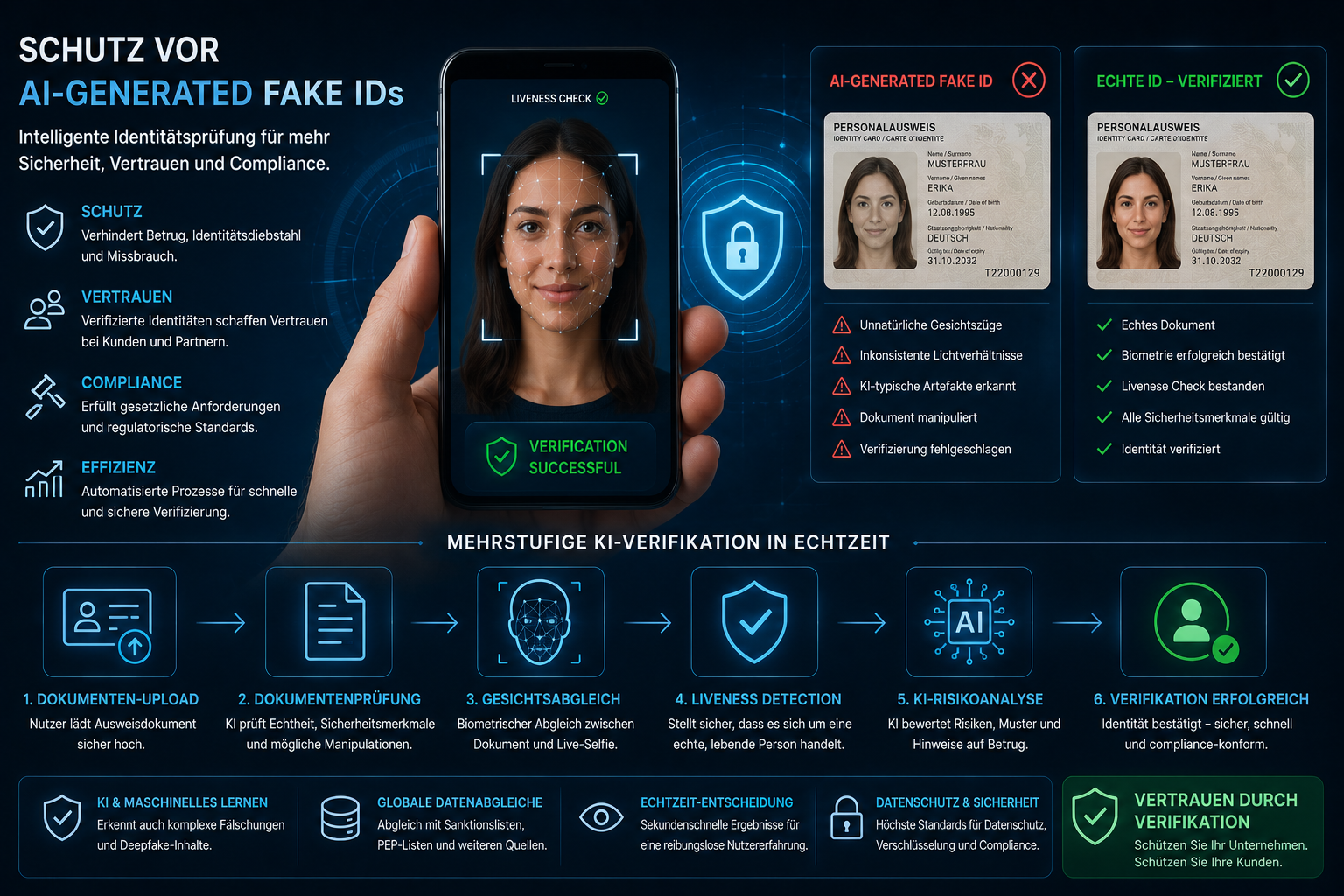
Why identity verification is more important than ever: The fight against AI-generated fake IDs in the customer portfolio
Digital identities as the foundation of trust, security and compliance.
The rapid development of artificial intelligence is not only changing business processes and customer interactions, but also presenting companies with new challenges in the field of identity verification. While modern AI systems offer numerous benefits, they also enable the creation of deceptively real fake ID documents, identities, and biometric proofs. For companies, the reliable verification of customer identities is therefore becoming a decisive success factor. Those who do not recognize AI-generated fake IDs risk financial damage, regulatory consequences and a lasting loss of trust.
The digital economy is based on trust
Whether banks, insurance companies, e-commerce platforms, FinTechs, dating apps or cryptocurrency exchanges – almost every digital business model is based on the assumption that customers are actually the people they say they are.
For a long time, the biggest challenge was to detect classic document forgeries or stolen identities. Today, the situation has changed fundamentally. Modern generative AI can generate realistic-looking ID documents, passport photos, selfies and even complete digital identities within a few minutes.
The quality of these forgeries has now reached a level that is often almost indistinguishable from real documents to the human eye.
This creates a new threat to companies worldwide.
The rise of AI-generated fake identities
Generative AI systems can now generate images that show people who never existed. These so-called synthetic identities are often combined with artificially created documents.
An attacker often only needs the following:
- a powerful AI application,
- some templates of real IDs,
- Image
- editing tools,
- publicly available data.
Complete digital identities can be created from this within a short time.
The most common forms of AI-based identity forgery include:
- forged identity cards,
- manipulated passports,
- synthetic selfies,
- Deepfake videos,
- artificially created faces,
- falsified proof of residence,
- manipulated account statements.
This development is fundamentally changing the risk landscape of many industries.
Why fake IDs are so dangerous for companies
A single unrecognized fake ID can have far-reaching consequences.
Whereas in the past individual fraud cases were often viewed in isolation, organized fraud networks now use automated processes to deploy hundreds or even thousands of fake identities at the same time.
This creates risks in several areas.
Financial losses
Fake identities are often used to:
- to obtain loans by fraud,
- commit payment fraud,
- to take advantage of bonus programs,
- money laundering,
- Cryptocurrency accounts.
The financial damage can be considerable, ranging from individual cases of fraud to systematic attacks on entire business models.
Reputational damage
Customers expect companies to provide secure identity verifications.
If it becomes known that fraudsters were able to open accounts or use services without any problems, public trust suffers.
Especially in regulated industries, damage to a company’s image can have long-term effects on a company’s market position.
Regulatory consequences
Many companies are subject to legal obligations to identify customers.
Those who use inadequate testing methods risk:
- high fines,
- supervisory measures,
- licensing issues,
- stricter inspections by authorities.
Therefore, the quality of identity verification is becoming increasingly strategic.
Synthetic Identities: The New Generation of Fraud
So-called synthetic identities are particularly problematic.
This is not the identity of a real person, but an artificially composed identity.
Criminals combine:
- real data elements,
- fictitious information,
- AI-generated images,
- manipulated documents.
The result is an identity that seems plausible at first glance, but in fact never existed.
This form of fraud is particularly difficult to detect because no real person is harmed and classic database comparisons often do not show any abnormalities.
Deepfakes change identity verification
Another risk factor is deepfake technologies.
Modern AI can now generate videos in which people appear to speak, blink or respond to instructions.
This puts pressure on video identification procedures in particular.
While early deepfakes were still relatively easy to detect, the systems are continuously improving.
Criminals are increasingly trying to use such technologies to:
- Videoident procedure,
- trick biometric checks,
- Manipulating liveness checks,
- digital account openings.
Companies must therefore constantly develop their testing procedures.
Why classic document checks are no longer enough
In the past, it was often sufficient to check an uploaded ID card.
Today, this approach alone is no longer sufficient.
An AI-generated ID card can look almost perfect.
Security features can be simulated or imitated in some cases.
This is why modern identity checks rely on multi-stage procedures.
These include:
- document analysis,
- biometric verification,
- Liveness Detection,
- Device analysis,
- behavioral analysis,
- Data validation,
- Risk scoring.
Only the combination of different verification mechanisms enables reliable detection of modern fraud attempts.
The role of artificial intelligence in the fight against fraud
Interestingly, AI is not only used for fraud, but also to combat it.
Modern identity platforms use AI-based systems to detect tampering.
These analyze, for example:
Document Features
The systems check:
- fonts,
- Safety features,
- Layout structures,
- hologram pattern,
- Printing properties,
- Image consistency.
Even the smallest deviations can provide indications of a forgery.
Image Forensics
AI Photo Analysis tools analyze uploaded images for traces of manipulation.
Among other things, the following are examined:
- pixel structures,
- Compression artifacts,
- Image transitions,
- lighting conditions,
- Shadow gradients.
In this way, a lot of AI-generated content can be identified.
Deepfake detection
Specialized models detect abnormalities in videos and selfies.
These include:
- unnatural facial movements,
- faulty light reflections,
- inconsistencies between image and sound,
- unusual facial expression patterns.
These technologies are increasingly becoming the standard of modern KYC processes.
Liveness detection as a crucial security factor
One of the most effective protective measures against AI-generated fake identities is so-called liveness detection.
This checks whether there is actually a living person in front of the camera.
The systems analyze, for example:
- spontaneous movements,
- Head rotations,
- Eye movements,
- facial dynamics,
- Depth information.
This prevents photos, videos, or digital avatars from being used successfully.
Liveness detection is now considered an indispensable part of professional identity checks.
KYC processes as a protective shield against fake identities
The so-called know-your-customer (KYC) process is becoming increasingly important due to the spread of generative AI.
A professional KYC process has several goals:
- Identity verification,
- fraud prevention,
- Compliance assurance,
- anti-money laundering,
- Protection of the company.
The more reliable the identity verification is, the less likely it is that fake identities will end up in the customer portfolio.
Experts therefore increasingly view KYC as a strategic protective mechanism rather than just a regulatory obligation.
Impact on banks and financial service providers
The financial sector is particularly hard hit.
Banks and FinTech companies manage sensitive assets and are therefore the focus of professional fraudsters.
Fake identities can be used for:
- Account openings,
- Credit fraud,
- Payment transaction offences,
- money laundering activities,
- Sanctions evasion.
That’s why financial companies around the world are investing significant sums in modern identity solutions.
Why dating platforms are also affected
It is not only banks that have to deal with the problem.
Dating platforms are also experiencing an increasing number of AI-generated profiles.
Fraudsters use artificially generated photos and identities to build trust and then exploit victims financially.
This form of so-called romance scamming causes billions of dollars in damage every year.
Verified identities are therefore increasingly becoming a quality feature of reputable platforms.
The economic value of trusted customer portfolios
A customer portfolio is much more than a collection of data sets.
It represents a core corporate value.
When a significant proportion of the customer base consists of fake identities, numerous problems arise:
- distorted business figures,
- erroneous analyses,
- increased fraud rates,
- regulatory risks,
- declining customer trust.
A high quality of identity, on the other hand, improves:
- Data quality,
- Customer loyalty,
- Compliance,
- Security,
- Company value.
The verification of identities thus becomes a direct competitive advantage.
The Future of Identity Verification
Experts assume that AI-generated fake identities will continue to increase.
At the same time, however, the defense mechanisms are also evolving.
Future systems will increasingly rely on multimodal analyses.
At the same time, the following are examined:
- documents,
- Selfies,
- Videos,
- biometric data,
- Device information,
- Behavioral patterns.
In addition, digital identity wallets and state-verified electronic identities could play an important role in the future.
These developments are intended to increase security and at the same time improve user-friendliness.
Trust as the most important currency of the digital economy
At a time when artificial intelligence is creating both opportunities and risks, trust is becoming one of the most valuable resources of modern businesses.
Customers want to be sure that platforms are reputable.
Companies want to be sure that their customers actually exist.
Authorities demand traceable and secure processes.
All these requirements meet at one central point: reliable identity verification.
Conclusion
Identity verification is now more important than ever. The increasing availability of generative AI enables the creation of deceptively real fake IDs, synthetic identities, and deepfakes that pose new challenges to traditional verification methods. Companies that do not reliably verify their customer identities expose themselves to significant financial, regulatory and reputational risks.
Modern KYC processes, biometric procedures, liveness detection, AI-supported image forensics and deepfake detection therefore form the basis of an effective protection concept. They help to detect fake identities at an early stage and prevent them from being included in the customer portfolio.
Ultimately, this is about much more than compliance or fraud prevention. It’s about the foundation of every digital business relationship: trust. Only companies that can ensure that their customers are actually the people they say they are will be able to operate successfully and resiliently in an increasingly AI-driven economy in the long term.