
The Role of De-Identification vs Anonymization to Protect Personal Data.
As businesses continue to embrace artificial intelligence, cloud computing, and data-driven decision-making, protecting personal information has become more important than ever. Organizations collect enormous amounts of customer, employee, and business data every day. While this information fuels innovation and enables personalized services, it also creates significant privacy risks if not handled properly.
Among the most effective privacy-preserving techniques are de-identification and anonymization. Although these terms are often used interchangeably, they describe different methods of protecting personal data. Understanding their differences is essential for organizations that want to comply with modern privacy regulations, reduce security risks, and maintain customer trust.
This article explores the role of de-identification versus anonymization, explains how each method works, highlights their advantages and limitations, and provides practical guidance for organizations navigating today’s complex data privacy landscape.
Why Personal Data Protection Matters
Digital transformation has dramatically increased the volume of personal data collected across industries. Healthcare providers store patient records, financial institutions process sensitive financial information, retailers analyze shopping behavior, and online platforms gather user activity to improve customer experiences.
Unfortunately, cybercriminals are also becoming more sophisticated. Data breaches expose millions of personal records every year, leading to identity theft, financial fraud, regulatory penalties, and reputational damage.
Beyond external threats, organizations must comply with increasingly strict privacy regulations such as:
- General Data Protection Regulation (GDPR)
- California Consumer Privacy Act (CCPA)
- Health Insurance Portability and Accountability Act (HIPAA)
- Personal Information Protection and Electronic Documents Act (PIPEDA)
- Various emerging AI governance and privacy frameworks worldwide
Reducing the amount of identifiable information available within datasets significantly lowers privacy risks while still enabling valuable research and analytics.
What Is Personal Data?
Personal data refers to any information that can identify an individual either directly or indirectly.
Examples include:
- Full name
- Home address
- Email address
- Phone number
- Government identification numbers
- IP addresses
- Biometric information
- Medical records
- Financial account details
- Location history
- Online identifiers
Some identifiers are obvious, while others become identifiable only when combined with additional information.
Protecting these data points is one of the primary objectives of modern privacy programs.
Understanding De-Identification
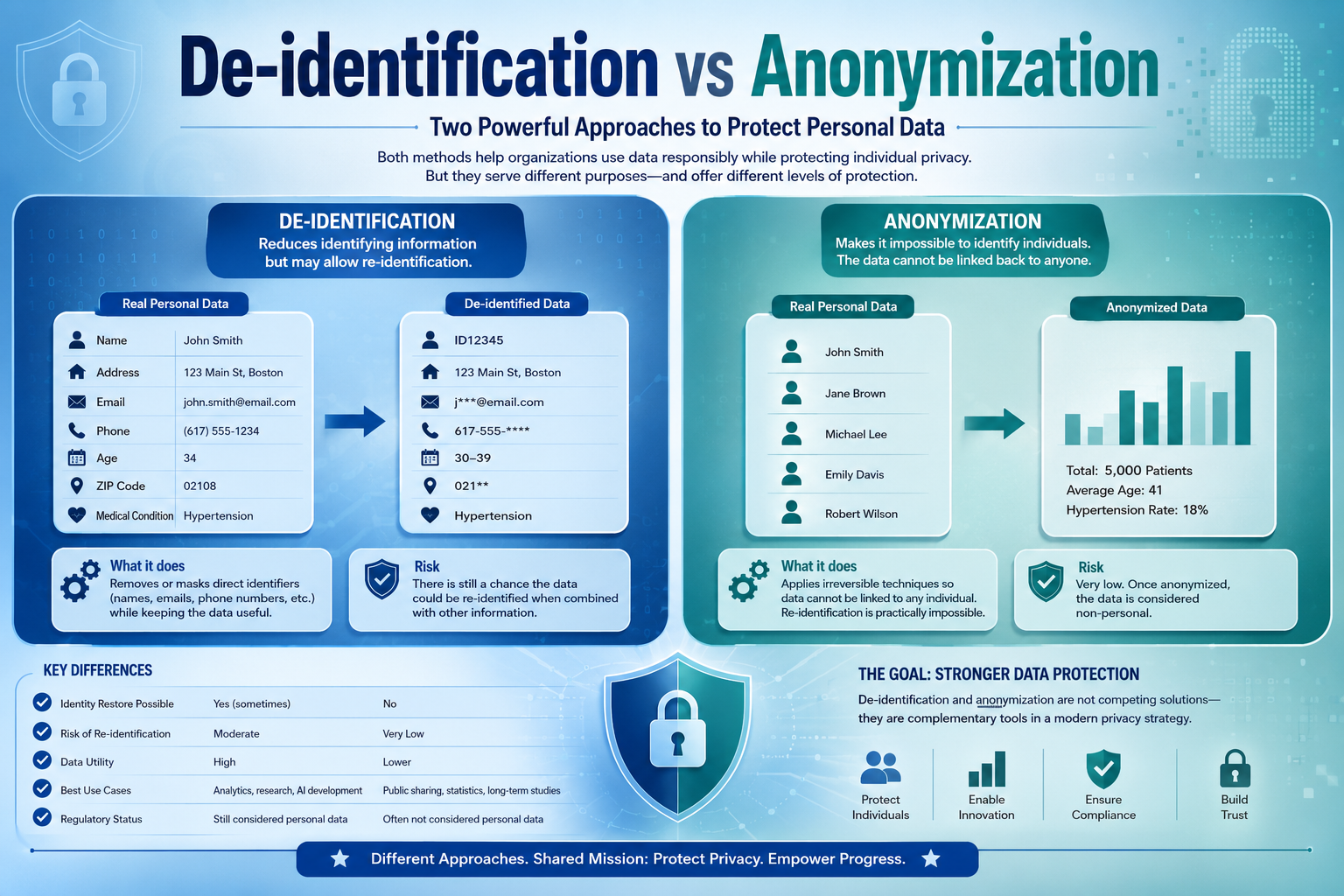
De-identification is the process of removing or modifying information that directly identifies an individual while retaining enough data to remain useful for analysis, research, or operational purposes.
Instead of completely destroying identifying information, de-identification reduces the likelihood that a person can be identified.
Common de-identification techniques include:
Removing Direct Identifiers
Sensitive fields such as:
- Names
- Social Security Numbers
- Passport Numbers
- Driver’s License Numbers
are removed entirely from the dataset.
Masking
Certain portions of data remain visible while sensitive parts are hidden.
For example:
Email:
[email protected]
becomes
m***@email.com
Credit card:
4532 11XX XXXX 8721
Pseudonymization
Individuals receive randomly generated identifiers instead of their actual identity.
Example:
Customer #12345
instead of
Jonny Space
A secure mapping between the identifier and the original identity may still exist, allowing authorized personnel to reconnect the data if necessary.
Generalization
Specific values become broader categories.
Instead of:
Age: 36
The record becomes:
Age: 30–40
Instead of:
ZIP Code: 56981
The record becomes:
ZIP Code: 569**
Benefits of De-Identification
Organizations favor de-identification because it balances privacy with business value.
Key benefits include:
Better Data Utility
Researchers can still analyze trends, customer behavior, disease progression, or purchasing patterns without exposing individual identities.
Regulatory Compliance
Many privacy regulations recognize de-identification as an important safeguard when implemented correctly.
Reduced Breach Impact
If unauthorized access occurs, attackers obtain significantly less usable personal information.
Supports AI Development
Machine learning models often require large datasets. De-identified information enables organizations to train algorithms while minimizing privacy risks.
Limitations of De-Identification
Although powerful, de-identification does not eliminate all privacy risks.
One major concern is re-identification.
Attackers may combine multiple datasets and use advanced analytics to reconstruct individual identities.
For example:
A dataset may only contain:
- ZIP code
- Birth year
- Gender
Individually these appear harmless.
Combined with publicly available voter records, however, they may uniquely identify many individuals.
As data analytics improve, organizations must continually evaluate re-identification risks.
What Is Anonymization?
Anonymization goes one step further.
Its objective is to make it impossible—or practically impossible—to identify an individual.
Unlike de-identification, anonymization permanently breaks the connection between the data and the original person.
Once properly anonyhttps://airisprotect.commized, no key or mapping exists that can restore the identity.
The data becomes anonymous rather than merely hidden.
Common Anonymization Techniques
Several methods help organizations achieve stronger privacy protection.
Data Aggregation
Instead of storing individual records, organizations publish statistical summaries.
Example:
Instead of:
John purchased Product A.
The report states:
1,500 customers purchased Product A.
Data Perturbation
Small amounts of statistical noise are added to prevent identification while maintaining analytical usefulness.
Randomization
Certain values are altered randomly to prevent linking records to specific individuals.
Differential Privacy
One of today’s most advanced privacy-preserving techniques.
Differential privacy injects carefully calibrated mathematical noise into datasets or query results, making it extremely difficult to infer information about any specific individual while preserving overall statistical accuracy.
Major technology companies and public institutions increasingly use differential privacy for large-scale analytics.
Advantages of Anonymization
Proper anonymization offers several major benefits.
Maximum Privacy Protection
Since identities cannot reasonably be reconstructed, privacy risks decrease substantially.
Lower Regulatory Burden
Under many legal frameworks, truly anonymized data may no longer be considered personal data.
This can simplify certain compliance obligations.
Increased Public Trust
Customers appreciate organizations that prioritize strong privacy protections.
Trust has become a competitive advantage in today’s digital economy.
Safer Data Sharing
Universities, healthcare organizations, and research institutions often share anonymized datasets to support scientific collaboration without exposing personal information.
Challenges of Anonymization
Despite its strengths, anonymization presents important trade-offs.
Reduced Data Utility
The more anonymous a dataset becomes, the less detailed and useful it may be for analytics.
Difficult to Achieve Perfectly
Modern AI techniques can sometimes identify hidden patterns that were previously considered anonymous.
Organizations must therefore continually assess whether anonymization remains effective.
Loss of Personalization
Anonymous data cannot support personalized customer experiences because identities are permanently removed.
De-Identification vs Anonymization: Key Differences
Understanding the distinction between these two concepts is critical for choosing the right privacy strategy.
| Feature | De-Identification | Anonymization |
| Personal identifiers removed | Yes | Yes |
| Identity can potentially be restored | Sometimes | No |
| Risk of re-identification | Moderate | Very Low |
| Data utility | High | Moderate |
| Supports personalized services | Yes | No |
| Suitable for research | Excellent | Excellent |
| Regulatory complexity | Moderate | Often Lower |
Neither approach is universally better. The right choice depends on business objectives, regulatory requirements, and acceptable privacy risks.
AI and the Growing Importance of Privacy Protection
Artificial intelligence has dramatically increased the demand for high-quality datasets.
Healthcare AI models diagnose diseases; Financial institutions detect fraud; Retailers predict purchasing behavior; Manufacturers optimize supply chains.
Each of these systems requires enormous volumes of data. Without proper safeguards, AI development could expose sensitive personal information.
Privacy-enhancing technologies—including de-identification, anonymization, federated learning, synthetic data, secure multiparty computation, and confidential computing—are becoming essential components of responsible AI development.
Organizations increasingly combine multiple techniques rather than relying on a single privacy method.
Best Practices for Organizations
Businesses should implement comprehensive privacy strategies rather than viewing de-identification or anonymization as one-time technical tasks.
Recommended best practices include:
- Conduct regular privacy impact assessments.
- Classify sensitive information before processing.
- Remove unnecessary personal identifiers.
- Limit access using role-based permissions.
- Encrypt sensitive datasets both in transit and at rest.
- Continuously monitor for re-identification risks.
- Update privacy controls as technology evolves.
- Train employees on secure data handling practices.
- Maintain detailed documentation for compliance audits.
- Review third-party vendors that process personal information.
Privacy protection should become an ongoing governance process integrated into every stage of the data lifecycle.
Future Trends in Privacy Protection
Emerging technologies continue to reshape how organizations protect personal information.
Synthetic data generation creates realistic artificial datasets that preserve statistical characteristics without exposing real individuals.
Federated learning enables AI models to train across decentralized devices without moving raw data.
Confidential computing uses secure hardware environments to protect sensitive information during processing.
Homomorphic encryption allows computations on encrypted data without first decrypting it.
As these technologies mature, organizations will increasingly combine them with de-identification and anonymization to create layered privacy defenses.
Frequently Asked Questions
Is de-identification the same as anonymization?
No. De-identification reduces the ability to identify individuals, while anonymization permanently removes any practical possibility of identifying them.
Can de-identified data be re-identified?
Yes. If additional datasets or identifying information become available, re-identification may be possible.
Is anonymized data completely safe?
Properly anonymized data offers very strong privacy protection, but organizations should periodically evaluate whether advances in technology create new re-identification risks.
Which method is better for AI?
Both have important roles. De-identification often preserves more analytical value, making it suitable for AI model development. Anonymization provides stronger privacy protection when identity is no longer needed.
Does GDPR distinguish between the two?
Yes. GDPR recognizes pseudonymization as a security measure while treating truly anonymized data differently because it no longer relates to an identifiable individual. Organizations should carefully assess whether their anonymization methods meet the required legal standard.
Conclusion
As organizations collect increasing volumes of personal information, protecting privacy has become a strategic necessity rather than merely a compliance obligation. De-identification and anonymization are two foundational approaches that help reduce privacy risks while enabling responsible data use.
De-identification offers an effective balance between usability and security, making it well suited for operational analytics, research, and AI development where some level of linkage may still be required. Anonymization, by contrast, provides a stronger level of protection by irreversibly removing the connection between data and individuals, making it ideal for public data sharing and long-term statistical analysis.
Neither technique is a universal solution. The most effective privacy strategies combine multiple safeguards, robust governance, ongoing risk assessments, employee training, encryption, and emerging privacy-enhancing technologies. By adopting a layered approach to data protection, organizations can foster innovation, build customer trust, and remain compliant with evolving privacy regulations in an increasingly data-driven world.