
Using Seamless Age Verification with AI to Block Access with a Fake Selfie: The Future of Secure Digital Identity Verification
AI-Powered Age Verification Is Transforming Online Safety and Regulatory Compliance
As digital platforms continue to expand, verifying a user’s age has become an essential requirement for businesses operating in regulated industries. Online retailers, gaming providers, streaming services, social media platforms, financial institutions, and age-restricted marketplaces must ensure that minors cannot access content, products, or services intended only for adults.
At the same time, user expectations have evolved. Consumers want fast, frictionless onboarding experiences without sacrificing privacy or security. Businesses, meanwhile, face increasing pressure to comply with age verification regulations while preventing sophisticated fraud attempts involving fake identities, manipulated documents, and AI-generated selfies.
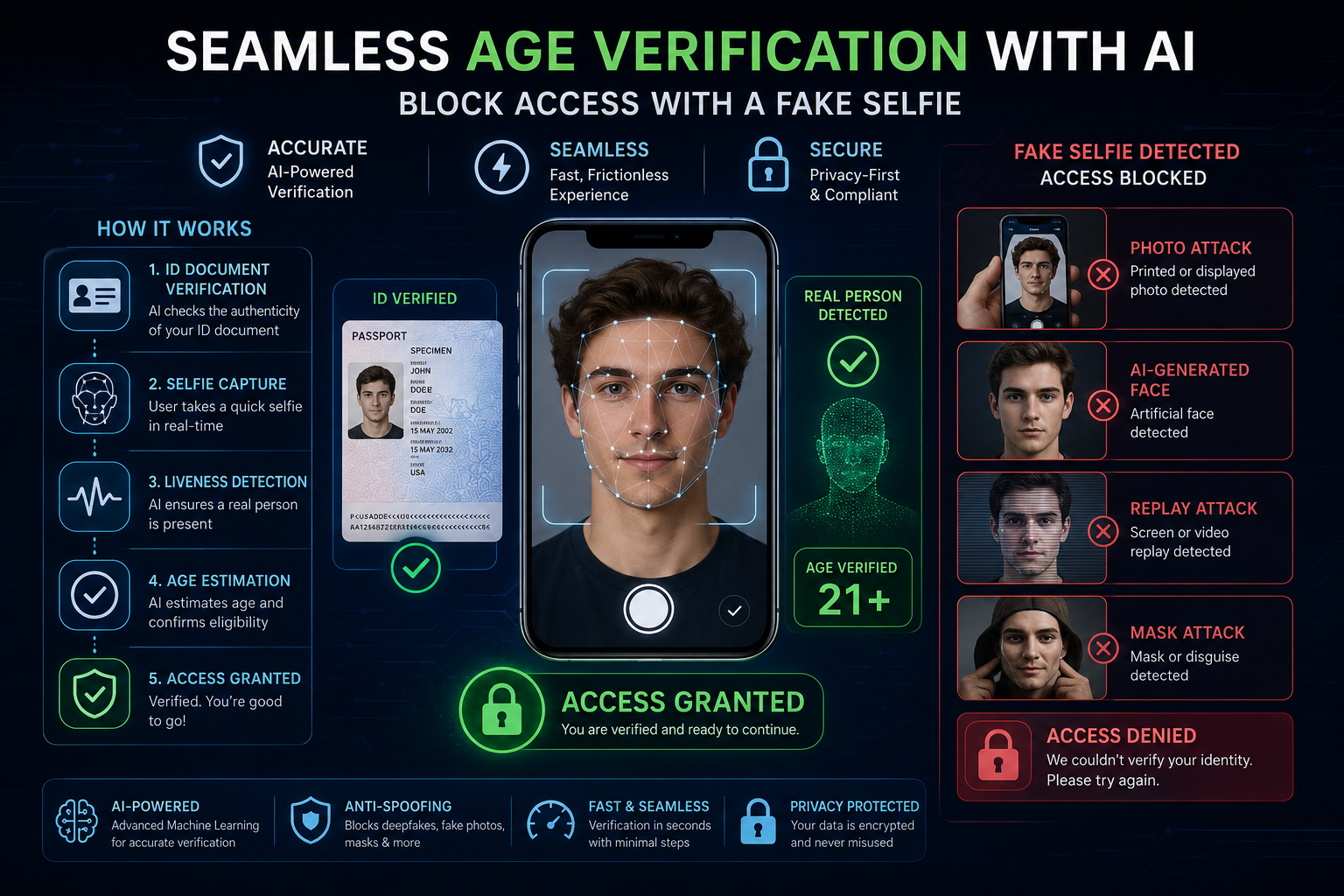
Artificial intelligence is addressing these challenges by enabling seamless age verification that combines biometric analysis, facial age estimation, document verification, and advanced liveness detection. One of the most significant capabilities of modern AI-powered verification systems is their ability to block access attempts made with fake selfies, including printed photos, replay attacks, masks, and AI-generated deepfakes.
By integrating computer vision, machine learning, biometric authentication, and intelligent anti-spoofing technologies, AI-driven age verification solutions deliver a secure, user-friendly, and scalable approach to digital identity verification while helping organizations comply with evolving regulatory requirements.
Why Age Verification Matters More Than Ever
Governments around the world are introducing stricter regulations to protect minors from accessing age-restricted products and services online. Industries such as online gambling, alcohol sales, tobacco retail, digital banking, gaming, adult entertainment, pharmaceuticals, and certain social media services must now implement reliable age verification mechanisms.
Traditional methods, such as manually uploading identification documents or relying on simple self-declarations, are no longer sufficient. They are vulnerable to identity fraud, document manipulation, and impersonation.
AI-powered age verification addresses these limitations by automatically verifying both the user’s identity and their age while ensuring that the person completing the verification is physically present and genuine.
The Rise of Fake Selfie Attacks
One of the fastest-growing threats to online identity verification is the use of fake selfies.
Fraudsters increasingly attempt to bypass verification systems using:
- Printed photographs
- Images displayed on smartphones or tablets
- High-resolution screen replays
- Edited facial images
- AI-generated faces
- Deepfake videos
- Silicone masks
- Synthetic identities
- Face-swapped images
- Digitally manipulated portraits
As generative AI becomes more sophisticated, creating realistic fake faces has become easier than ever. Conventional selfie verification systems that simply compare two images may fail to detect these attacks.
This is why modern age verification solutions rely on AI-powered liveness detection and anti-spoofing technologies.
What Is AI-Powered Seamless Age Verification?
Seamless age verification is an automated process that confirms whether a user meets the required age threshold without introducing unnecessary friction into the customer journey.
Instead of requiring lengthy manual reviews, AI analyzes biometric characteristics, official identity documents, and facial features in real time.
The verification process typically includes:
- Facial biometric analysis
- Age estimation using AI
- Identity document verification
- Liveness detection
- Face matching
- Fraud detection
- Anti-spoofing analysis
- Risk scoring
- Automated decision making
The entire process can often be completed within seconds while maintaining a high level of security and accuracy.
How AI Estimates Age
Artificial intelligence has made significant advances in estimating a person’s approximate age from facial characteristics.
Modern AI models analyze numerous biometric indicators, including:
- Facial geometry
- Skin texture
- Bone structure
- Facial proportions
- Wrinkle patterns
- Eye characteristics
- Jawline development
- Overall facial maturity
Rather than relying on a single feature, machine learning models evaluate hundreds of visual characteristics simultaneously to generate an estimated age range.
When combined with document verification, AI-based age estimation provides an additional layer of confidence during the verification process.
Document Verification Enhances Accuracy
Age estimation alone may not satisfy legal or regulatory requirements. Many jurisdictions require verification using government-issued identification documents.
AI-powered document verification automatically authenticates:
-
Passports
-
National identity cards
-
Driver’s licenses
- Residence permits
- Government-issued digital IDs
Computer vision algorithms inspect security features, machine-readable zones (MRZ), document layouts, fonts, holograms, and watermarks to identify signs of tampering or forgery.
This automated verification significantly reduces the likelihood of fraudulent identities being accepted.
Blocking Access with Fake Selfies
One of the greatest strengths of AI-powered age verification is its ability to reject fake selfie attacks.
Instead of simply matching a selfie with a document photograph, advanced AI evaluates whether the presented face originates from a genuine, live individual.
The system can detect:
-
Printed photographs
-
Display attacks using mobile screens
-
Replayed videos
- Deepfake videos
- AI-generated faces
- Face masks
- Image manipulation
- Synthetic biometric samples
If suspicious activity is detected, the verification session can be rejected immediately, preventing unauthorized access to restricted services.
AI-Based Liveness Detection
Liveness detection has become a cornerstone of secure biometric verification.
Its purpose is to confirm that the individual presenting biometric data is physically present during the verification session.
Advanced AI analyzes:
- Eye blinking
- Natural head movement
- Facial depth
- Skin reflectance
- Lighting consistency
- Facial muscle movement
- Texture analysis
- Three-dimensional geometry
Passive liveness detection performs these checks without requiring users to complete complicated actions, improving both security and user experience.
Benefits of Seamless Age Verification
Organizations implementing AI-powered age verification benefit in several important ways.
Improved User Experience
Fast automated verification minimizes onboarding friction and reduces customer abandonment.
Stronger Fraud Prevention
AI detects sophisticated spoofing attempts before fraudsters gain access.
Regulatory Compliance
Organizations can demonstrate compliance with age-restricted access requirements and digital identity regulations.
Higher Verification Accuracy
Machine learning continuously improves fraud detection while reducing false approvals.
Lower Operational Costs
Automation significantly reduces manual review workloads.
Faster Decision Making
Verification results are typically available within seconds.
Industries That Benefit from AI Age Verification
Online Gaming
Gaming platforms must prevent underage participation while maintaining smooth user registration.
AI verification enables rapid onboarding without compromising security.
Online Gambling
Regulators require strict identity and age verification.
Biometric authentication helps operators meet compliance obligations while reducing fraud.
Alcohol and Tobacco Retail
E-commerce platforms selling age-restricted products can verify customer eligibility before completing purchases.
Adult Content Platforms
Age verification protects minors while supporting compliance with regional legislation.
Financial Services
Banks and fintech providers verify customer identities during digital onboarding while preventing identity fraud.
Social Media Platforms
Many social media services are introducing age verification to protect younger users and comply with evolving regulations.
Healthcare
Healthcare portals may verify age before granting access to regulated medical services or pharmaceuticals.
AI and Privacy Protection
Responsible age verification solutions are designed with privacy in mind.
Modern platforms implement:
- Data encryption
- Secure biometric storage
- Privacy-by-design principles
- Minimal data collection
- User consent management
- Audit logging
- Configurable retention policies
Many AI-powered verification systems also support compliance with privacy regulations such as the General Data Protection Regulation (GDPR) and other regional data protection frameworks.
Organizations should ensure that biometric information is processed transparently, securely, and only for legitimate purposes in accordance with applicable laws.
Why Fake Selfie Detection Is Essential
Fraud techniques evolve rapidly.
Cybercriminals increasingly exploit artificial intelligence to create realistic synthetic identities capable of deceiving traditional verification systems.
Without effective anti-spoofing technology, businesses risk:
- Identity fraud
- Financial losses
- Regulatory penalties
- Reputational damage
- Unauthorized account creation
- Circumvention of age restrictions
AI-powered fake selfie detection helps mitigate these risks by continuously learning from emerging attack patterns and adapting to new fraud methods.
The Technology Behind AI Verification
Modern age verification platforms combine several advanced technologies into a unified workflow.
These include:
- Artificial intelligence
- Computer vision
- Deep learning
- Facial biometrics
- Passive liveness detection
- Document authentication
- OCR (Optical Character Recognition)
- Risk analytics
- Behavioral analysis
- Fraud intelligence
Together, these technologies provide multiple layers of protection against increasingly sophisticated identity fraud.
Best Practices for Organizations
Businesses implementing AI-powered age verification should follow a layered security strategy.
Recommended best practices include:
- Combine age estimation with document verification.
- Use passive liveness detection to identify spoofing attempts.
- Continuously update AI fraud detection models.
- Monitor verification analytics for unusual activity.
- Encrypt biometric and identity data.
- Implement secure APIs and authentication controls.
- Educate employees about emerging fraud techniques.
- Conduct regular security and compliance audits.
- Balance user convenience with strong security controls.
- Review verification policies regularly as regulations evolve.
A multi-layered approach provides stronger protection than relying on any single verification method.
The Future of AI-Powered Age Verification
Artificial intelligence continues to reshape digital identity verification.
Future innovations are expected to include:
- Privacy-preserving biometrics
- Decentralized digital identities
- Continuous authentication
- Behavioral biometric analysis
- Improved deepfake detection
- Advanced fraud intelligence
- Cross-platform digital identity verification
- Faster mobile-first verification experiences
These developments will further strengthen digital trust while making identity verification more efficient and accessible.
Building Digital Trust Through Intelligent Verification
Consumers increasingly expect secure digital experiences without unnecessary complexity.
Organizations that implement intelligent verification systems demonstrate a commitment to protecting both their customers and their platforms.
By preventing fake selfie attacks, verifying official identity documents, estimating age accurately, and confirming biometric authenticity, AI-powered age verification supports safer online environments for businesses and users alike.
This combination of automation, accuracy, and security helps organizations strengthen customer confidence while reducing fraud and operational risk.
Conclusion
As online services continue to expand across regulated industries, reliable age verification has become a critical component of digital trust, user protection, and regulatory compliance. Traditional verification methods are no longer sufficient to defend against sophisticated fraud techniques powered by artificial intelligence.
AI-powered seamless age verification combines biometric facial analysis, age estimation, document authentication, and advanced liveness detection to verify users quickly and securely. By identifying fake selfies, blocking deepfake attacks, detecting presentation attacks, and confirming the authenticity of government-issued identification documents, modern verification platforms provide a comprehensive defense against identity fraud.
Beyond improving security, these solutions streamline customer onboarding, reduce manual review efforts, lower operational costs, and enhance the overall user experience. Organizations across gaming, financial services, healthcare, telecommunications, online retail, and other regulated sectors can benefit from a scalable, AI-driven approach to age verification that balances convenience with robust protection.
As identity fraud techniques continue to evolve, businesses must adopt equally advanced verification technologies to stay ahead of emerging threats. AI-powered age verification with intelligent fake selfie detection represents a major step toward a safer, more trustworthy digital ecosystem where legitimate users enjoy seamless access while fraudulent actors are effectively prevented from bypassing critical security controls.