
Social Media and Trust: How “How Old Do I Look?” Can Support Safer Online Communities
Social Media Trust Is Becoming a Digital Priority
Social media has fundamentally changed the way people communicate, build relationships and share information. Every day, millions of users interact through profiles, images, videos, comments and private messages. These digital interactions can create valuable communities, but they also create a fundamental challenge: How can users and platforms know who is really behind an online profile?
Trust has become one of the most important elements of a successful social media platform.
Users want to communicate with real people. Parents want safer environments for younger users. Businesses want reliable digital identities. Community operators want to prevent fraud, abuse, impersonation and inappropriate interactions.
At the same time, creating an account is often remarkably easy. A person can potentially register with a username, an email address and a profile picture. In some environments, that may not provide enough information to establish whether a profile represents a genuine person or whether the stated age is credible.
This is where new approaches to AI-powered identity checks and age estimation can provide additional support.
One increasingly familiar concept is the simple question:
“How old do I look?”
At first glance, this may appear to be nothing more than an entertaining social media feature. However, AI-powered facial age estimation can have applications that go beyond entertainment. When implemented responsibly, it can become one component of a broader strategy for social media trust, user safety and identity verification.
What Does “How Old Do I Look?” Actually Mean?
The phrase “How old do I look?” traditionally describes a simple social interaction. Someone uploads a photograph and asks friends or other users to estimate their age.
Artificial intelligence can transform this concept into an automated process. An AI-based system can analyze a facial image and generate an estimated age or age range based on visual characteristics.
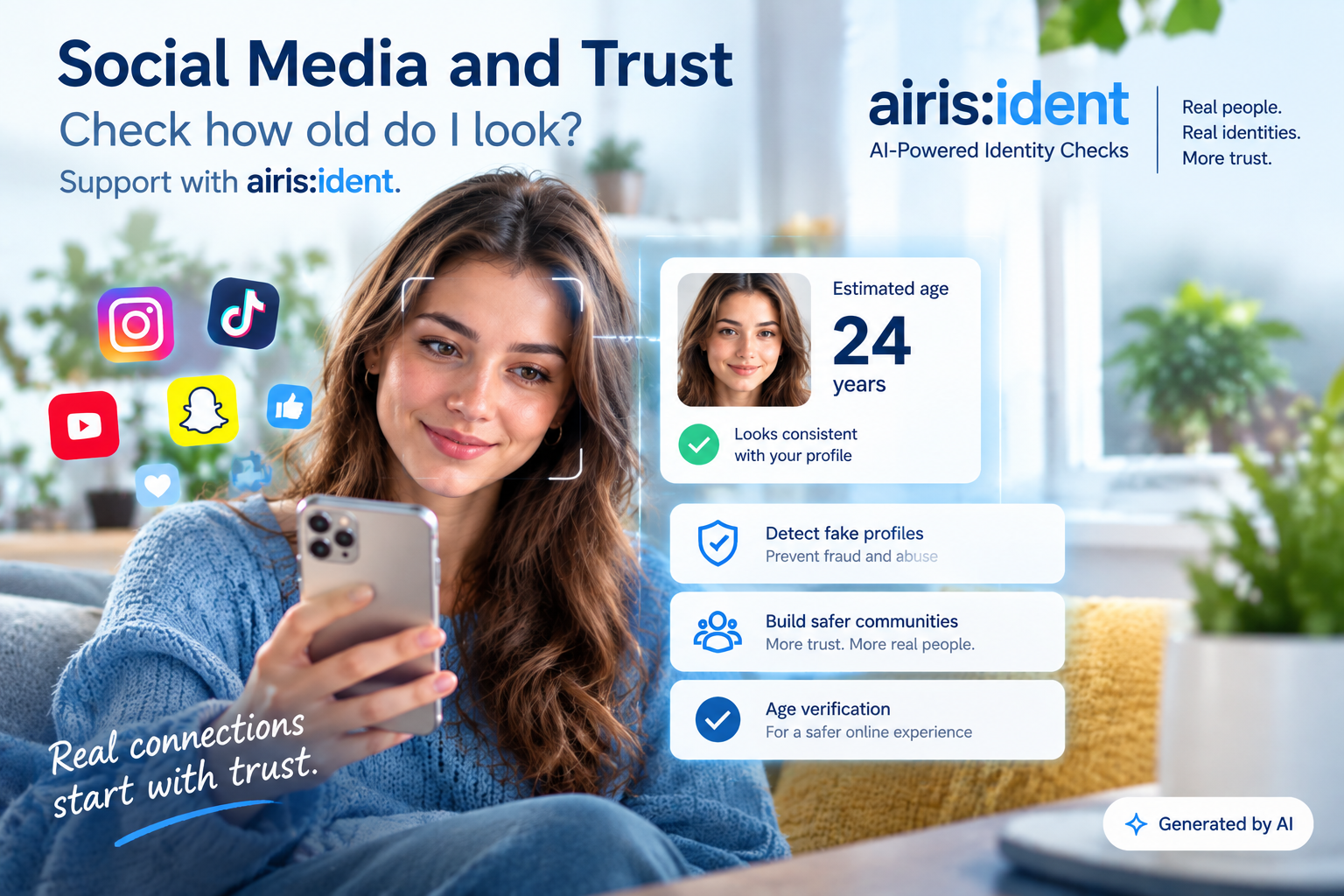
For example, a system might determine that a person appears to be approximately 24 years old, while acknowledging that the estimate is not necessarily the person’s actual chronological age.
This distinction is extremely important.
Age estimation is not the same as age verification.
Age estimation answers a question such as: “What age does this person appear to be?”
Age verification seeks to establish: “Can we reliably determine whether this person meets a specific age requirement?”
The two technologies can complement each other, but they should not automatically be treated as interchangeable.
For social media platforms, age estimation can nevertheless provide a useful additional signal in situations where profile information and visual characteristics need to be assessed.
Why Trust Matters on Social Media
Trust is the foundation of digital communities. When users believe that other participants are genuine, they are more likely to communicate, share content and participate in discussions. When trust disappears, community quality can decline quickly.
Several problems can contribute to a loss of trust:
- Fake profiles
- Impersonation
- Misleading profile information
- Age misrepresentation
- Automated accounts
- Bots
- Fraud attempts
- Harassment
- Manipulated images
- Stolen profile pictures
- Repeated account creation after moderation actions
Not every anonymous profile is problematic. Privacy and pseudonymous participation can be legitimate and valuable. However, platforms still need mechanisms to identify situations where users deliberately provide misleading information or where an account presents a meaningful safety risk.
This is where AI-powered identity checks can become part of a broader Trust & Safety strategy.
The Rise of Fake Profiles
Fake profiles represent one of the most persistent challenges for social platforms.
A fake profile may use:
- A stolen photograph
- An AI-generated face
- An altered photograph
- A fictional identity
- Incorrect age information
- Someone else’s personal information
- A combination of genuine and fabricated information
The profile itself may initially look completely authentic. This makes traditional moderation difficult.
A username does not prove identity. An E-mail address does not necessarily prove that a person is who they claim to be. Even a profile photograph alone cannot establish identity. Platforms therefore increasingly need multiple verification signals.
AI-powered image analysis and identity checks can become part of this layered approach.
Can “How Old Do I Look?” Improve Social Media Safety?
The answer is potentially yes—but only when the technology is used appropriately.
An AI age-estimation feature can provide a visual signal that complements information supplied by the user. For example, imagine a social media platform where a user enters an age during registration. The platform could potentially perform an optional or policy-based visual age estimation process.
If the profile states that the person is 25 but the automated system estimates a significantly younger age range, the platform could trigger an additional verification step. The important point is that the AI result does not necessarily need to produce an automatic rejection. Instead, it can act as a risk signal.
A possible workflow could be:
User registration → Profile information → AI age estimation → Risk assessment → Additional verification if required → Account activation
This approach can be more flexible than relying on a single technology.
Supporting Social Media Trust with airis:ident
Services such as airis:ident can support identity-related workflows by combining AI-based analysis with identity-check processes.
For social media operators, the objective is not simply to ask a user, “How old do you look?” The broader question is:
Can the platform establish enough confidence that an account represents a legitimate user and meets the platform’s applicable requirements?
AI-based image analysis can contribute to this process by providing additional information from a submitted facial image. Depending on the specific implementation, an identity-check solution can form part of workflows designed to:
- Support user onboarding
- Detect inconsistencies
- Assess age-related signals
- Support identity checks
- Reduce fake-account risks
- Improve confidence in user profiles
- Trigger additional verification when necessary
This layered approach can help platforms move from a simple registration model toward a more sophisticated Trust & Safety architecture.
Age Estimation Is Not a Magic Solution
It is important to maintain realistic expectations.
AI cannot determine a person’s exact age simply by looking at a photograph. Facial appearance varies considerably between individuals. Lighting, camera quality, facial expression, image resolution and other factors can influence an estimate. A person may look younger or older than their actual age.
Consequently, an AI age estimate should generally be treated as an estimate rather than absolute proof of age. This is especially important when platforms operate age-restricted services. Where legislation or business policies require reliable age verification, platforms may need stronger verification methods in addition to facial age estimation.
The most effective strategy is therefore often a combination of technologies and processes.
Combining AI Age Estimation with Identity Verification
The real value comes from combining different signals.
Consider a hypothetical onboarding process:
Step 1: User enters profile information
The user provides their name, date of birth and other required information.
Step 2: Facial image is analyzed
An AI system assesses the submitted facial image and produces an age estimate.
Step 3: Identity information is checked
Where required, the user can complete a stronger identity verification process.
Step 4: Results are compared
The platform can assess whether the available signals are consistent.
Step 5: Risk-based decision
Low-risk users may continue normally, while inconsistent or suspicious cases can be sent to an additional review process.
This creates a risk-based identity verification workflow rather than treating every user identically.
Protecting Communities Against Age Misrepresentation
Age misrepresentation can create significant challenges for social platforms. A user may intentionally enter an incorrect age to access features or communities that are not intended for them.
This is particularly relevant where platforms offer:
- Age-restricted content
- Adult communities
- Dating services
- Live communication
- Private messaging
- Financial services
- Gaming features
- Community spaces with age requirements
The objective of an age-related safety system should not simply be to collect more personal information.
Instead, platforms should focus on obtaining the minimum appropriate information necessary to meet their safety and compliance objectives. Privacy-by-design principles should therefore remain central to any implementation.
Social Media, AI and the Challenge of Synthetic Identities
Another emerging issue is the growth of AI-generated images. Generative AI can create highly realistic faces that do not correspond to real people. This creates a new challenge for social media platforms.
A fake profile no longer necessarily requires a stolen photograph. A bad actor may create an entirely synthetic identity using an AI-generated portrait. This makes visual authenticity increasingly important.
An effective Trust & Safety strategy may therefore need to consider several questions:
- Is the image likely to represent a real person?
- Does the profile information appear consistent?
- Is the person potentially using a synthetic identity?
- Does the submitted image correspond to the identity information?
- Is additional verification appropriate?
AI-powered identity services can help platforms build additional layers around these questions.
User Experience Is Also Important
Security cannot come at the expense of usability.
If users have to complete complicated identity checks every time they access a social platform, frustration can increase. This is why risk-based workflows are attractive.
Most users want the registration process to be fast and simple. A platform could therefore use automated signals to determine when additional verification is appropriate.
For example:
Low-risk interaction: Minimal friction.
Potential inconsistency: Additional automated analysis.
High-risk or regulated scenario: Stronger identity verification.
This approach can help balance security, privacy and user experience.
The Importance of Transparency
If a social platform uses AI-based age estimation, transparency becomes particularly important.
Users should understand:
- Why an age estimate is being performed
- What the technology is intended to achieve
- Whether the estimate is used for verification or risk assessment
- What happens when the system is uncertain
- Whether human review is possible
- How personal data is processed
- How long relevant data is retained
Clear communication can increase user confidence. The goal should be to create a system that feels like a safety feature rather than unexplained surveillance.
Human Oversight Still Matters
AI can process images rapidly and consistently, but automated systems should not necessarily make every final decision.
There are cases where context matters.
An AI system may produce an uncertain result. A user may dispute a decision. An image may have poor quality. The system may encounter an unusual appearance that it has not handled well. Human review can provide an important escalation mechanism.
A modern approach therefore combines:
AI automation + clear rules + human oversight
This allows technology to handle scale while people remain responsible for difficult cases.
Building Trust Through Layered Verification
The future of social media safety is unlikely to depend on one single verification technology. Instead, platforms can combine multiple signals.
These may include:
- Email verification
- Phone verification
- Device signals
- Account behavior
- Image analysis
- Age estimation
- Identity document checks
- Facial matching
- User reporting
- Fraud detection
- Content moderation
- Human review
Each layer addresses a different part of the trust problem. This is particularly important because online abuse is constantly evolving. A solution that works against one generation of fake profiles may not be sufficient against the next.
“How Old Do I Look?” as More Than a Social Feature
The phrase “How old do I look?” has a natural place in social media because people are already curious about how others perceive them.
But the underlying technology can have a more serious application. When integrated responsibly into a broader identity and safety architecture, AI age estimation can provide a useful additional signal for social media platforms.
It can help identify potential inconsistencies and determine whether an account should undergo additional verification. The technology should not be presented as an infallible method for determining someone’s age.
Instead, it can be one component in a layered system designed to increase confidence and reduce risk.
The Future of Trust on Social Media
Social media platforms are entering an era in which trust will increasingly depend on intelligent verification. As AI-generated content, synthetic identities and automated accounts become more sophisticated, platforms will need better tools to understand the people and content participating in their communities.
AI-powered age estimation, image analysis and identity verification can play an important role.
The question is no longer simply:
“How many users do we have?”
It is increasingly:
“How much can our users trust the community they are joining?”
Solutions such as airis:ident can support this transition by helping platforms introduce AI-assisted identity and age-related checks into their existing workflows.
Conclusion: Real People, More Trust
Social media succeeds when people feel comfortable interacting with one another.
Trust is therefore not an optional feature. It is part of the foundation of a healthy digital community.
The simple question “How old do I look?” illustrates how AI-powered facial analysis can move from entertainment toward practical Trust & Safety applications. While age estimation should not be confused with definitive age verification, it can provide a valuable additional signal when combined with identity checks and other verification technologies.
For social media platforms, dating services, online communities and other user-generated-content environments, a layered approach can help address fake profiles, age misrepresentation and synthetic identities.
airis:ident can support this broader strategy by providing AI-powered identity-check capabilities that help platforms build more reliable onboarding and verification workflows. The future of social media will not be defined only by how many people can connect.
It will increasingly be defined by how safely, authentically and confidently those people can connect.In a digital world where a profile picture can be real, manipulated or entirely synthetic, building trust requires more than a username and password.
It requires intelligent verification. And sometimes, it starts with a simple question:
“How old do I look?”