
Age Guesser – Do It the Right Way: How AI Age Estimation Can Support Safer Digital Platforms
Why “Age Guesser” Technology Matters
The question “How old do I look?” has existed for generations. In the digital world, however, age estimation has developed into much more than a social conversation or an entertaining guessing game.
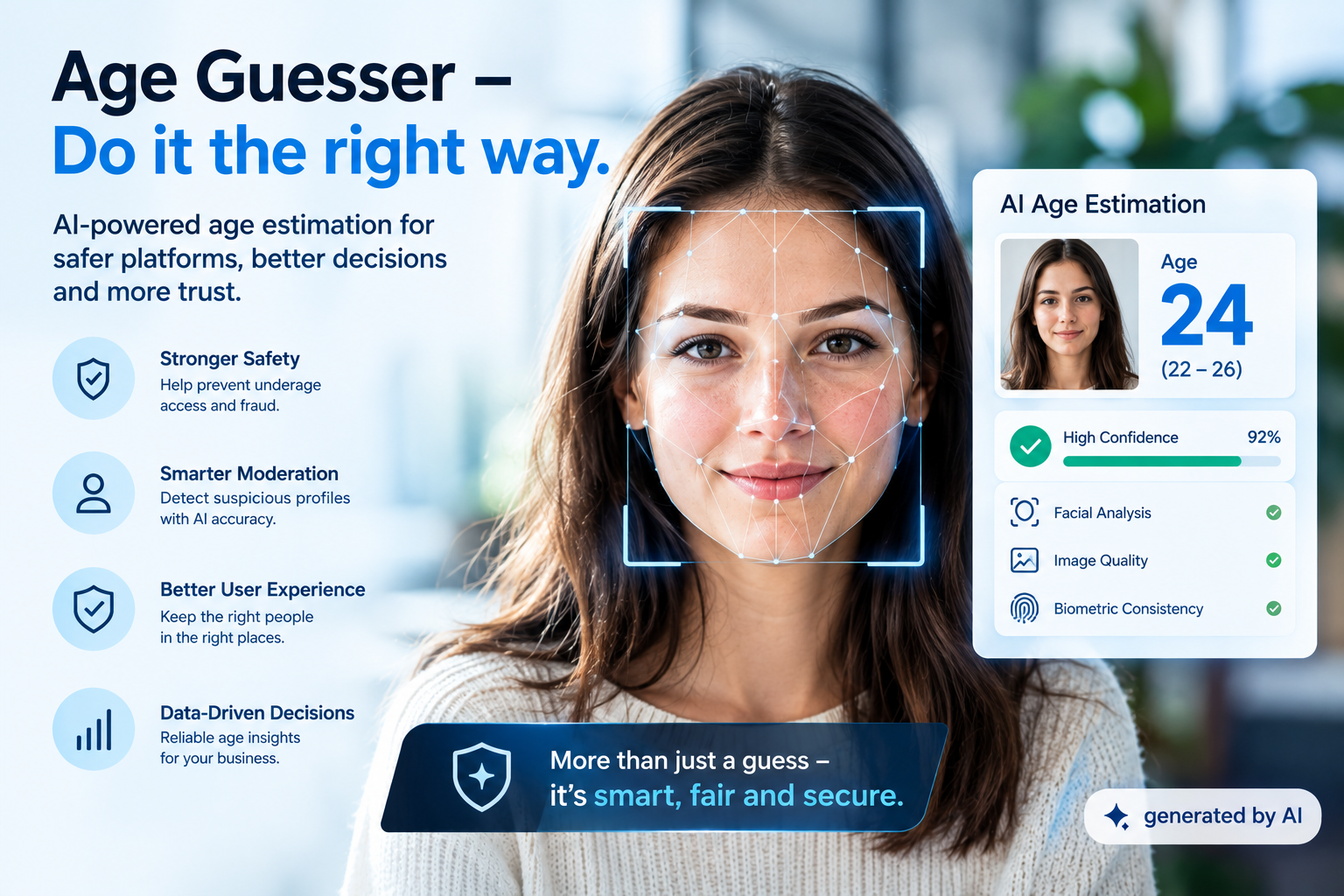
Today, an AI age guesser can analyze an image and provide an estimated age or age range within seconds. This technology is becoming increasingly relevant for social networks, dating platforms, online communities, marketplaces, gaming services, content platforms, and websites that need to understand whether users potentially belong to a particular age group.
But there is an important distinction between simply guessing someone’s age and using AI age estimation responsibly.
An AI age guesser should not be presented as an infallible source of truth. Facial appearance varies significantly between individuals, and age estimation can be affected by image quality, lighting, camera angle, facial expression, cultural differences, and many other factors.
The right approach is therefore not simply to ask, “Can AI guess someone’s age?”
The more important question is:
“How can businesses use AI age estimation responsibly as part of a broader safety, moderation, and verification strategy?”
When implemented correctly, an AI age guesser can become a valuable supporting technology for Trust & Safety, age assurance, content moderation, and user protection. Verification with airisident.com e.g. is a great way to check the correct forms.
What Is an AI Age Guesser?
An AI age guesser is an artificial intelligence system designed to estimate a person’s approximate age based on visual information, typically from a photograph or video frame.
Computer vision models analyze facial characteristics and patterns that may correlate with age. Instead of relying on a human moderator to manually estimate age, AI can process images automatically and consistently at scale.
Depending on the technology, the result may be presented as:
- An estimated age
- An age range
- A confidence indicator
- An age category
- A recommendation for additional verification
For example, a system might estimate that a person appears to be within a particular age range rather than returning a single definitive number.
This distinction is important as Age estimation is not necessarily the same as age verification. An age guesser estimates appearance. A verification process establishes age using additional evidence.
The two technologies can complement each other when they are used appropriately.
Age Estimation vs. Age Verification
One of the most important concepts for businesses implementing an age-related AI system is understanding the difference between age estimation and age verification.
Age Estimation
Age estimation attempts to answer: “What age or age range does this person appear to be?” It can be useful for: Preliminary screening, Content personalization, Community safety, Moderation workflows, User experience features, Risk assessment or Additional verification triggers.
Age Verification
Age verification attempts to answer: “Can we establish that this person meets a defined age requirement?”
Depending on the application and jurisdiction, this may involve an identity document, trusted identity data, biometric comparison, or another appropriate verification method. Check airisident.com for more options and service requirements.
An AI age guesser should therefore generally be viewed as one component of an age-assurance strategy rather than a universal replacement for formal verification.
Why “Do It the Right Way” Matters
AI technology can make age estimation fast and scalable, but responsible implementation is essential. A platform should avoid treating an estimated age as an unquestionable fact.
For example, if an AI system estimates that a person looks 21, this does not necessarily prove that the individual is 21. The system may be affected by:
- Image resolution or Lighting conditions
- Camera quality and Facial expression
- Makeup or Facial hair
- Aging differences between individuals and Image compression
- Camera perspective as well as training data and model limitations
A responsible implementation therefore considers uncertainty.
Instead of: “The AI says this person is 21, therefore the person is 21.”
A more appropriate workflow might be:
“The AI estimates that the person appears to be within a particular age range. If the result is relevant to a safety requirement, additional verification may be requested.”
This approach creates a more robust safety architecture.
AI Age Guessing for Social Media
Social media platforms have millions of users and enormous amounts of visual content. Age estimation can support several Trust & Safety use cases.
For example, an AI system could help identify situations where a user’s apparent age appears inconsistent with the age category associated with an account. This could trigger additional checks rather than automatically taking punitive action.
Potential applications include Age-aware user experiences, Protection of younger users and the detection of potentially underage accounts. Also it has Content-access controls and Moderation prioritization with additional verification workflows.
The key principle is proportionality. AI should support platform safety while avoiding unnecessary interference with legitimate users.
Age Guessers for Dating Platforms
Dating platforms have a particularly strong interest in authenticity and user safety.
Users typically expect profiles to represent real people and accurate information. An AI age guesser can provide an additional signal during onboarding or profile moderation. For example, a dating service could compare a declared age category with an AI-estimated age range. If there is a substantial discrepancy, the platform could request additional verification.
The process might look like this:
Profile creation → Image moderation → AI age estimation → Risk assessment → Additional verification if necessary
This does not mean that every age discrepancy represents fraud. People can naturally look significantly younger or older than their chronological age.
Consequently, the AI result should be treated as a signal rather than an automatic accusation.
Age Estimation and Adult Platforms
Age assurance is especially important for platforms offering age-restricted content or services.
In such environments, platforms may need mechanisms designed to prevent minors from accessing content that is not appropriate for them. AI age estimation can potentially contribute to the first stage of a broader age-assurance process.
For example:
- A user submits an image.
- AI estimates an approximate age range.
- The result is evaluated against the platform’s requirements.
- If the result creates uncertainty, additional age verification may be requested.
- The account proceeds only after the relevant requirements have been satisfied.
This layered approach can reduce reliance on a single technology. For age-restricted services, businesses should also consider applicable legal requirements and obtain appropriate legal and compliance advice for their specific markets.
The Role of AI Image Moderation
Age estimation does not need to operate in isolation.
It can be combined with AI image moderation like airisprotect.com to create a broader image safety workflow.
For example, a platform could analyze an uploaded image for:
- Potentially inappropriate content and Manipulation
- Duplicate images and AI-generated imagery
- Suspicious profile photographs or Potentially fraudulent documents
- Age-related signals
This combination creates a more comprehensive approach. Instead of simply asking whether an image appears to show a certain age, the system can evaluate the image from several safety perspectives.
This is particularly useful for platforms where users upload large quantities of photographs.
AI Age Guesser and Fake Profiles
Fake profiles represent another important application area.
Fraudsters may use stolen photographs, manipulated photographs, or AI-generated faces to create convincing identities. An AI age guesser can potentially identify inconsistencies between the information supplied by a user and the visual characteristics of a submitted photograph. For example:
Declared age: 19
AI-estimated age range: significantly different
This should not automatically mean that the account is fake. Instead, it can become a risk signal. The platform could combine it with additional indicators such as:
- Duplicate profile images
- Suspicious registration patterns
- Inconsistent identity information
- Manipulated images
- Document inconsistencies
- Repeated account creation
- Suspicious behavioral activity
This layered analysis is generally more meaningful than relying on a single age estimate.
Age Guesser Technology and AI-Generated Faces
Generative AI has changed the online identity landscape.
Today, artificial faces can be created that look highly realistic. These synthetic faces can potentially be used to construct fictional profiles. For this reason, modern Trust & Safety systems increasingly need to consider the relationship between age estimation, image authenticity, and identity verification. Airisident.com ist he right way here.
An AI-powered workflow could potentially analyze:
Is the image authentic?
Does the image appear manipulated?
Does the apparent age align with the declared information?
Is the image associated with other accounts?
Does the identity verification process provide consistent evidence?
The answers to these questions can then contribute to an overall risk assessment.
Privacy Should Be Part of the Design
Responsible age estimation requires more than technical accuracy. It also requires careful consideration of privacy.
Facial images can represent highly sensitive personal information, depending on the context and applicable laws. Businesses should therefore establish clear rules concerning the collection, processing, retention, and deletion of image data.
Important considerations include always Data minimization, Purpose limitation, Secure processing, Appropriate retention periods and Access controls. Also Transparency, User rights, Appropriate legal basis and sure Human oversight for significant decisions.
Businesses operating in Europe should pay particular attention to applicable GDPR requirements and other relevant regulations. The technical capability to analyze an image does not automatically mean that a company should collect or retain every possible piece of information.
Good age estimation technology should be accompanied by good data governance.
Accuracy Is Important — But Context Matters
When discussing AI age estimation, accuracy is obviously an important consideration. However, businesses should avoid reducing the evaluation of an age guesser to a single accuracy number.
A more useful evaluation considers the specific business application. Questions may include:
- How large is the acceptable error range?
- Is the system being used for entertainment or safety?
- What happens when the result is uncertain?
- What happens when the AI is wrong?
- Is additional verification available?
- Are humans involved in exceptional cases?
An AI system used for an informal “How old do I look?” feature has different requirements from an age-assurance system used for access to age-restricted services.
The use case determines the appropriate level of assurance.
Human Moderation Still Has a Role
AI can process thousands or millions of images much faster than human teams. However, automation does not eliminate the value of human expertise. Human moderators can review complex cases, investigate inconsistencies, and handle situations where automated results are uncertain.
A practical workflow can therefore combine: AI analysis + risk scoring + human review
For example, straightforward cases may be handled automatically, while ambiguous cases are escalated. This approach can reduce the workload of moderation teams without assuming that AI is perfect.
Creating a Responsible Age Estimation Workflow
Businesses considering an AI age guesser can implement a structured process.
- Define the Purpose
First determine why age estimation is needed. The purpose should determine the design. Is it for:
- User engagement?
- Content personalization?
- Safety?
- Age assurance?
- Fraud prevention?
- Moderation?
- Access control?
- Select Appropriate AI Technology
The technology should match the use case. A system intended for entertainment may require a different level of assurance from one supporting an age-restricted service.
- Establish an Age Range
Instead of focusing exclusively on an exact age, businesses may find an estimated age range more useful. For example, the system could categorize users into predefined age groups.
- Define Uncertainty Handling
Determine what happens when the AI is uncertain. A responsible workflow should have a clearly defined fallback.
- Add Additional Verification
Where age has legal or safety significance, consider combining estimation with an appropriate verification method.
- Monitor Performance
AI systems should be regularly evaluated using representative data and real-world conditions.
- Maintain Human Oversight
Create escalation procedures for cases where automated results are inconclusive or contested.
A Better User Experience with AI Age Estimation
Age estimation can also improve user experience when implemented carefully.
Traditional verification procedures can sometimes be complicated. An AI-powered preliminary assessment may allow platforms to determine whether additional verification is actually necessary. This can support a more adaptive onboarding process.
That could look like: Continue with Low-risk result. Do Additional checks when Uncertain results come up and do a Verification against Potential mismatch.
Such a process can reduce unnecessary friction while maintaining appropriate safety controls. The objective should not be to make every user complete the same verification process. Instead, platforms can consider using risk-based verification where appropriate.
AI Age Guesser as Part of Trust & Safety
Trust & Safety is broader than content moderation alone.
It encompasses the systems and processes used to create safer digital environments. AI age estimation can contribute to this ecosystem alongside:
- Image, Video and Text moderation
- Identity or Document verification
- Fraud and Fake account detection also for
- User reporting and Human moderation
This makes age estimation particularly interesting for companies developing comprehensive platform safety strategies.
The Future of Age Estimation
The development of AI-powered computer vision is likely to continue changing how platforms approach age-related safety. Future systems may combine visual analysis with additional privacy-preserving technologies and verification methods.
The industry is also likely to place increasing emphasis on:
- Responsible AI
- Transparency
- Data minimization
- Explainability
- Bias testing
- Age assurance
- Synthetic media detection
- Identity protection
At the same time, businesses will need to adapt to changing regulatory requirements.
The technology alone will not determine whether an age-estimation system is successful. Its implementation, governance, transparency, and integration into a broader safety framework will be equally important.
Conclusion: Age Guesser – Do It the Right Way
An AI age guesser can be much more than a digital version of the traditional question, “How old do I look?”
Used responsibly, age estimation can become a useful supporting technology for AI moderation, Trust & Safety, fraud prevention, identity verification, and age assurance.
An estimated age is not automatically proof of a person’s real age. Instead, AI age estimation can provide a valuable signal that helps a platform determine when additional checks may be appropriate.
By combining AI age estimation with image moderation, identity verification, document analysis, fraud detection, and human review, businesses can develop a layered approach to digital safety.
The future of age assurance is therefore unlikely to depend on a single “magic” technology. It will depend on intelligent combinations of technologies, responsible data practices, appropriate verification methods, and clear Trust & Safety processes.
Age guesser technology can be useful — when businesses do it the right way.