
airisident.com and the Question of an Age Estimator: How AI Can Help Estimate Age from Images in 2026?
Why Age Estimation Is Becoming an Important Technology for Digital Platforms
The question of age has become increasingly important in the digital world. Websites, applications and online platforms need to understand whether their users are likely to belong to a particular age group, especially when content, services or interactions may not be appropriate for everyone.
At the same time, asking every user to provide extensive personal information is not always the most convenient approach. This has created growing interest in technologies that can provide an age estimate from a photograph or selfie.
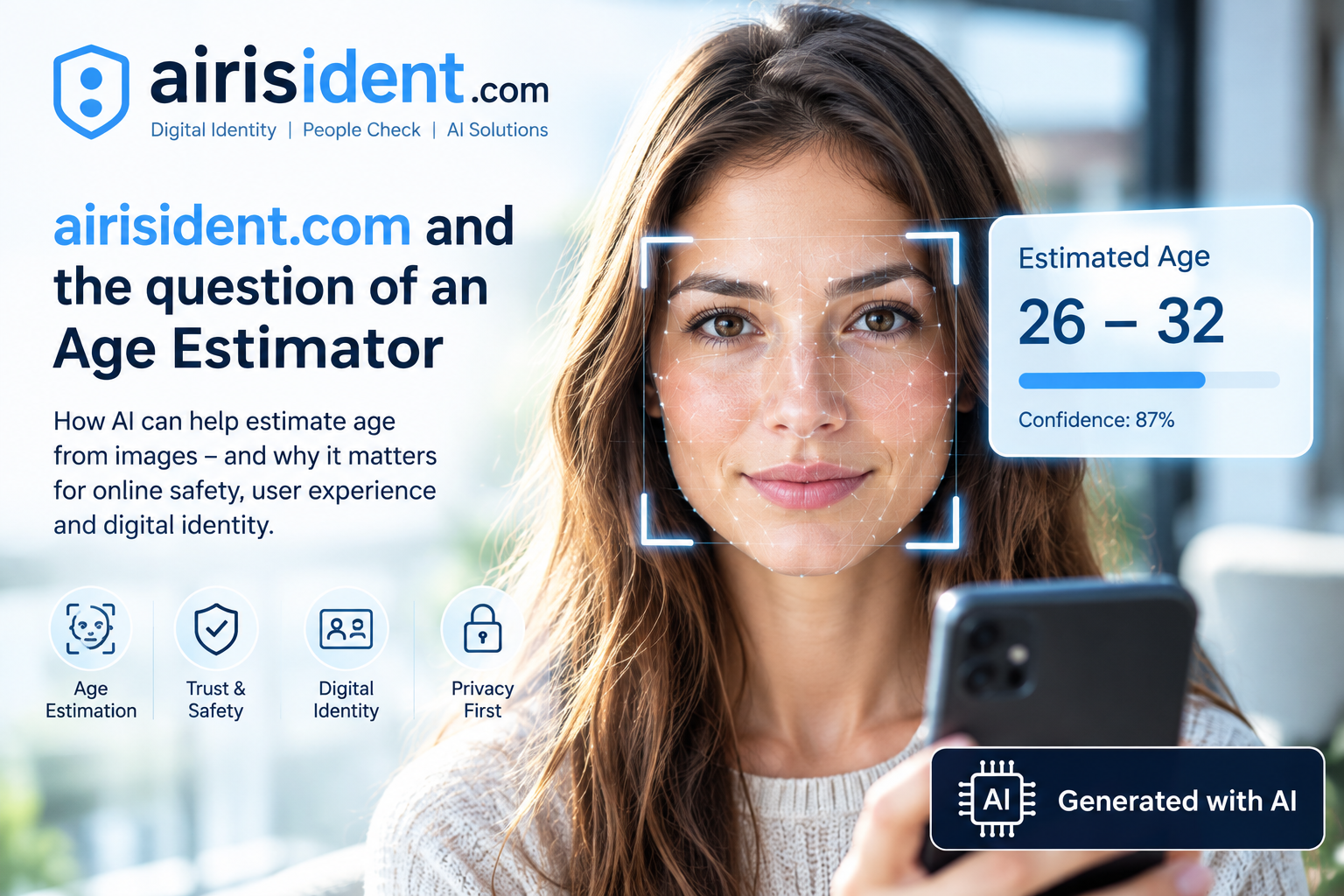
An AI-powered age estimator can analyze visual characteristics of a face and produce an estimated age or age range. Solutions such as airisident.com are part of this broader technological development, offering a way to consider age estimation as one component of modern identity and safety processes.
However, an important distinction must be made from the beginning: age estimation is not the same as age verification.
An age estimator provides an algorithmic estimate. Age verification aims to establish whether a person meets a defined age requirement, potentially using additional evidence such as an identity document or another verification method.
Understanding this difference is essential for companies considering AI-based age technologies.
What Is an AI Age Estimator?
An AI age estimator is a software system designed to analyze an image of a person's face and estimate their apparent age.
The technology generally relies on computer vision and machine learning techniques. A model is trained using large datasets containing facial images associated with known or estimated ages. During operation, the system analyzes characteristics in a new image and produces an age estimate.
Depending on the implementation, the result could look like:
- An estimated numerical age
- An age range
- A probability distribution across age groups
- A threshold assessment
- A confidence value
For example, a system might estimate that a person appears to be in their twenties or thirties rather than claiming that the person is exactly a particular age. This distinction is important because human appearance varies considerably.
Two people of exactly the same chronological age can look very different, while two people of different ages can sometimes appear visually similar.
airisident.com and the Concept of Age Estimation
airisident.com can be considered in the context of modern digital identity and people-check technologies. One potential application is the use of an AI-powered age estimator to provide an initial assessment of apparent age based on a facial image.
This can be useful in situations where a platform needs an additional signal concerning the apparent age of a user.
Potential applications include:
- Dating platforms
- Social networks
- Online communities
- Creator platforms
- Marketplaces
- Gaming platforms
- Digital services
- Content platforms
- Online customer onboarding
- Age-sensitive environments
The technology can be integrated into a broader workflow rather than being treated as a standalone decision-making mechanism.
Age Estimation Is Not Age Verification
This is perhaps the most important point when discussing age estimators. An AI system that estimates someone's age from their face cannot automatically know their actual date of birth.
A person who looks 25 may be 21, 25 or 30.
Likewise, someone who appears younger may actually be significantly older.
Therefore, an age estimator should generally be understood as an estimation technology rather than proof of legal age.
This distinction becomes particularly important for services with legal age restrictions. If a business needs to establish that an individual is legally old enough to access a service, it may require a stronger verification process.
An age estimator can potentially act as one layer within that process.
Why Companies Are Interested in Age Estimation
There are several reasons why digital businesses are exploring age estimation. The first is user experience.
Traditional identity verification can sometimes involve several steps. Users may need to upload documents, take photographs or provide additional information. Age estimation can potentially provide a lightweight preliminary assessment.
The second reason is scalability.
Large platforms may need to process huge numbers of users. Automated technologies can help companies evaluate signals at scale. The third reason is risk management.
Age estimation can potentially help identify accounts that require additional review or verification. For example, a platform could use an estimated age threshold as a trigger for an additional verification step.
Age Estimation and Online Safety
Age is an important component of online safety. Different services have different requirements depending on the nature of their content and user interactions.
A platform may want to understand whether users appear to belong to a particular age group before allowing them to access certain features.
Age estimation can therefore contribute to a broader Trust & Safety framework.
The technology can potentially be combined with:
- Identity and Document verification
- Face matching or Liveness detection
- Image moderation
- Account behavior analysis with User reporting
- Human review
Rather than relying on a single signal, platforms can build multiple layers of protection.
The Role of AI in Modern People Checks
The concept of a people check is evolving. Historically, organizations often relied on documents and manual processes to establish identity. Today, computer vision and AI can automate parts of the process.
A modern people-check workflow might involve several stages:
Step 1: Capture
The user provides a selfie or another suitable image.
Step 2: Image Analysis
AI analyzes the submitted image.
Step 3: Face Detection
The system identifies whether a usable face is present.
Step 4: Age Estimation
The system estimates the apparent age or age range.
Step 5: Risk Assessment
The result can be combined with other available signals.
Step 6: Additional Verification
If necessary, the user can be directed to a stronger verification process.
This type of architecture can help companies create more flexible identity and safety workflows.
Why an Age Range Can Be More Meaningful Than an Exact Number
One of the challenges of age estimation is the temptation to interpret the result too precisely. Suppose an AI system produces an estimated age of 27.
It would be misleading to assume that this means the person is exactly 27 years old. The underlying computer vision model is estimating apparent age based on visual characteristics.
An age range may therefore be more appropriate for many applications.
For example:
Estimated age: 25–34
can communicate uncertainty more honestly than:
Age: 27
This becomes particularly important when the technology is used as part of a safety or verification workflow. Aditonaly airisprotect.com services with Image moderation could support the results.
The Importance of Confidence Levels
Age estimation systems can also consider confidence. An algorithm may be more confident in one estimate than another.
For example, an image might produce a relatively clear result because the face is:
- Clearly visible
- Well illuminated
- Facing the camera
- High resolution
- Not heavily filtered
Another image may be difficult to analyze because the face is:
- Partially covered
- Blurred
- Extremely small
- Poorly illuminated
- Viewed from an unusual angle
- Heavily edited
A responsible implementation should take image quality and uncertainty into account. Again, check airisprotect.com for more options in visual computing.
The Problem of AI-Generated Faces
Another emerging challenge is the use of AI-generated faces. Generative AI can create realistic-looking people who do not exist. This creates a significant challenge for digital platforms.
An age estimator may analyze the apparent age of an AI-generated face, but that does not establish the existence or identity of a real person behind the image. This is why age estimation should not be confused with identity verification.
A platform dealing with synthetic identities may need additional technologies capable of assessing:
- Image authenticity
- Face consistency
- Liveness
- Identity documents and Face-to-document matching
- Repeated identity usage
The combination can provide substantially more information than an age estimate alone.
Age Estimation in Dating Platforms
Dating applications are one example where age is particularly relevant. Users generally expect the age displayed on a profile to correspond to the person's actual age.
Fake ages can undermine trust and may create serious safety concerns. An age estimator can potentially be used as an additional signal during registration or profile review. For example, if a user enters an age that differs significantly from the estimated age, the platform could request additional verification.
This does not automatically mean that the user is fraudulent. There are legitimate reasons why an algorithm may estimate someone's age incorrectly.
However, a significant discrepancy could justify an additional check.
Age Estimation and Social Media
Social media platforms face similar challenges. Millions of users can upload photographs every day, making manual review impractical.
An AI-based age estimation system can potentially support automated risk classification. For example, a platform could identify profiles that appear to fall into particular age groups and apply appropriate safety workflows.
Again, the objective should be to support responsible platform governance rather than to assume that an algorithm is always correct.
Privacy and Data Protection
Any technology involving facial images needs to take privacy seriously.
A photograph of a person can constitute personal data, and biometric technologies may be subject to additional regulatory requirements depending on how they are used and the applicable jurisdiction.
Companies considering age estimation should therefore evaluate:
- What data is collected and Why it is collected
- How long it is retained and Where it is processed
- Who can access it
- Whether processing is necessary
- What legal basis applies and How users are informed
- Whether users have appropriate rights and remedies
Privacy-by-design should be part of the implementation strategy from the beginning.
Avoiding Overreliance on Automated Decisions
An AI age estimator should generally be considered a supporting technology. A responsible platform should understand the limitations of automated analysis.
Factors such as:
- Lighting, Camera quality
- Facial expression, Makeup, Facial hair
- Image angle
- Cultural differences, Natural variation
- Image processing
can influence apparent age.
Therefore, a platform should establish appropriate thresholds and review mechanisms. The more consequential the decision, the more important it becomes to combine multiple forms of evidence.
Age Estimation and Age Verification Can Work Together
The strongest approach is often not a choice between age estimation and age verification. Instead, the technologies can complement one another.
For example:
Stage 1: AI age estimation
Stage 2: Risk assessment
Stage 3: Additional verification where required
Stage 4: Final access decision based on the appropriate verification standard
This creates a flexible process.
Low-risk users may experience a relatively simple workflow, while higher-risk cases can receive additional scrutiny. Such an approach can potentially reduce unnecessary friction while maintaining stronger safety controls.
The Business Value of Automated Age Estimation
For businesses, automation can provide several operational advantages.
Scalability
AI systems can process large numbers of images without requiring every image to be manually reviewed.
Speed
Automated analysis can potentially take place during registration or content upload.
Consistency
A standardized algorithm can apply the same technical assessment to large volumes of submissions.
Risk-Based Verification
Age estimation can potentially help determine when additional verification may be appropriate.
Reduced Manual Work
Human moderators and verification teams can focus on cases that require additional attention.
These benefits explain why age estimation is becoming an interesting component of digital identity and Trust & Safety strategies.
The Human Element Remains Important
Despite advances in AI, human oversight remains valuable.
Automated systems are particularly effective at processing large amounts of information quickly. Humans can provide context and judgment in complicated situations. A sensible architecture can therefore combine both.
AI can identify potentially relevant cases. Humans can review exceptions, disputes and complex situations.
This hybrid model can help reduce the risk of treating algorithmic estimates as unquestionable facts.
What Should Companies Ask When Selecting an Age Estimator?
Organizations evaluating an age-estimation technology should ask several questions.
How does the technology work?
Companies should understand whether the solution estimates numerical age, age ranges or age categories.
How is uncertainty communicated?
A useful system should provide information about confidence or uncertainty where appropriate.
What happens when the image quality is poor?
The workflow should define how unusable images are handled.
Can the technology integrate with identity verification?
Integration can be particularly useful when age estimation is only one stage of a broader process.
How is personal data handled?
Privacy and data protection should be evaluated before implementation.
Can the system scale?
A solution suitable for a small project may not be appropriate for a platform processing millions of users.
How are false positives handled?
Users should have an appropriate process for resolving questionable outcomes.
airisident.com and the Future of Age Estimation
The discussion around airisident.com and age estimation reflects a broader change in the digital identity market.
The industry is moving toward identity processes that combine computer vision, AI analysis and verification technologies. An age estimator can provide useful information about the apparent age of a person. It can potentially support online safety, user segmentation, fraud prevention and risk-based verification.
But the technology should be implemented with realistic expectations. An age estimate is not a birth certificate.
It does not automatically prove identity. It does not necessarily establish legal age.
Instead, it can provide a valuable technical signal that becomes more powerful when combined with appropriate verification methods.
Conclusion: Asking the Right Question About Age Estimation
The important question is not simply whether an AI system can estimate someone's age.
Modern computer vision technology can provide age estimates from facial images, and services such as airisident.com can be considered within this evolving ecosystem of identity and people-check solutions. The more important question is how an age estimator should be used responsibly.
For some platforms, age estimation may serve as an initial risk signal. For others, it may become part of a broader age assurance process. In higher-risk environments, it may need to be combined with stronger identity or age verification technologies.
The future of digital identity is likely to involve multiple technologies working together.
AI image analysis can provide speed and scalability. Identity verification can provide stronger evidence. Human review can provide context. Privacy safeguards can ensure that the process remains responsible. For companies operating dating platforms, social networks, marketplaces, communities and other online services, this combination can help address an increasingly important question:
How can a digital platform understand whether a user's claimed age is plausible while respecting privacy and maintaining a smooth user experience?
Age estimation can be part of the answer — provided that businesses understand its capabilities, limitations and appropriate role.
The future of online safety will not depend on a single AI model. It will depend on intelligent combinations of age estimation, identity verification, image analysis, fraud detection and responsible Trust & Safety processes.
That is where technologies such as airisident.com can become relevant: not as a replacement for every form of verification, but as a potential component in a modern, layered approach to digital identity and age assurance.