
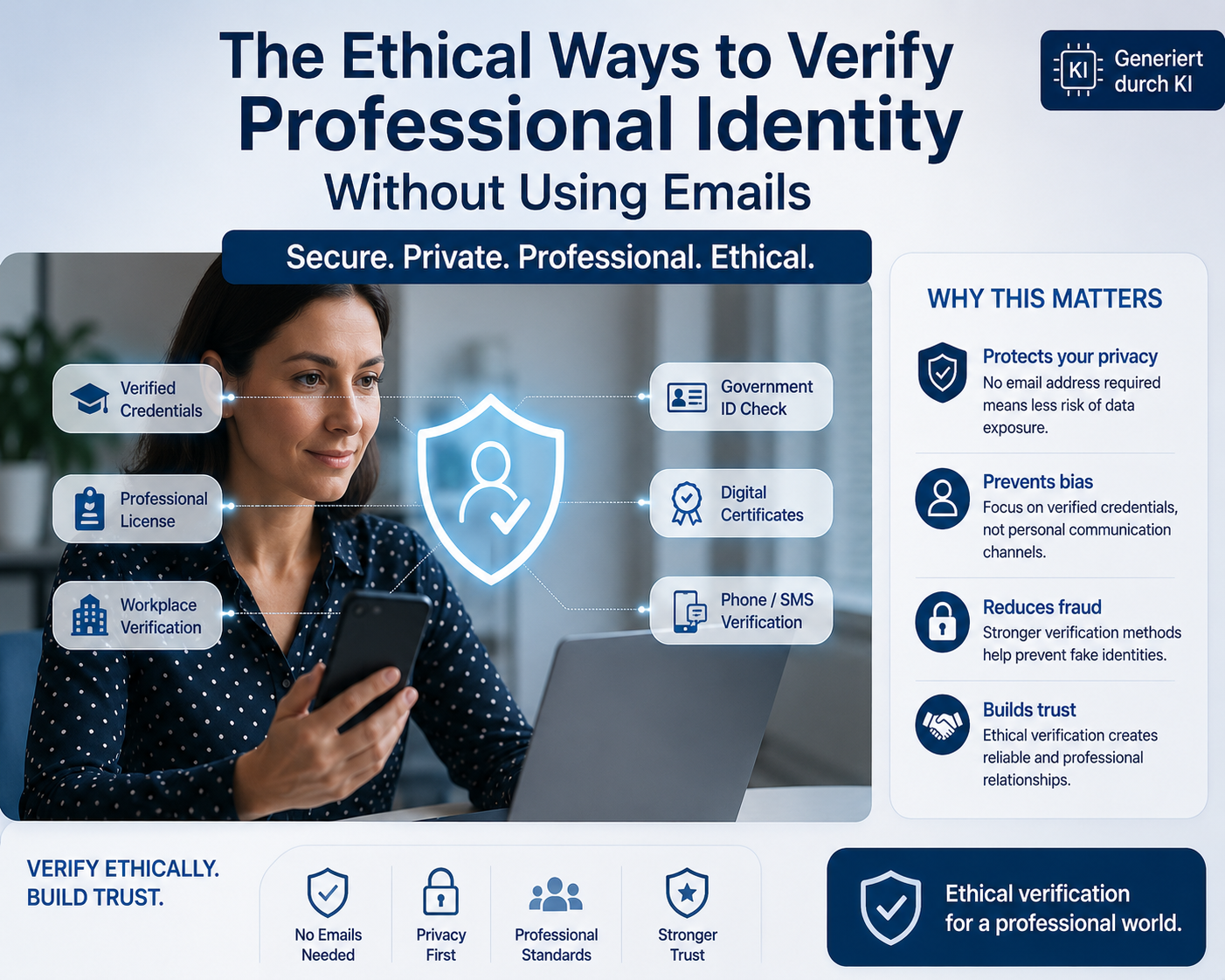
The Ethical Ways to Verify Professional Identity Without Using Emails.
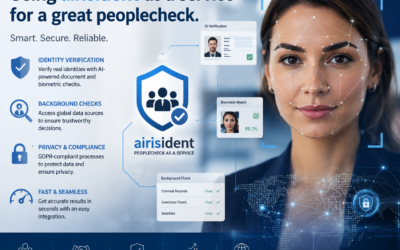
Professional identity verification is becoming increasingly important in a digital-first business environment. Discover how organizations can verify professional identity without using emails while protecting privacy, reducing fraud, and creating a more trustworthy digital ecosystem. By the way a great chance to test is using our service of airisident.com.
In an increasingly digital economy, knowing who you are dealing with has become a fundamental requirement for businesses, platforms, marketplaces, recruitment services, financial providers, and professional networks. However, traditional verification methods often rely heavily on email addresses, corporate domains, or links sent to an inbox. While email verification can be useful in certain situations, it is not always the most reliable, secure, or privacy-friendly way to establish a person’s professional identity.
Organizations looking to verify professional identity without using emails now have access to a growing range of alternative technologies. These include government-issued ID verification, professional license validation, digital certificates, phone-based verification, biometric authentication, business registry checks, and privacy-preserving digital identity solutions.
The objective should not simply be to collect more personal information. Ethical identity verification is about finding the right balance between trust, security, privacy, transparency, and user experience.
Why Professional Identity Verification Matters
Professional identity verification helps organizations establish confidence that a person is who they claim to be and that their professional credentials are legitimate.
This is particularly important in industries where trust is directly connected to business relationships. Online marketplaces, freelance platforms, professional communities, recruitment portals, financial services, healthcare platforms, consulting networks, and business-to-business services may all need mechanisms to distinguish genuine professionals from fraudulent or misleading profiles.
Fake identities can create significant risks. A person could falsely claim to be a licensed professional, represent a company without authorization, use another person’s credentials, or create a fake professional profile to manipulate other users.
The consequences can include:
- Fraud and financial losses
- Reputational damage
- Regulatory and compliance problems
- Fake professional profiles
- Credential abuse
- Identity theft
- Social engineering attacks
- Loss of customer trust
- Unauthorized access to business services
For this reason, professional identity verification is increasingly becoming a core element of digital trust and safety strategies. Services like airisident.com support that, sometimes in combination with the image and video moderation tool and check of airisprotect.com
However, verification does not necessarily require an email address.
The Limitations of Email-Based Verification
Email verification is one of the simplest forms of digital authentication. A platform sends a verification link or code to an email address, and the user confirms ownership of that mailbox.
This approach can establish control over an email account, but it does not necessarily prove professional identity.
For example, having access to an address such as [email protected] does not automatically prove that the person is a licensed architect, doctor, lawyer, financial professional, engineer, or authorized representative of a particular organization.
Email accounts can also be:
- Compromised
- Shared
- Forwarded
- Created temporarily
- Controlled by former employees
- Used with aliases
- Subject to phishing attacks
Another issue is accessibility. Not every professional has access to a corporate email address. Freelancers, contractors, independent consultants, entrepreneurs, creators, temporary workers, and professionals between jobs may use personal email accounts.
Therefore, businesses that want to verify professional identity without using emails should consider verification methods that evaluate stronger evidence of identity and professional status.
Government-Issued ID Verification
One of the most established alternatives to email verification is government-issued identification.
Depending on the jurisdiction and use case, users may be asked to provide an identity document such as a passport, national identity card, or driver’s license.
Modern identity verification systems can analyze documents automatically and look for indicators such as:
- Document authenticity
- Security features
- Expiration dates
- Document numbers
- Machine-readable zones
- Tampering indicators
- Data consistency
- Portrait consistency
Advanced systems can also compare information from the document with other verification signals.
The ethical principle is important: organizations should only collect the information necessary for the stated purpose.
A company verifying whether a professional is a real person may not need to permanently retain a complete copy of an identity document. In some cases, verification can be performed while storing only a limited verification result.
This approach supports the principle of data minimization.
Professional License Verification
For regulated professions, professional licenses can provide much stronger evidence than email ownership.
A professional may claim to be a doctor, lawyer, engineer, financial advisor, electrician, architect, or other regulated professional. Instead of relying on an email address, an organization can verify the relevant license or registration.
Depending on the country and profession, verification may involve:
- License numbers
- Professional registries
- Certification authorities
- Regulatory databases
- Credential providers
- Issuing organizations
This method directly addresses the question businesses actually need to answer: Does this person have the professional credentials they claim to have?
License verification can therefore be particularly valuable for professional marketplaces and platforms where users depend on the qualifications of other members.
Digital Certificates and Verifiable Credentials
Digital identity technology is also creating new possibilities for professional identity verification.
Digital certificates and verifiable credentials can allow organizations or institutions to issue cryptographically verifiable information about a person.
Instead of asking someone to prove their identity through an email account, a user could present a credential confirming information such as:
- Professional qualification
- Educational achievement
- Employment status
- Membership in a professional organization
- License status
- Training completion
The major advantage is that verification can become more focused.
Rather than collecting extensive personal information, a platform may only need confirmation that a specific claim is valid.
For example, the relevant question may not be “Who is this person in every possible detail?” but rather “Is this person currently certified to perform this professional activity?”
That distinction is central to ethical identity verification.
Phone and SMS Verification
Phone-based verification is another alternative to email.
A user can receive a one-time verification code through SMS or another secure communication channel. This can establish control over a phone number and provide an additional authentication factor.
However, businesses should recognize that phone verification alone is not equivalent to identity verification.
A phone number does not necessarily prove professional status. It is better understood as one component within a broader identity verification process.
For higher-risk applications, phone verification can be combined with:
- Government ID verification
- Selfie or biometric matching
- Professional credential checks
- Device intelligence
- Authentication technologies
This layered approach can provide stronger protection than relying on one signal.
Biometric Identity Verification
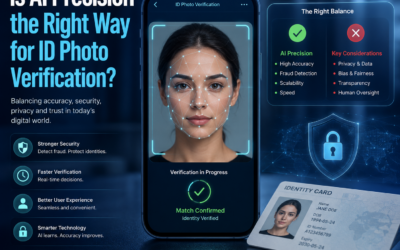
Biometric technologies can provide another method for verifying that a person presenting an identity document is the same individual represented by that document.
Depending on the technology and legal framework, biometric verification may involve facial comparison or other biometric signals. Check airisident.com or airisprotect.com for support.
A typical process may involve:
- The user presents an identity document.
- The system extracts relevant information.
- The user provides a live image or biometric signal.
- The system compares the biometric information.
- Fraud and manipulation indicators are evaluated.
- The system produces a verification result.
However, biometric identity verification requires particularly careful handling.
Ethical implementation should include transparency, appropriate consent, strong security, limited retention, clear purpose definition, and consideration of accuracy and potential bias.
Biometrics should not be treated as a magic solution. The technology should be implemented as part of a carefully designed privacy-first identity verification strategy.
Business Registry Verification
For professional identity verification in a business environment, company registries can provide valuable evidence.
An individual may claim to be the owner, director, representative, or employee of a particular organization. Rather than relying solely on an email address, organizations can verify relevant information against authoritative business records where legally and technically appropriate.
Potential verification points include:
- Company registration
- Business status
- Registered officers
- Company name
- Business address
- Professional associations
- Public corporate information
This approach can be particularly useful for B2B marketplaces, supplier platforms, procurement services, and professional networks.
It also demonstrates an important principle: identity verification should verify the claim that matters.
If the important question is whether someone legitimately represents a business, business-related evidence may be more relevant than email ownership.
Multi-Factor Professional Identity Verification
The strongest verification systems often combine several independent signals.
For example, a platform could combine:
Identity document + biometric verification + professional credential + phone verification
This creates a significantly stronger identity assurance process than relying on a single email address.
The goal is not to make verification unnecessarily complicated. Instead, organizations should apply risk-based verification.
A low-risk professional community may require only basic verification. A high-risk financial, healthcare, or regulated environment may require considerably stronger checks.
This approach can improve both security and user experience.
Privacy Should Be at the Center of Ethical Verification
The ability to verify professional identity without using emails should not become an excuse to collect excessive personal data.
Ethical verification starts with a simple question:
What information is actually necessary to establish trust?
Organizations should avoid collecting data simply because technology makes it possible.
A privacy-first verification framework should consider:
- Data minimization
- Purpose limitation
- Secure processing
- Limited retention
- Transparent user communication
- Appropriate consent
- Access controls
- Encryption
- Auditability
- Clear deletion policies
For example, a platform may need to know that a user’s professional license is valid without necessarily needing to retain every detail contained in the user’s identity documents.
This distinction can significantly reduce privacy risks.
Avoiding Bias in Professional Identity Verification
Ethical identity verification must also consider fairness.
Automated systems can make mistakes. Optical character recognition can fail. Facial comparison systems can produce false matches or false rejections. Documents can vary significantly between countries and regions.
Organizations should therefore avoid designing systems where an automated decision becomes an unquestionable final judgment.
A responsible approach can include:
- Human review for ambiguous cases
- Clear appeal mechanisms
- Regular accuracy testing
- Monitoring for disproportionate error rates
- Multiple verification options
- Accessibility considerations
- Transparent explanations
The goal is to prevent legitimate professionals from being excluded simply because an automated system cannot confidently verify their information.
Why Email-Free Verification Can Improve Accessibility
There is also an important accessibility argument for alternative verification.
Not every professional works in a conventional corporate environment.
Consider:
- Freelancers
- Entrepreneurs
- Consultants
- Independent contractors
- Temporary employees
- Remote workers
- Self-employed professionals
- Creators
- International professionals
A corporate email address may not exist for these individuals.
An email-independent verification process allows organizations to focus on verifiable professional evidence rather than employment infrastructure.
This can create a more inclusive digital ecosystem.
The Role of AI in Professional Identity Verification
Artificial intelligence is increasingly being used to support automated identity and document analysis.
AI-powered systems can analyze documents, images, and other verification signals at high speed. This can help organizations identify potential inconsistencies, suspicious documents, manipulated images, or unusual verification patterns.
For businesses processing large numbers of users, AI can also reduce the workload associated with manual verification.
However, AI should support responsible decision-making rather than replace accountability.
An ethical AI identity verification system should be:
- Transparent
- Auditable
- Security-focused
- Privacy-conscious
- Tested regularly
- Designed with human oversight
- Appropriate to the level of risk
AI can make verification faster, but speed should never become more important than accuracy, fairness, and privacy.
Professional Identity Verification and Fraud Prevention
Fraudsters continuously adapt their methods.
Fake profiles, stolen credentials, manipulated documents, impersonation, synthetic identities, and social engineering can all undermine digital trust.
A robust verification strategy can make these attacks more difficult.
Instead of asking only whether a user controls an email address, organizations can evaluate multiple pieces of evidence.
For example:
Identity + credential + biometric match + phone + professional registration
Each additional independent signal can increase confidence.
This is particularly valuable for online marketplaces where users may never meet one another physically.
Trust must therefore be created digitally.
Designing a User-Friendly Verification Process
Security and user experience should not be treated as opposites.
A complicated verification process can cause legitimate users to abandon registration. A process that is too simple can expose the platform to fraud.
The best approach is often a progressive verification model.
A platform could begin with a simple verification step and request additional information only when the risk level requires it.
For example:
Step 1: Basic account verification
Step 2: Phone verification
Step 3: Identity document verification
Step 4: Professional credential verification
Step 5: Additional verification for high-risk activities
This approach allows businesses to balance security with convenience.
Transparency Builds Trust
Users should understand why they are being asked to verify their identity.
Instead of displaying a vague message such as “Verification required,” organizations should explain:
- Why verification is necessary
- What information is being collected
- How it will be used
- How long it will be retained
- Who can access it
- What happens if verification fails
- How users can appeal a decision
Transparency is particularly important when sensitive identity information is involved.
A user who understands the purpose of verification is more likely to perceive the process as legitimate rather than intrusive.
The Future of Email-Free Identity Verification
The future of digital identity is likely to become increasingly decentralized, credential-based, and privacy-conscious.
Rather than repeatedly submitting personal information to every platform, users may increasingly be able to present trusted digital credentials.
This could change the traditional relationship between users and online services.
Instead of saying:
“Give us your email address so we can verify you.”
organizations may increasingly say:
“Present the credential necessary to prove the claim relevant to this service.”
That is a fundamentally different model.
It moves identity verification away from simple account ownership and toward verifiable trust.
For businesses, this could reduce fraud, improve onboarding, increase compliance, and create stronger relationships with customers and professional users.
For individuals, it could mean greater control over their personal information.
Conclusion: Verification Without Email Can Be More Ethical and More Effective
The ability to verify professional identity without using emails provides organizations with an opportunity to rethink how digital trust is created.
Email verification still has a legitimate role in authentication, but it should not automatically be considered proof of professional identity. A corporate email address can demonstrate access to an account, but it does not necessarily demonstrate qualifications, licensing, authorization, or the real-world identity of the individual.
Ethical alternatives include government-issued ID verification, professional license checks, business registry verification, digital certificates, verifiable credentials, phone verification, biometric authentication, and carefully designed multi-factor verification systems.
The most effective strategy is not necessarily to collect the most data. It is to collect the right evidence for the specific trust decision.
For modern businesses, this means combining security with privacy, automation with human oversight, and fraud prevention with a positive user experience.
As digital professional relationships continue to expand, identity verification will become an increasingly important part of online trust and safety. Organizations that adopt privacy-first, risk-based, and transparent verification methods can protect their users while building a more reliable professional ecosystem.
Ultimately, the future of professional identity verification should not be about proving everything about a person.
It should be about proving exactly what needs to be trusted — securely, ethically, and with as little unnecessary personal information as possible.