

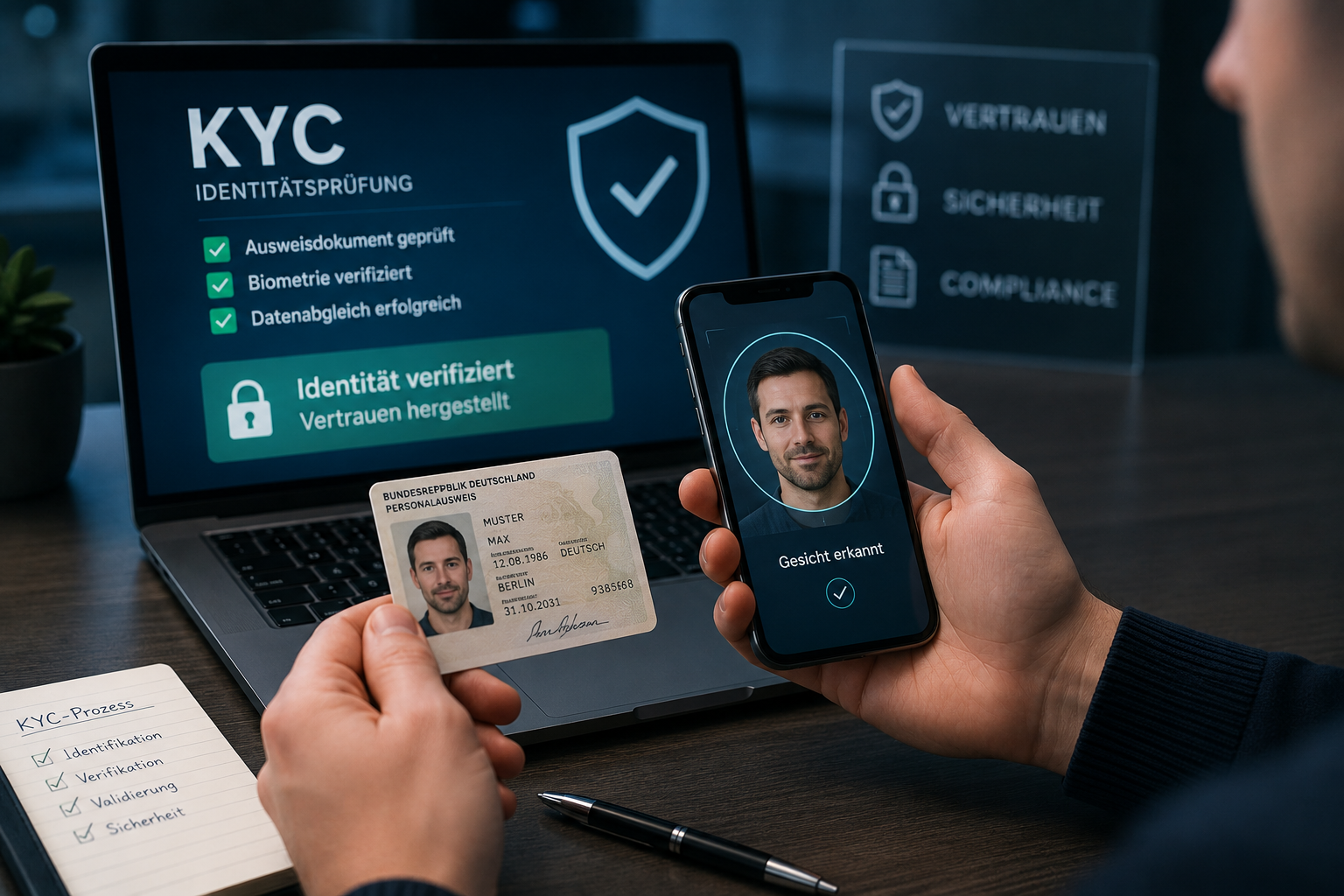
Correct identity verification as a central part of the KYC process: Why trust in the digital economy starts with reliable verification
From financial services to dating platforms to marketplaces and social networks, the digital world faces a common challenge: reliably identifying users. While cybercrime, identity theft and fraud attempts are on the rise worldwide, the so-called Know-Your-Customer (KYC) process is becoming increasingly important. Correct identity verification forms the foundation for security, compliance and trust in digital business models.
Digital identity is becoming a decisive factor of trust
In an increasingly networked society, more and more business processes are shifting to digital channels. Account openings are done online, loans are applied for via smartphone, insurance policies are taken out digitally and even interpersonal relationships are created via apps and platforms.
However, this development also increases the risk of identity abuse. Criminals use stolen identity documents, manipulated images or artificially generated identities to commit fraud, conceal money laundering or gain access to sensitive systems.
Companies are therefore faced with the challenge of ensuring that behind a digital profile is actually the person they claim to be.
This is exactly where the KYC process comes in.
What does KYC mean?
KYC stands for “Know Your Customer” and describes the legally and organizationally prescribed measures for identifying and verifying customers.
The term originally comes from the financial sector. Banks and financial institutions are required to establish the identity of their customers in order to prevent money laundering, terrorist financing and other financial crimes.
However, KYC is now being used far beyond the banking sector. Identity checks are also becoming increasingly standard in the following areas:
- FinTech companies
- Insurance
- Cryptocurrency platforms
- E-commerce marketplaces
- Mobile Operators
- The Sharing Platform
- Online Gaming Providers
- The Dating Platform
- Social Media Networks
User identity verification is increasingly becoming a universal security mechanism.
Why Proper Identity Verification Is So Important
An identity check fulfills several central functions.
On the one hand, it serves to comply with legal requirements. Companies must be able to prove that they have adequately vetted their customers.
On the other hand, it protects both companies and users from fraud.
Faulty or inadequate test methods can have serious consequences:
- Identity theft
- Account takeovers
- Financial fraud
- Money laundering
- Fake-Profile
- Loss of trust
- Reputational damage
- High regulatory penalties
Especially in times of increasing digitalization, the quality of identity verification is becoming a decisive competitive factor.
The classic flow of a KYC process
A professional KYC process consists of several steps.
-
Collection of customer data
First, basic information is collected.
These include, for example:
- First and last name
- Date of birth
- Nationality
- Residential address
- Contact Details
This data forms the basis for further examinations.
-
Document verification
An official identity document is then verified.
Typical documents are:
- Identity card
- Passport
- Residence permit
- Driver’s license (depending on the application)
This checks whether the document is genuine, valid and unaltered.
-
Biometric Verification
Modern KYC procedures complement document verification with biometric methods.
These include, in particular:
- Facial recognition
- Selfie Matching
- Video identification
- Liveness Detection
The goal is to ensure that the person is actually physically present and not just a photo or digital manipulation is used.
-
Data reconciliation
The collected data is compared with internal and external data sources.
This allows discrepancies to be detected and risks to be assessed.
-
Risk assessment
Finally, the customer risk is assessed.
Depending on the industry and regulatory requirements, additional checks may be necessary.
The role of modern AI in the identity verification process
Artificial intelligence is currently changing the way identities are verified.
In the past, many verification steps had to be carried out manually. Today, intelligent systems take over a large part of these tasks automatically.
The most important areas of application include:
Document Analysis
AI systems can analyze ID documents within a few seconds.
In doing so, they realize:
- Safety features
- Manipulations
- Changes to title blocks
- Image editing
- Counterfeiting attempts
This increases speed while reducing human error.
Face matching
With the help of modern facial recognition, biometric features can be compared between the ID document and the live recording.
The technology analyzes numerous facial features and calculates match scores.
This determines whether the person in front of the camera is actually the same as the person on the ID.
Liveness Detection
One of the most important developments in modern KYC is the so-called “liveness detection”.
In this case, the system checks whether the person is a living person.
Among other things, the technology detects:
- Natural head movements
- Eye movements
- Depth information
- Light reflections
- Facial Dynamics
This will prevent photos, screen recordings, or videos from being used to deceive.
The growing danger of deepfakes
With the rise of generative AI, new challenges arise.
Today, deepfake technologies make it possible to create deceptively real images and videos.
Criminals are increasingly using these opportunities to bypass identity checks.
Procedures based exclusively on static photos are particularly affected.
A modern KYC system must therefore be able to detect deepfake attacks.
For this purpose, special AI models are used that analyze abnormalities, for example:
- unnatural facial movements
- faulty shadows
- Inconsistent lighting conditions
- Image Artifacts
- Traces of manipulation
The combination of biometric analysis and deepfake recognition will be one of the most important security measures in digital identity management in the future.
Man and machine as an optimal combination
Despite high levels of automation, humans remain an important part of the KYC process.
Today, the most powerful systems work according to the so-called “human-in-the-loop” principle.
The AI takes over the initial check and marks anomalies.
Complex or unclear cases are then reviewed by specially trained staff.
This combination offers several advantages:
- high speed
- Low error rate
- Better fraud detection
- Greater traceability
- regulatory certainty
Experts currently consider this approach to be a best practice in the field of digital identity verification.
Data protection and compliance as central requirements
Identity data is one of the most sensitive pieces of personal information of all.
Therefore, companies must meet the highest requirements for data protection and information security.
Key requirements include:
- encrypted data transmission
- Secure storage
- Access restrictions
- Transparent consent processes
- Deletion concepts
- Auditability
European companies in particular must take into account the requirements of the General Data Protection Regulation (GDPR).
In addition, new regulations for artificial intelligence are becoming increasingly important.
Companies must ensure that automated decisions are made in a comprehensible, fair and non-discriminatory manner.
KYC as protection against financial crime
A key purpose of KYC is to combat financial crime.
Criminals often try to disguise illicit funds through seemingly legitimate accounts or business relationships.
Careful identity verification can detect suspicious activity at an early stage.
This concerns, among other things:
- Money laundering
- Terrorist financing
- Fraud networks
- Sanctions violations
- Identity abuse
International regulators therefore consider effective KYC procedures to be an indispensable tool for stabilizing the financial system.
KYC outside the financial industry
Identity verification is also becoming increasingly important outside of traditional financial services.
Dating platforms use verification procedures to reduce fake profiles.
Marketplaces protect buyers and sellers from fraud.
Sharing services check drivers and users.
Gaming platforms use identity verification for age verification and fraud prevention.
The same principle applies in all these areas:
The more reliably a user’s identity can be determined, the higher the trust within the respective ecosystem.
The future of digital identity verification
The coming years will be characterized by further technological innovations.
Experts expect progress in particular in the following areas:
Biometric Multi-Factor Verification
Several biometric features are checked at the same time.
These include, for example:
- Face
- Voice
- Movement patterns
- Behavioral Biometrics
AI-powered risk analytics
Future systems will not only be able to check identities, but also predict potential risks.
Digital Identity Wallets
State- or privately provided digital identities could greatly simplify identification.
Users would no longer have to re-enter their data on each platform.
Real-time fraud detection
Advanced AI systems will be able to immediately detect suspicious activity and automatically initiate countermeasures.
Conclusion
Correct identity verification is now much more than a regulatory obligation. It forms the basis for trust, security and integrity in digital business models. The KYC process protects businesses from financial and legal risks and protects users from identity theft, fraud, and abuse.
Modern technologies such as artificial intelligence, biometric verification, liveness detection and deepfake recognition enable a new generation of digital identity checks. At the same time, humans remain an indispensable part of the process, especially in complex or suspicious cases.
In a world where digital identities are becoming increasingly economic, social, and legal, the quality of the KYC process is becoming a critical success factor. Companies that rely on reliable, transparent and privacy-compliant identity checks not only create regulatory security, but above all the most important asset of the digital economy: trust.