

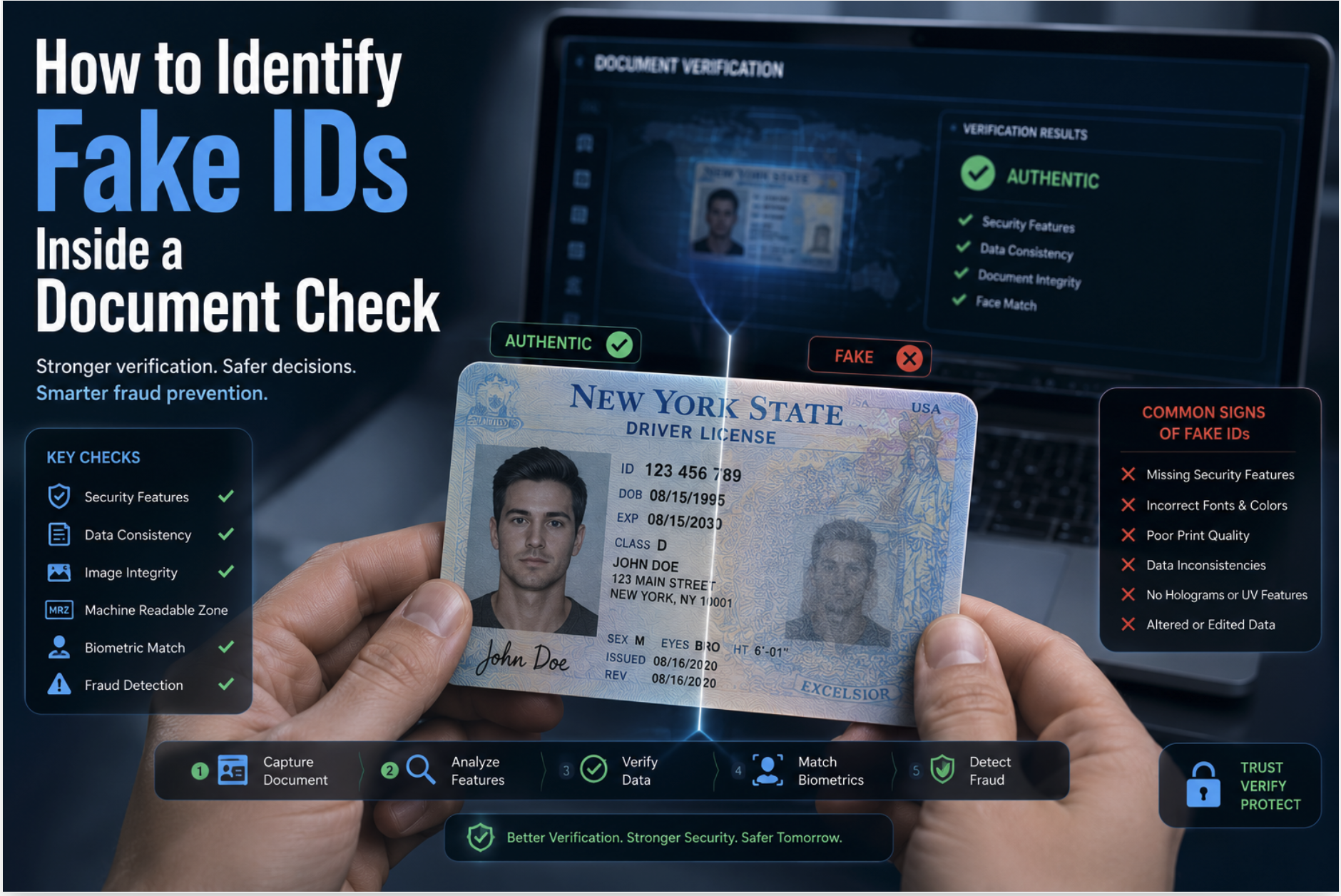
How to Identify Fake IDs Inside a Document Check
Identity fraud has become one of the fastest-growing challenges for organizations that rely on digital onboarding and Know Your Customer (KYC) procedures. Criminals continue to develop increasingly sophisticated counterfeit identity documents that are capable of bypassing basic verification methods. As businesses expand their digital services, compliance professionals must understand how to identify fake IDs during a document check while maintaining regulatory compliance and minimizing customer friction.
Modern document verification is no longer limited to visually inspecting an ID card. It combines forensic document analysis, machine learning, artificial intelligence, biometric verification, and fraud intelligence to determine whether an identity document is genuine.
This article explains the most effective techniques for identifying fake IDs during document verification, highlights common fraud methods, and outlines best practices for compliance teams operating in highly regulated industries.
Why Fake ID Detection Matters and how to Identify Fake IDs
Identity verification plays a central role in anti-money laundering (AML), Know Your Customer (KYC), Customer Identification Program (CIP), and fraud prevention requirements across financial services, fintech, cryptocurrency platforms, healthcare, telecommunications, travel, gaming, and e-commerce.
Accepting a fraudulent identity document may result in:
- Financial fraud
- Account takeover
- Money laundering
- Synthetic identity fraud
- Regulatory penalties
- Reputation damage
- Chargebacks and financial losses
With identity fraud increasing worldwide, organizations can no longer rely on manual inspection alone.
Understanding Modern Fake IDs
Today’s fake identity documents are far more advanced than simple photocopies.
Fraudsters commonly use:
Counterfeit Documents
These are completely fabricated documents designed to imitate genuine government-issued IDs.
Common examples include:
- Fake passports
- Counterfeit driver’s licenses
- Forged national identity cards
- Fake residence permits
Professional counterfeiters often reproduce:
- Fonts
- Colors
- Holograms
- UV elements
- Microprinting
- Machine-readable zones (MRZ)
Some high-quality counterfeit documents appear authentic to the human eye.
Altered Documents
Rather than creating an entirely fake document, criminals modify legitimate documents.
Typical alterations include:
- Replacing photographs
- Editing names
- Changing birth dates
- Modifying expiration dates
- Replacing document numbers
These alterations are often digitally manipulated before printing.
Synthetic Identity Documents
Synthetic identity fraud combines real information with fabricated personal data.
Examples include:
- Real social security information with fake names
- Genuine photos combined with fictional identities
- Modified personal information on stolen documents
Synthetic identities are especially difficult to detect because parts of the information are legitimate.
Step 1: Inspect Overall Document Quality
The first stage of every document check is evaluating overall document quality.
Compliance professionals should examine:
- Printing consistency
- Color accuracy
- Font alignment
- Lamination quality
- Edge cutting
- Material thickness
Government-issued documents typically use highly controlled manufacturing processes.
Signs of poor manufacturing include:
- Blurry text
- Pixelated photographs
- Uneven borders
- Misaligned printing
- Incorrect dimensions
These indicators may suggest counterfeit production.
Step 2: Verify Security Features
Modern identity documents contain multiple physical security features.
These include:
Holograms
Authentic holograms change appearance depending on viewing angle.
Counterfeit holograms often:
- Remain static
- Appear flat
- Lose reflective properties
- Show incorrect colors
Microprinting
Many IDs include microscopic text invisible to the naked eye.
Counterfeit documents frequently:
- Blur microtext
- Replace microprinting with simple lines
- Use incorrect spacing
UV Security Features
Ultraviolet elements remain invisible under normal lighting.
UV inspection may reveal:
- Government logos
- Hidden patterns
- Fluorescent fibers
- Security seals
Missing UV elements are a common fraud indicator.
Guilloche Patterns
Intricate background line patterns are difficult to reproduce.
Counterfeit documents may display:
- Broken lines
- Irregular spacing
- Color bleeding
- Distorted curves
Step 3: Validate the Machine Readable Zone (MRZ)
Passports and many identity cards contain a Machine Readable Zone.
The MRZ contains encoded personal information including:
- Full name
- Date of birth
- Nationality
- Expiration date
- Passport number
Compliance teams should compare:
- Visible data
- MRZ data
- OCR extracted data
Any inconsistency should trigger additional review.
Step 4: Analyze Document Data Consistency
Fraud often becomes apparent through inconsistent information.
Verify that:
- Birth dates match across all fields.
- Document numbers follow the issuing country’s format.
- Expiration dates are plausible.
- Issue dates precede expiration dates.
- Gender markers are consistent.
- Nationality codes are valid.
Automated validation can identify formatting errors that are difficult to detect manually.
Step 5: Detect Image Manipulation
Many fraudulent IDs originate from digitally edited source files.
Image forensic analysis may identify:
- Cloned pixels
- Edited backgrounds
- Compression artifacts
- Layer inconsistencies
- Artificial sharpening
- Photo replacement
AI-powered systems can detect subtle modifications that remain invisible during manual inspection.
Step 6: Verify Document Authenticity Using AI
Artificial intelligence has significantly improved fake ID detection.
Modern verification engines analyze hundreds of characteristics simultaneously.
Examples include:
- Security feature recognition
- Template matching
- Font analysis
- Pixel-level inspection
- Image integrity verification
- Layout comparison
- Deep learning anomaly detection
Instead of checking one characteristic, AI evaluates the entire document as a complete forensic object.
Step 7: Detect Presentation Attacks
Fraudsters frequently submit:
- Printed copies
- Screenshots
- Images displayed on another device
- Edited PDFs
- Re-photographed documents
Presentation attack detection identifies:
- Screen reflections
- Display pixels
- Moiré patterns
- Image borders
- Print artifacts
Preventing presentation attacks is essential for remote identity verification.
Step 8: Perform Liveness Verification
Even if a document appears genuine, it may belong to another individual.
Biometric liveness detection confirms that:
- A real person is present.
- The user is not using a photograph.
- The user is not using a deepfake.
- The user is not wearing a realistic mask.
- The user matches the ID portrait.
Face matching combined with liveness verification significantly reduces identity fraud.
Step 9: Cross-Check with Trusted Databases
Many organizations validate document information against:
- Government databases (where permitted)
- Watchlists
- Sanctions databases
- Politically Exposed Persons (PEP) databases
- Lost or stolen passport databases
Cross-referencing increases confidence in the verification process and helps identify high-risk applicants.
Common Warning Signs of Fake IDs
Compliance professionals should remain alert for several recurring indicators:
- Inconsistent fonts
- Missing holograms
- Incorrect spacing
- Cropped photographs
- Blurred text
- Mismatched MRZ information
- Invalid document numbers
- Incorrect country templates
- Signs of digital editing
- Poor image quality
- Missing UV features
- Unusual document dimensions
While a single issue may not confirm fraud, multiple anomalies often warrant additional investigation.
AI vs. Manual Document Inspection
Manual inspection remains valuable, particularly for edge cases and escalations. However, relying solely on human review presents several challenges:
- Reviewer fatigue
- Inconsistent decisions
- Longer processing times
- Limited ability to detect subtle digital manipulation
AI-powered document verification addresses these limitations by providing consistent, repeatable analysis at scale. Automated systems can rapidly compare submitted documents against extensive template libraries, inspect image integrity, and identify anomalies that may escape visual review. The most effective compliance programs combine AI-driven screening with experienced human analysts for exception handling and final decision-making.
Best Practices for Compliance Teams
To strengthen fake ID detection during document checks, organizations should adopt a layered verification strategy.
Recommended best practices include:
- Combine document verification with biometric face matching.
- Use AI-powered fraud detection to complement manual reviews.
- Keep document template libraries up to date.
- Train staff on emerging fraud techniques and document security features.
- Implement risk-based workflows with escalation procedures.
- Monitor fraud trends and update verification rules regularly.
- Maintain detailed audit logs to support regulatory requirements.
- Review system performance and false-positive rates to improve efficiency over time.
A multi-layered approach provides greater resilience than relying on any single verification method.
Regulatory Considerations
Compliance professionals must balance fraud prevention with privacy and data protection obligations. Depending on the jurisdiction, document verification processes may be subject to regulations such as data protection laws, anti-money laundering directives, and industry-specific standards.
Organizations should ensure that:
- Personal data is processed lawfully and securely.
- Verification records are retained according to regulatory requirements.
- Access to sensitive identity information is restricted.
- AI systems are monitored for accuracy, fairness, and transparency where applicable.
- Verification procedures are documented and regularly reviewed.
Strong governance helps demonstrate compliance during audits and regulatory examinations.
The Future of Fake ID Detection
The evolution of generative AI, deepfakes, and advanced image editing tools continues to raise the sophistication of identity fraud. At the same time, document verification technologies are becoming more intelligent through machine learning, computer vision, and behavioral analytics.
Future verification solutions are expected to integrate:
- Real-time fraud intelligence sharing.
- Advanced document authenticity scoring.
- Continuous AI model improvements.
- Enhanced biometric verification.
- Risk-based authentication workflows.
- Improved cross-border document recognition.
Organizations that invest in adaptive verification technologies will be better positioned to respond to emerging threats while maintaining efficient customer onboarding.
Conclusion
Identifying fake IDs during a document check requires far more than a quick visual inspection. Modern compliance programs rely on a combination of forensic document analysis, AI-powered verification, biometric authentication, security feature validation, and risk-based decision-making to distinguish genuine documents from sophisticated counterfeits.
As fraud techniques continue to evolve, compliance professionals must continuously update their processes, technologies, and expertise. By combining human judgment with automated verification systems and adhering to regulatory best practices, organizations can significantly reduce fraud risk, strengthen customer trust, and support secure digital onboarding.
Ultimately, effective fake ID detection is not achieved through a single technology or control. It is the result of a comprehensive, multi-layered verification strategy that evolves alongside the changing landscape of identity fraud.