

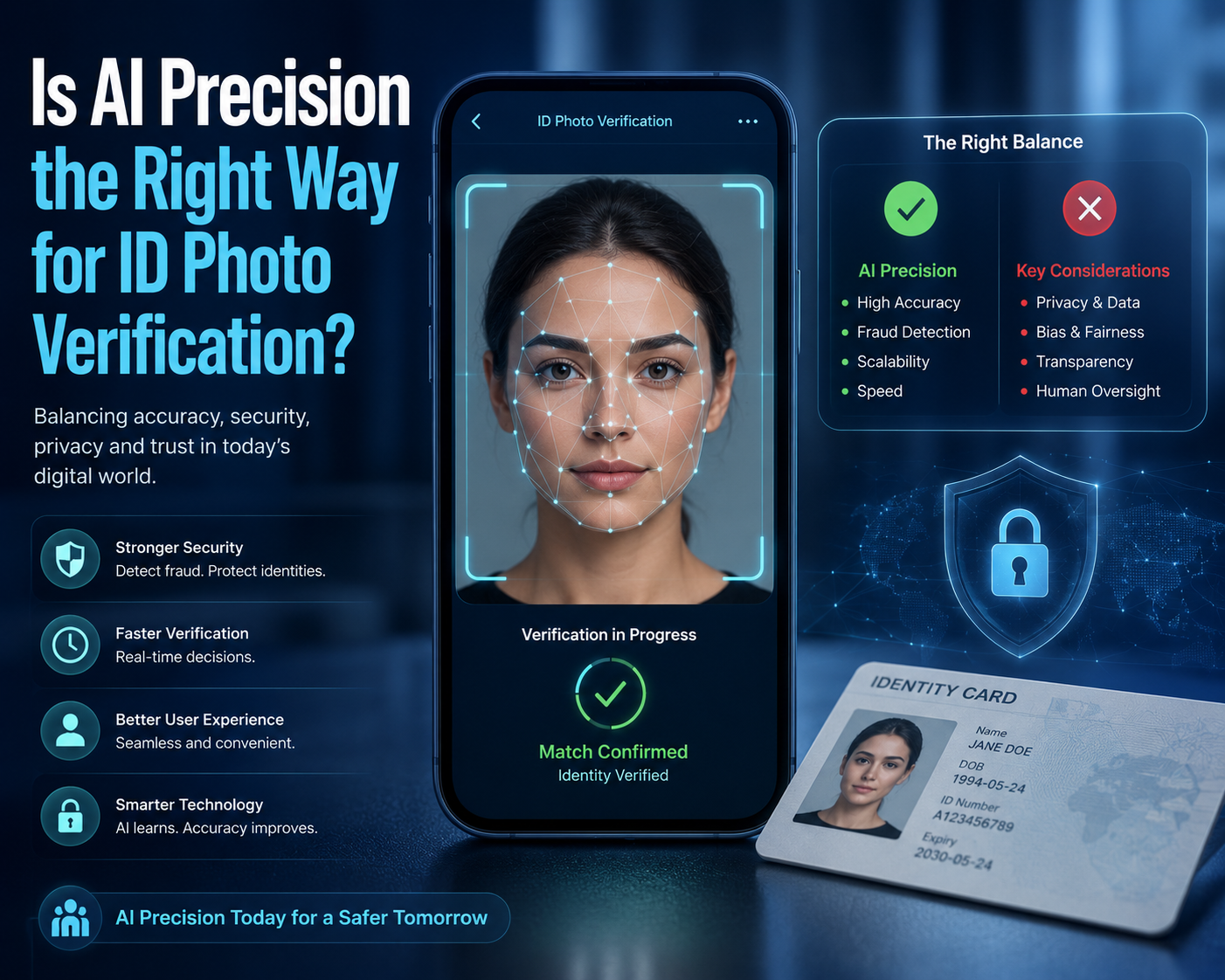
Is AI Precision the Right Way for ID Photo Verification?
Artificial intelligence has transformed nearly every aspect of digital identity verification. From opening online bank accounts to verifying identities for remote employment, AI-powered ID photo verification has become an essential component of modern security systems. Organizations increasingly rely on advanced algorithms to compare identification documents with live selfies, detect fraudulent documents, and verify that a real person is present during authentication.
As cybercrime and identity fraud continue to increase worldwide, businesses need verification solutions that are not only fast but also highly accurate. AI precision has emerged as one of the strongest selling points for modern identity verification platforms. Machine learning models can analyze thousands of facial landmarks within milliseconds while detecting subtle inconsistencies that would often be missed by the human eye.
However, despite impressive technological advancements, many experts continue to ask an important question:
Is AI precision alone the right approach for ID photo verification?
The answer is more nuanced than a simple yes or no. While AI dramatically improves verification speed and fraud detection, relying exclusively on algorithmic precision may introduce concerns regarding privacy, fairness, transparency, and regulatory compliance.
This article explores how AI precision works in ID photo verification, its advantages, limitations, and why the future likely lies in combining artificial intelligence with responsible human oversight.
The Growing Importance of Digital Identity Verification
Digital transformation has fundamentally changed how people interact with organizations. Customers expect to open accounts online, access government services remotely, and complete financial transactions without visiting physical offices.
Industries adopting AI-powered ID verification include:
- Banking
- Financial technology (FinTech)
- Insurance
- Healthcare
- Telecommunications
- Online gaming
- Cryptocurrency exchanges
- E-commerce
- Travel
- Government digital services
Every one of these industries faces the same challenge:
How can they verify that someone truly is who they claim to be?
Traditional manual verification processes are expensive, slow, and vulnerable to human error. Employees may overlook forged documents or struggle to identify sophisticated identity fraud techniques.
Artificial intelligence offers a scalable alternative capable of verifying millions of identities every day.
What Is AI Precision in ID Photo Verification?
AI precision refers to the ability of machine learning models to correctly determine whether an identity document and a submitted facial image belong to the same individual.
Modern AI systems analyze numerous characteristics simultaneously, including:
- Facial geometry
- Eye positioning
- Nose proportions
- Jawline structure
- Ear placement
- Skin texture
- Facial symmetry
- Distance between facial landmarks
- Lighting consistency
- Image quality
Instead of relying on simple image matching, deep neural networks generate mathematical representations—often called face embeddings—that allow two images to be compared with remarkable accuracy.
The closer these representations are, the higher the confidence that both images depict the same person.
How AI-Powered ID Verification Works
Although implementations differ among providers, most AI verification systems follow a similar workflow.
Step 1: Document Capture
The user uploads a photograph of an official identification document such as:
- Passport
- Driver’s license
- National ID card
- Residence permit
The AI evaluates image quality before processing the document.
Step 2: Document Authentication
The system checks whether the document appears genuine by examining:
- Security patterns
- Fonts
- Holograms
- Machine-readable zones (MRZ)
- Barcodes
- Watermarks
- Layout consistency
Advanced AI models can detect manipulated or digitally altered documents with impressive speed.
Step 3: Selfie Capture
Users are asked to take a live selfie.
Many verification platforms also request:
- Head movements
- Smiles
- Blinking
- Turning left and right
- Reading random numbers aloud
These actions help confirm that a real person is present.
Step 4: Facial Comparison
The AI compares:
- The portrait from the ID document
- The live selfie
The software measures hundreds or even thousands of biometric features before calculating a similarity score.
Step 5: Liveness Detection
One of the biggest advances in recent years is AI-based liveness detection.
Rather than simply comparing two photographs, modern systems verify that the submitted selfie comes from a living person rather than:
- Printed photographs
- Computer screens
- Deepfakes
- Video replays
- Masks
This significantly reduces identity fraud.
Why AI Precision Matters
Accuracy directly influences both security and user experience.
If AI precision is too low, organizations experience:
- More fraudulent approvals
- Increased financial losses
- Regulatory risks
- Identity theft
- Customer distrust
If precision is too strict, legitimate users may experience:
- Failed verification attempts
- Delays
- Frustration
- Higher abandonment rates
The ideal AI verification system balances security with convenience.
Benefits of AI Precision for ID Verification
-
Faster Verification
Manual identity verification may take several minutes—or even hours during busy periods.
Modern AI systems frequently complete verification in less than one minute.
This speed improves customer onboarding while reducing operational costs.
-
Improved Fraud Detection
Artificial intelligence can recognize subtle indicators of document tampering that humans often overlook.
Examples include:
- Pixel inconsistencies
- Copy-and-paste artifacts
- Manipulated photographs
- Synthetic identities
- Fake holograms
- Altered expiration dates
Machine learning models continuously improve as they analyze new fraud attempts.
-
Scalability
Large organizations may process hundreds of thousands of identity verifications daily.
Hiring enough trained specialists to review every submission would be impractical.
AI allows organizations to scale globally while maintaining consistent verification standards.
-
Consistent Decision-Making
Human reviewers naturally differ in experience, concentration, and judgment.
AI applies the same verification criteria every time.
This consistency reduces variability in decision-making and helps organizations standardize identity verification processes.
-
Reduced Operational Costs
Automation lowers the need for extensive manual review teams.
Organizations can redirect human specialists toward complex or high-risk cases while allowing AI to handle routine verifications efficiently.
AI Precision Is Not Perfect
Despite impressive advances, AI remains far from infallible.
Several factors can negatively affect verification accuracy, including:
- Poor lighting
- Low-resolution images
- Motion blur
- Facial coverings
- Aging
- Significant hairstyle changes
- Glasses or hats
- Camera quality
- Extreme camera angles
Even highly sophisticated algorithms may occasionally reject legitimate users or accept fraudulent attempts under challenging conditions.
For this reason, leading identity verification providers increasingly combine AI automation with intelligent human review rather than relying solely on machine-generated decisions.
AI Bias: Can Precision Be Fair for Everyone?
While AI has significantly improved identity verification, precision alone does not guarantee fairness. One of the most widely discussed challenges in facial recognition technology is algorithmic bias. AI systems learn from training data, and if that data lacks diversity or contains hidden biases, the resulting models may perform better for some demographic groups than others.
For example, an AI model trained primarily on images from a limited population may struggle to accurately verify individuals with different skin tones, facial structures, or age groups. This can lead to higher false rejection rates for legitimate users, creating frustration and potentially excluding people from essential digital services.
Organizations developing AI-powered verification systems are actively addressing these concerns by:
- Expanding and diversifying training datasets
- Regularly testing models across demographic groups
- Monitoring false acceptance and false rejection rates
- Updating algorithms to reduce unintended bias
- Conducting independent audits and fairness assessments
Fairness is no longer viewed as an optional enhancement—it is a fundamental requirement for trustworthy AI systems.
Privacy: A Critical Consideration in Biometric Verification
Unlike passwords, biometric characteristics cannot easily be changed if compromised. This makes privacy protection a central concern for any organization handling facial images or biometric data.
AI-powered identity verification platforms typically process highly sensitive information, including:
- Government-issued identification documents
- Facial photographs
- Biometric templates
- Personal information
- Device metadata
- Location and timestamp information
Organizations must therefore implement robust safeguards to protect this data from unauthorized access, misuse, or breaches.
Key privacy measures include:
- End-to-end encryption
- Secure cloud or on-premises storage
- Data minimization practices
- Role-based access controls
- Limited data retention periods
- Automatic deletion of unnecessary biometric data
Many leading providers also offer verification processes where biometric templates are encrypted or stored separately from personally identifiable information, reducing the impact of potential security incidents.
Compliance with Global Privacy Regulations
Regulatory compliance has become one of the defining factors in selecting an AI identity verification solution.
Depending on the region and industry, organizations may need to comply with regulations such as:
- General Data Protection Regulation (GDPR)
- Anti-Money Laundering (AML) requirements
- Know Your Customer (KYC) regulations
- eIDAS 2.0 (European Digital Identity Framework)
- California Consumer Privacy Act (CCPA)
- Personal Information Protection and Electronic Documents Act (PIPEDA)
- ISO/IEC security standards
These frameworks generally require organizations to:
- Collect only necessary personal data
- Clearly inform users how data will be used
- Obtain appropriate consent where required
- Protect biometric information with strong security measures
- Allow individuals to exercise their privacy rights
- Maintain accountability for automated decision-making
Compliance is not merely a legal obligation—it also strengthens customer confidence in digital identity services.
The Growing Threat of Deepfakes
The rapid advancement of generative AI has introduced a new challenge for identity verification: deepfakes.
Deepfake technology can create highly realistic synthetic images and videos that imitate real people. As these tools become more accessible, fraudsters are increasingly attempting to bypass identity verification systems using AI-generated faces or manipulated videos.
Common attack methods include:
- AI-generated profile photos
- Video replay attacks
- Face-swapping technology
- Synthetic identities
- Digitally altered identification documents
These sophisticated attacks require equally advanced defenses.
AI Versus AI: Fighting Synthetic Identity Fraud
Ironically, one of the strongest defenses against AI-generated fraud is artificial intelligence itself.
Modern verification systems increasingly use multiple AI models working together to identify signs of manipulation. These systems analyze subtle indicators that humans may never notice, such as:
- Inconsistent lighting reflections
- Abnormal skin textures
- Irregular eye movements
- Frame-by-frame video anomalies
- Compression artifacts
- Digital editing traces
Advanced liveness detection further strengthens security by requiring users to perform dynamic actions that are difficult for prerecorded videos or static images to replicate.
Rather than relying on a single verification signal, many platforms combine several layers of analysis to improve resilience against evolving fraud techniques.
Human Expertise Still Matters
Despite remarkable progress in AI precision, fully automated identity verification is not always appropriate.
Experienced human reviewers remain valuable for handling situations such as:
- Low-quality document images
- Edge cases with ambiguous results
- Potential identity theft investigations
- Unusual or unfamiliar document formats
- Appeals following failed verification attempts
- High-value or high-risk transactions
Human specialists can consider contextual information, exercise judgment, and identify nuances that automated systems may overlook.
For this reason, many organizations adopt a human-in-the-loop approach. In this model:
- AI performs the initial verification.
- Low-risk cases are processed automatically.
- Borderline or high-risk cases are escalated to trained reviewers.
- Human feedback helps improve future AI performance.
This hybrid strategy combines the speed of automation with the discernment of human expertise.
Measuring AI Precision
Organizations evaluating identity verification solutions often look beyond simple accuracy claims. Several performance metrics provide a more complete picture:
False Acceptance Rate (FAR)
The percentage of fraudulent users incorrectly accepted as legitimate.
A lower FAR indicates stronger protection against identity fraud.
False Rejection Rate (FRR)
The percentage of legitimate users incorrectly rejected.
A lower FRR contributes to a smoother customer experience.
Equal Error Rate (EER)
The point at which FAR and FRR are equal.
A lower EER generally reflects better overall biometric performance.
Verification Speed
The time required to complete an identity verification process.
Fast verification improves customer satisfaction while supporting high-volume operations.
Liveness Detection Accuracy
The system’s ability to distinguish a live person from spoofing attempts such as printed photos, video replays, masks, or deepfakes.
Evaluating these metrics together provides a more balanced assessment than focusing on precision alone.
Building Trust Through Transparency
As AI becomes more integrated into identity verification, transparency plays an increasingly important role.
Users are more likely to trust verification systems when organizations clearly communicate:
- Why biometric data is collected
- How facial images are processed
- How long information is retained
- Who can access the data
- How automated decisions are made
- What options exist if verification fails
Providing understandable privacy notices, accessible support channels, and clear appeal mechanisms can improve user confidence and demonstrate accountability.
Industry Applications
AI-powered ID photo verification is now widely used across sectors, each with its own security and compliance requirements.
Banking and Financial Services
Banks use AI verification during customer onboarding to meet AML and KYC obligations while reducing fraud.
Healthcare
Healthcare providers verify patient identities before granting access to sensitive medical records or telemedicine services.
Travel and Hospitality
Airlines and border control agencies increasingly employ biometric verification to streamline passenger processing while maintaining security.
E-Commerce and Marketplaces
Online platforms verify sellers and buyers to reduce account fraud and build trust within digital marketplaces.
Telecommunications
Mobile network operators use identity verification to activate SIM cards, helping prevent identity theft and comply with regulatory requirements.
These examples illustrate how AI precision supports secure digital interactions across a wide range of industries.
The Future of AI-Powered ID Photo Verification
Artificial intelligence continues to evolve at an extraordinary pace, and identity verification technologies are advancing alongside it. Future verification platforms will likely move beyond simple facial comparisons and adopt a more comprehensive approach to digital identity.
Emerging innovations are expected to include:
- Continuous identity verification throughout a user session
- Passive authentication with minimal user interaction
- Enhanced AI models capable of detecting increasingly sophisticated fraud
- Privacy-preserving biometric technologies
- Improved interoperability with digital identity wallets
- Greater explainability in AI-driven decision-making
Rather than replacing existing security measures, these innovations will complement them, creating layered defenses that improve both security and user experience.
Beyond Facial Recognition: Multimodal Biometrics
Although facial recognition remains the most widely adopted biometric technology for online identity verification, many experts believe the future lies in multimodal biometrics.
Instead of relying on a single biometric trait, multimodal systems combine multiple forms of authentication, such as:
- Facial recognition
- Fingerprint verification
- Voice recognition
- Iris scanning
- Behavioral biometrics
- Device intelligence
- Location analysis
- Risk-based authentication
Combining multiple signals makes identity fraud significantly more difficult while reducing reliance on any single verification method.
For example, if facial recognition produces an uncertain result due to poor lighting or camera quality, additional biometric or contextual signals can help confirm the user’s identity without unnecessarily rejecting legitimate customers.
Explainable AI Will Become Increasingly Important
As AI systems play a greater role in identity verification, regulators and users alike are demanding greater transparency.
Traditionally, many AI models have operated as “black boxes,” providing decisions without clear explanations. However, organizations increasingly need to understand why a verification was accepted, rejected, or flagged for review.
Explainable AI (XAI) seeks to address this challenge by providing insights into the factors influencing automated decisions. While protecting system security, explainability can help organizations:
- Improve internal auditing
- Meet regulatory expectations
- Identify model weaknesses
- Reduce bias
- Build greater customer trust
Transparency is likely to become a defining feature of next-generation identity verification platforms.
Best Practices for Organizations
Organizations implementing AI-powered ID photo verification should focus on more than technological performance alone. A comprehensive strategy includes governance, privacy, security, and user experience.
Recommended best practices include:
-
Combine AI with Human Oversight
Use AI for routine verifications while escalating uncertain or high-risk cases to trained specialists.
-
Continuously Monitor Model Performance
Regularly evaluate false acceptance rates, false rejection rates, demographic performance, and emerging fraud patterns.
-
Protect Biometric Data
Encrypt sensitive information, minimize data retention, and implement strong access controls to safeguard personal information.
-
Stay Current with Regulations
Review applicable privacy, identity verification, and financial compliance requirements as regulations evolve across jurisdictions.
-
Educate Users
Clearly explain the verification process, why biometric information is needed, and how personal data is protected. Transparent communication can improve both trust and completion rates.
-
Test Against Emerging Threats
Conduct ongoing security testing using realistic fraud scenarios, including deepfakes, synthetic identities, and document manipulation techniques, to ensure verification systems remain resilient.
Frequently Asked Questions (FAQ)
Is AI more accurate than manual ID verification?
In many routine verification scenarios, AI can process identity checks more quickly and consistently than manual review. However, complex or ambiguous cases often benefit from human expertise. A hybrid approach that combines AI automation with trained reviewers is widely considered the most effective strategy.
Can AI detect fake identification documents?
Yes. Modern AI systems analyze document layouts, security features, fonts, holograms, machine-readable zones, and image integrity to identify signs of forgery or manipulation. Their effectiveness depends on the quality of the algorithms and the sophistication of the fraudulent document.
What is liveness detection?
Liveness detection is a security technique used to verify that a real, present person—not a photograph, video replay, mask, or AI-generated image—is completing the verification process. It is a key defense against presentation attacks and deepfake fraud.
Does AI store facial images permanently?
Not necessarily. Data retention practices vary by provider and organizational policy. Many systems retain biometric information only for as long as necessary to complete verification or meet legal obligations. Strong privacy controls and transparent retention policies are essential.
Can AI eliminate identity fraud?
No technology can eliminate fraud entirely. AI significantly strengthens fraud prevention by detecting suspicious patterns and automating verification at scale, but determined attackers continually develop new techniques. Effective fraud prevention combines AI, human oversight, layered security, and ongoing monitoring.
Is AI verification compliant with privacy regulations?
It can be, provided organizations implement appropriate safeguards and comply with applicable regulations such as GDPR, AML/KYC requirements, and other regional privacy laws. Compliance depends not only on the technology but also on how it is deployed and managed.
Final Thoughts: Is AI Precision the Right Way for ID Photo Verification?
AI precision has fundamentally transformed digital identity verification, enabling organizations to verify users faster, more consistently, and at greater scale than ever before. From reducing onboarding times to detecting sophisticated document fraud, artificial intelligence has become an indispensable tool in the fight against identity-related crime.
However, precision alone should not be viewed as the sole measure of a successful identity verification system.
Trustworthy verification requires a balanced approach that incorporates security, privacy, fairness, transparency, and regulatory compliance. Organizations must recognize that even highly accurate AI models can encounter challenging situations involving poor image quality, demographic diversity, or rapidly evolving fraud techniques.
The most effective identity verification solutions therefore combine advanced AI capabilities with thoughtful human oversight, strong governance, and continuous model improvement. This layered approach not only enhances fraud prevention but also helps ensure legitimate users are treated fairly and their personal information is protected.
Looking ahead, innovations such as multimodal biometrics, explainable AI, privacy-enhancing technologies, and increasingly sophisticated liveness detection are expected to further strengthen digital identity ecosystems. As these technologies mature, organizations that prioritize responsible AI deployment will be best positioned to deliver secure, seamless, and trustworthy verification experiences.
Ultimately, the question is not whether AI precision is the right way for ID photo verification—it is how AI precision can be integrated responsibly within a broader framework of security, ethics, and human accountability. When supported by robust privacy protections and transparent governance, AI has the potential to redefine digital trust for businesses and individuals alike.