
Why Companies Should Include Good Age Verification Software in Their Business Procedures
Digital transformation has changed how companies interact with customers. From e-commerce and online entertainment to dating platforms, gaming services, social communities, marketplaces, and digital content providers, businesses increasingly offer products and services that can be accessed remotely and around the clock.
This convenience creates enormous opportunities, but it also introduces an important responsibility: companies need to know whether their users are legally permitted to access specific products, services, or content.
For businesses operating in age-restricted markets, relying on a simple checkbox that asks users to confirm their age is no longer necessarily sufficient. A professional age verification software solution can provide a more structured and reliable approach to determining whether a user meets a required age threshold.
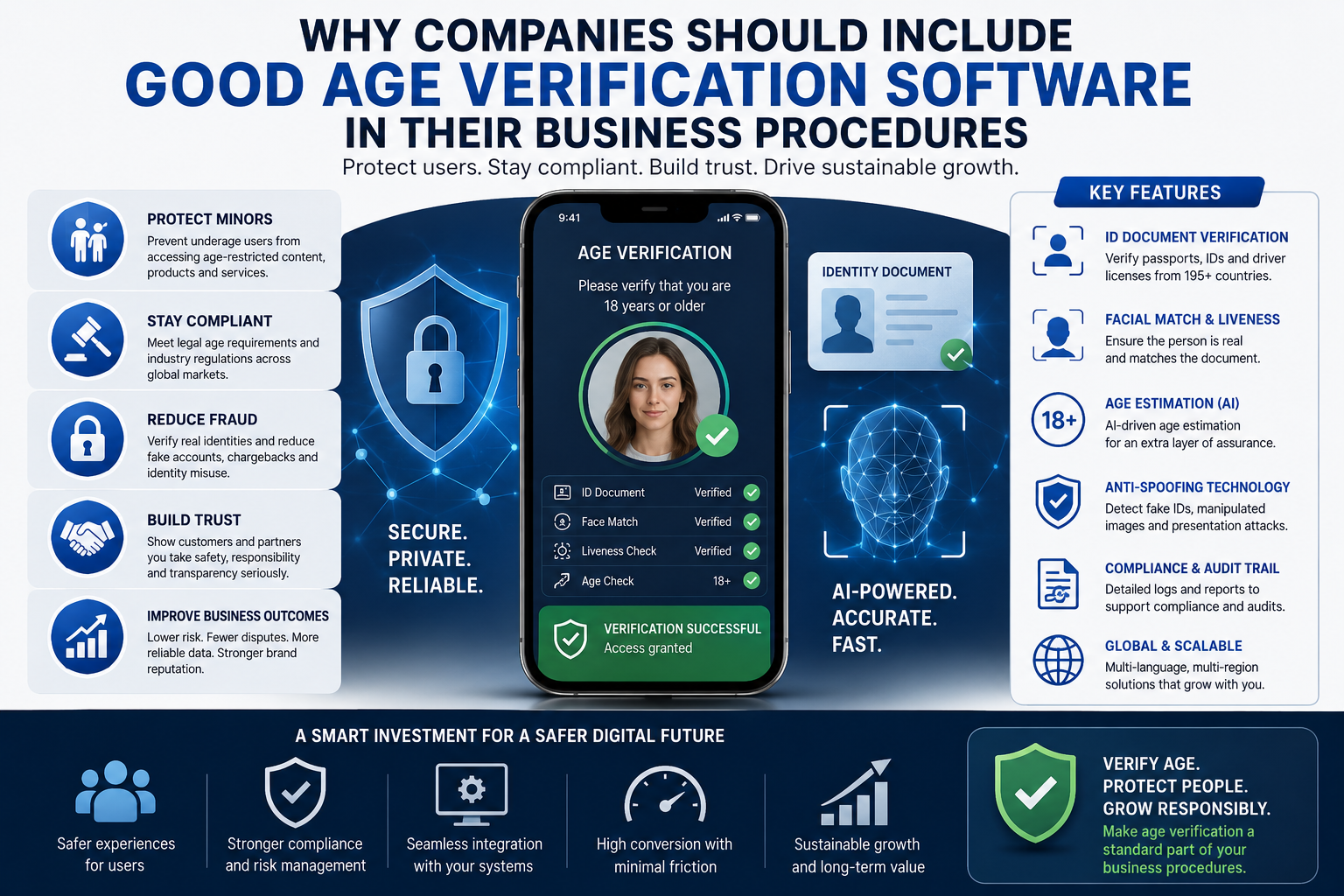
The purpose of age verification is not simply to create another obstacle during registration. Properly implemented, it can help companies protect minors, reduce fraudulent access, support regulatory compliance, improve platform safety, and strengthen customer trust.
As digital services continue to expand, integrating effective age verification into standard business procedures is becoming an increasingly strategic decision.
What Is Age Verification Software?
Age verification software is technology designed to determine whether an individual meets a specified age requirement.
Depending on the business model, technology, jurisdiction, and risk level, age verification can involve different methods.
These may include:
- Date-of-birth verification
- Identity document verification
- Database or identity checks
- Biometric analysis
- Facial age estimation
- Selfie verification
- Liveness detection
- Identity matching
- Digital identity solutions
- Multi-factor verification
A basic system might verify information supplied by a customer, while a more advanced solution can compare information from an identity document with a selfie or use biometric technologies to establish that the person attempting to access a service is a real individual.
The appropriate method depends on the company’s specific requirements.
The key principle is that businesses should select a verification process that provides an appropriate level of assurance without creating unnecessary friction for legitimate customers.
Why Age Verification Has Become a Business Priority
The internet has made it possible for users of almost any age to access digital services.
From a business perspective, this presents a significant challenge when certain products, services, or content are intended only for adults or specific age groups.
A platform may have strong terms and conditions stating that users must be over a particular age. However, a policy alone does not necessarily prevent someone from entering a false date of birth.
This creates a gap between declared age and verified age.
Age verification software can help reduce this gap.
Rather than simply asking a user to state their age, businesses can implement technology that provides a higher level of confidence in the user’s eligibility.
This is particularly important for companies that operate in industries where access restrictions, consumer protection, or age-related legal obligations are important parts of their risk management strategy.
Protecting Minors in Digital Environments
One of the most important reasons to implement age verification is the protection of minors.
Children and teenagers increasingly use smartphones, social networks, online marketplaces, gaming services, streaming platforms, and other digital products.
Not every online service is appropriate for every age group.
Companies therefore need mechanisms that help prevent minors from accessing services or content that are not intended for them.
A well-designed age verification system can act as an additional layer of protection.
It can be used during registration, before accessing restricted content, before purchasing age-restricted products, or at another appropriate stage of the customer journey.
Age verification should not be viewed as a complete solution to online child safety. It is one component of a broader safety strategy that may also include parental controls, content moderation, reporting mechanisms, user education, privacy protections, and responsible platform design.
Nevertheless, it can be an important technical control.
Age Verification Versus a Simple Age Declaration
Many websites have traditionally relied on a simple question:
“Are you over 18?”
The user selects “Yes” and continues.
Although this approach is easy to implement, it relies almost entirely on user honesty.
A person who wants to access restricted content can simply provide a false date of birth or select the appropriate confirmation button.
This means that an age declaration is fundamentally different from age verification.
An age declaration asks the user to state their age.
Age verification attempts to establish whether that claim is credible using additional information or technology.
The appropriate solution depends on the company’s risk profile and applicable requirements, but businesses should understand this distinction when designing their procedures.
Supporting Regulatory and Compliance Procedures
Age-related requirements can be an important part of compliance for businesses operating in regulated or age-restricted sectors.
Companies may need to demonstrate that they have taken appropriate steps to prevent unauthorized access to certain products, services, or content.
Age verification software can become part of the organization’s broader compliance framework.
It can provide structured workflows, verification results, timestamps, risk assessments, and other records that may support internal compliance processes, subject to applicable privacy and data-retention requirements.
However, companies should avoid assuming that installing an age verification tool automatically makes them compliant.
Technology is only one component of compliance.
Businesses should understand the laws and regulations applicable to their particular industry and markets, establish appropriate internal procedures, and obtain professional legal advice where necessary.
The software should then support those procedures.
Reducing Fraud and False Information
Age verification can also help address fraud.
Online businesses frequently encounter inaccurate or deliberately manipulated customer information.
Users may attempt to create accounts using false dates of birth, another person’s identity, or manipulated documents.
Advanced verification systems can combine different signals to identify suspicious activity.
For example, document verification can analyze an identity document, while biometric or selfie-based technology can help determine whether the person presenting the document is actually the person associated with it.
This can create a stronger verification process than relying on manually entered information alone.
For businesses, the benefit goes beyond age control.
Better verification can contribute to a broader identity and fraud-prevention strategy.
The Role of AI in Modern Age Verification
Artificial intelligence is increasingly influencing digital verification technologies.
AI and computer vision can analyze identity documents, facial characteristics, images, and other signals.
For example, facial age estimation technologies can attempt to estimate whether a person appears to be above a defined age threshold.
Other systems may use AI to analyze document characteristics or detect signs of manipulation.
However, companies should be careful when evaluating AI-based age verification.
No AI system should be treated as infallible.
Age estimation is inherently probabilistic, and accuracy can vary according to factors such as image quality, lighting, demographics, and the specific technology being used.
For higher-risk scenarios, businesses may therefore combine different verification mechanisms rather than relying on a single AI prediction.
This can create a layered approach to digital age assurance.
A Layered Approach to Age Verification
A strong age verification strategy does not necessarily depend on one technology.
Instead, businesses can create different verification levels based on risk.
For example:
Low-risk access: A basic age declaration may be sufficient where legally appropriate.
Moderate-risk access: Additional age estimation or identity-related verification may be introduced.
High-risk or regulated access: Document verification, identity matching, biometric checks, and additional controls may be appropriate.
This type of risk-based architecture allows companies to balance security with customer experience.
Not every customer necessarily needs the same level of verification.
The objective should be to apply proportionate controls based on the nature of the service and the associated risks.
Improving Customer Trust
Trust is one of the most valuable assets a digital business can have.
Customers want to know that companies take security and responsible business practices seriously.
A visible and well-designed age verification process can communicate that a company is actively trying to prevent unauthorized access.
This can be particularly important for businesses operating in sensitive industries.
Customers may be more comfortable using a platform when they know that the company has implemented structured safeguards.
However, the verification experience needs to be designed carefully.
A process that is unnecessarily complicated, slow, or confusing can discourage legitimate customers.
The best solutions therefore aim to combine security with convenience.
Age Verification and Customer Experience
One of the biggest challenges for companies is finding the right balance between security and usability.
If verification requires too many steps, customers may abandon the registration or purchasing process.
If verification is too weak, the company may not achieve its intended level of protection.
Modern age verification software can help address this challenge by automating much of the process.
Instead of requiring users to communicate with a human employee, a digital workflow can guide them through the necessary steps.
Depending on the solution, customers may be able to upload an identity document, take a selfie, complete an automated verification process, and receive a result within a relatively short period.
Automation can make verification both scalable and efficient.
The Importance of Privacy by Design
Age verification involves potentially sensitive personal information.
This makes privacy an essential consideration.
Companies should carefully evaluate what information is collected, why it is needed, how long it is retained, who can access it, and how it is protected.
A strong age verification solution should support data minimization wherever possible.
In some situations, the company may only need confirmation that a customer has reached a particular age threshold rather than storing extensive identity information.
For example, the business may need to know that a customer is over 18 rather than maintaining a copy of the person’s identity document indefinitely.
Privacy-conscious architecture can therefore reduce unnecessary data exposure.
Companies should also consider applicable data protection laws and their obligations regarding personal data.
Preventing Fake or Manipulated Verification Attempts
Another reason to invest in professional age verification software is the growing sophistication of digital manipulation.
Artificial intelligence can be used to create convincing fake images, synthetic identities, manipulated documents, and other forms of deceptive digital content.
This creates new challenges for businesses.
A basic visual check may no longer be enough in higher-risk environments.
Modern verification systems can incorporate techniques designed to detect suspicious documents, manipulated images, inconsistent information, and signs of spoofing.
Liveness detection can also help distinguish a live person from a static photograph or certain types of presentation attacks.
As digital fraud evolves, verification technology will need to evolve with it.
Integrating Age Verification Into Existing Business Procedures
Age verification should not exist as an isolated technical feature.
Companies should integrate it into their broader business processes.
For example, an organization can define:
- When age verification is required.
- Which customers must complete verification.
- Which verification method is appropriate.
- What happens when verification succeeds.
- What happens when verification fails.
- How suspicious cases are escalated.
- How customer information is protected.
- How verification results are monitored.
- How the system is tested.
- How procedures are updated when requirements change.
This creates a structured operating model rather than simply adding a verification button to a website.
Human Oversight Still Matters
Automation can dramatically improve the efficiency of age verification, but human oversight remains valuable.
There will always be edge cases.
A document may be damaged. A customer’s image may be unclear. An automated system may produce an uncertain result. A legitimate customer may experience a technical problem.
Businesses should therefore have procedures for handling exceptions.
Human review can provide an escalation path when automated verification cannot confidently determine the appropriate outcome.
This is particularly important when verification decisions can have significant consequences for customers.
The strongest model is often automation with appropriate human oversight.
Scaling Age Verification Across Markets
International businesses face another challenge: different markets can have different requirements, identity documents, customer expectations, and regulatory environments.
A scalable age verification platform should therefore support an organization’s growth rather than forcing it to create completely separate processes for every market.
Businesses should evaluate whether their chosen solution supports relevant document types, languages, verification methods, and regional requirements.
Scalability is particularly important for companies planning international expansion.
A verification solution that works for a few thousand customers may not be sufficient when the company grows to millions of users.
Age Verification for Different Industries
The relevance of age verification extends across many sectors.
E-Commerce
Online retailers may need to restrict the purchase of age-restricted products.
Online Entertainment
Certain digital content may be intended only for adults.
Gaming
Some gaming products and services may require age-related controls.
Dating Platforms
Age verification can help platforms establish that users meet minimum age requirements.
Online Marketplaces
Marketplaces can use age verification alongside seller verification and content moderation.
Social Platforms
Age assurance can support broader child-safety and access-control strategies.
Financial and Digital Services
Certain services may use age and identity checks as part of broader customer onboarding procedures.
The exact requirements differ considerably, but the underlying principle is similar: businesses need appropriate mechanisms to manage age-related access.
Measuring the Success of an Age Verification System
Companies should not simply install age verification software and assume the project is complete.
Performance should be monitored.
Useful metrics may include:
- Verification completion rates
- Customer abandonment rates
- Verification processing time
- False rejection rates
- Manual review rates
- Fraud detection rates
- Successful verification rates
- Customer support requests
- System availability
- Security incidents
Monitoring these indicators helps businesses identify weaknesses and improve the customer journey.
A successful age verification system should provide meaningful protection without unnecessarily preventing legitimate customers from accessing services.
Choosing the Right Age Verification Software
Businesses should carefully evaluate potential providers before implementing a solution.
Important considerations include:
Accuracy: How reliably can the technology establish age or identity?
Security: How is customer information protected?
Privacy: Does the solution support data minimization and appropriate data handling?
Scalability: Can it handle the company’s expected growth?
Integration: Can it connect with existing registration, payment, CRM, or identity systems?
User experience: Is the verification process easy for legitimate customers?
Fraud resistance: Can the technology address spoofing, manipulated documents, and other fraudulent attempts?
Reporting: Does the system provide useful verification records and operational insights?
Flexibility: Can verification workflows be adapted to different business requirements?
These questions can help companies select technology based on actual business needs rather than marketing claims alone.
The Strategic Value of Age Verification
Age verification should not be regarded merely as a compliance expense.
It can become an important part of a company’s overall trust and safety strategy.
A robust verification process can help reduce unauthorized access, support customer protection, improve fraud prevention, and demonstrate that the organization takes responsible digital operations seriously.
For companies operating in competitive digital markets, trust can become a genuine differentiator.
Customers are more likely to remain loyal to platforms that provide a secure and reliable experience.
At the same time, businesses can benefit from reducing the operational consequences associated with fraudulent accounts, inappropriate access, and preventable security problems.
Conclusion: Age Verification Is Becoming a Core Business Procedure
As more products and services move online, businesses need increasingly sophisticated methods to determine who can access what they offer.
A simple age declaration may be insufficient for higher-risk environments. Age verification software can provide a more structured approach by combining technologies such as identity verification, document analysis, biometric checks, liveness detection, and AI-powered age estimation.
The objective is not to make digital services unnecessarily complicated.
The objective is to create an appropriate balance between security, compliance, privacy, customer experience, and business efficiency.
Companies that integrate age verification into their business procedures can establish stronger safeguards for minors, reduce certain types of fraud, support responsible access management, and strengthen trust among customers and business partners.
The future of digital business will increasingly depend on the ability to establish trust remotely. Companies that treat age verification as an integrated component of their trust and safety strategy—not simply as an isolated technical feature—will be better prepared to operate responsibly in an increasingly digital economy.
Ultimately, good age verification software is not just about determining whether someone is old enough. It is about creating a safer, more trustworthy, and more responsible digital environment in which businesses can grow while customers can interact with online services with greater confidence.