
Community Check with airis:ident: Guess the age by Photo. How Age Estimation by Photo Can Support Safer Online Communities
Introduction: Why Community Checks Are Becoming More Important
Online communities are growing at an extraordinary pace. Social platforms, dating services, marketplaces, forums, gaming communities, classified advertising portals, creator platforms, and user-generated-content websites all depend on one essential factor: trust.
People want to know that the individuals they interact with are genuine, that community rules are respected, and that the platform takes user safety seriously. At the same time, operators need practical tools that can help them identify risks without making registration and verification unnecessarily complicated.
This is where modern community check solutions can play an important role.
A community check can combine different forms of automated analysis to help platforms identify suspicious accounts, detect potentially inappropriate content, and improve confidence in the users participating in a digital environment. One increasingly discussed capability is age estimation by photo.
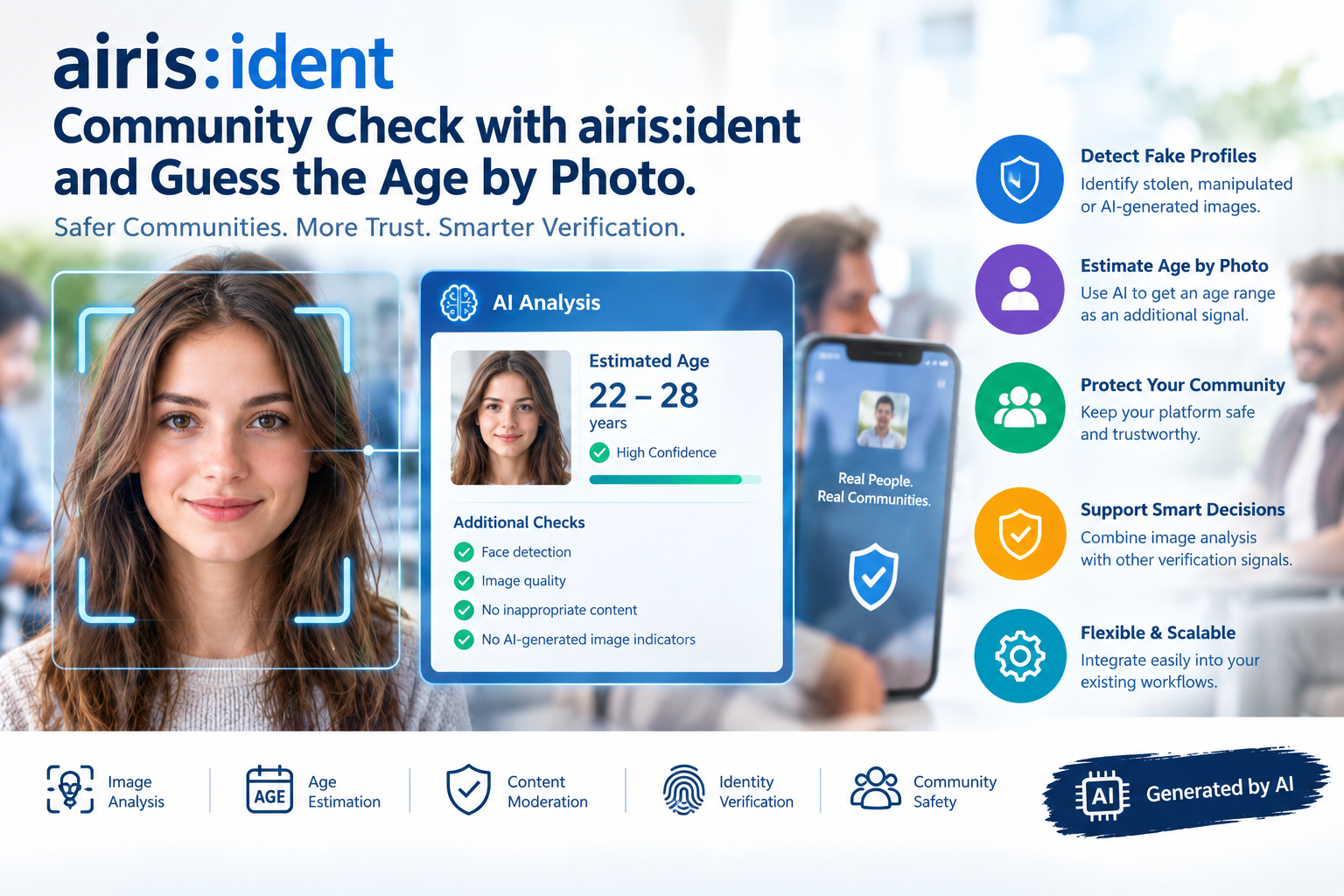
With technologies such as airis:ident, a platform can potentially use a submitted photograph as one signal in a broader user-verification workflow. Instead of relying exclusively on a username, email address, or self-declared date of birth, an AI-supported system can analyze visual information and provide an estimated age range or an indication of whether additional verification may be appropriate.
The important distinction is that guessing or estimating age by photo is not the same as proving age. A responsible community check should use age estimation as a supporting risk signal and, where necessary, combine it with stronger verification methods.
The result can be a more intelligent, scalable, and user-friendly approach to online community safety.
What Is a Community Check?
A community check is a structured process designed to assess whether users, profiles, images, and other forms of submitted content are appropriate for participation in a digital community.
Traditional community management often depends heavily on manual review. Moderators inspect profiles, respond to reports, and investigate suspicious accounts after problems occur.
However, this reactive approach becomes increasingly difficult as a platform grows.
A modern community check can introduce automated technology before, during, and after registration.
Depending on the platform, a community check can include:
- Profile photo analysis
- Image moderation
- Identity verification
- Age estimation
- Document verification
- Duplicate image detection
- Fake profile detection
- AI-generated image detection
- Content safety screening
- Risk-based review workflows
The objective is not necessarily to reject users automatically. Instead, automated checks can help platforms identify situations that require additional attention.
This creates an important principle for modern trust and safety:
Use automation to identify risk, and use appropriate verification or human review when certainty is required.
Why Age Matters in Online Communities
Age can be relevant to many online services.
Different platforms have different audiences, legal obligations, business models, and community policies. Some services are designed specifically for adults, while others need to maintain different experiences or restrictions for younger users.
Accurate knowledge about age can therefore be relevant to:
- Dating platforms
- Social communities
- Gaming services
- Online marketplaces
- Creator platforms
- Digital entertainment services
- Forums
- Membership websites
- Age-restricted services
The challenge is that many websites still rely on self-declared information.
A user may simply enter a date of birth during registration.
That information may be correct. But it may also be inaccurate, outdated, or intentionally falsified.
This is why many businesses are exploring additional mechanisms for a more reliable community check.
Photo-based age estimation is one such mechanism.
What Does “Guess the Age by Photo” Actually Mean?
The phrase “guess the age by photo” describes a technological process in which artificial intelligence analyzes visual characteristics in an image and generates an estimated age or age range.
For example, a system might analyze a face and determine that the individual visually appears to fall within a broad range such as:
- Under approximately 18
- Approximately 18–24
- Approximately 25–34
- Approximately 35–44
- 45+
The exact categories depend on the technology and its intended use.
It is important to understand that this is an estimate, not a guaranteed fact.
Human appearance varies significantly. People of the same chronological age can look very different, while people from different age groups can appear visually similar.
Lighting, image quality, camera angle, facial expression, makeup, hairstyle, and image processing can also affect the result.
For this reason, age estimation should be treated as one component of a broader verification strategy.
How airis:ident Can Fit Into a Community Check Strategy
airis:ident can be positioned as part of an intelligent digital verification workflow where images and identity-related signals are analyzed to support trust and safety.
A potential community check process could begin when a user uploads a profile photograph.
The system can then analyze the image and identify relevant characteristics, depending on the configured workflow.
For example, an automated process could evaluate:
- Whether a recognizable face is present.
- Whether the image appears suitable for the intended verification process.
- Whether the photograph may require additional review.
- Whether the visual information provides an age-related signal.
- Whether additional identity or age verification should be requested.
This approach can be valuable because it introduces a risk-based decision layer.
Rather than treating every user identically, platforms can potentially identify situations where stronger verification is appropriate.
That can improve both safety and user experience.
The Difference Between Age Estimation and Age Verification
This distinction is critical.
Age estimation asks:
“How old does this person appear to be based on the available image?”
Age verification asks:
“Can we establish that this person meets a defined age requirement with sufficient evidence?”
These are not the same question.
A photo-based estimate may be useful for screening, triage, or risk scoring. However, where a platform requires reliable proof of age, additional verification may be necessary.
A sophisticated community check workflow can therefore use age estimation as an early-stage signal.
For example:
Low-Risk Case
The estimated age appears comfortably above the platform’s threshold. The user can continue, subject to the platform’s normal policies.
Uncertain Case
The image produces an ambiguous age estimate. The system requests additional information or verification.
High-Risk Case
The system indicates that the user may not meet the required age threshold. The platform can trigger a stronger verification process or restrict access according to its policies.
This layered model is generally more practical than relying on one automated prediction.
Why Photo-Based Community Checks Can Improve User Experience
Verification systems often create friction.
Users may abandon registration if they are asked to complete a lengthy process before understanding the value of a service.
A photo-based community check can potentially create a smoother first step. The user may simply provide a suitable photograph, and automated analysis can determine whether additional verification is necessary.
This supports a principle that is becoming increasingly important in digital product design:
Risk should determine friction.
Users who present low-risk signals may experience a fast onboarding process.
Users or situations requiring greater confidence can be routed into enhanced verification. This can help businesses balance:
- Safety
- Conversion
- User experience
- Operational efficiency
- Compliance requirements
A community check should not automatically mean a complicated registration process. Instead, intelligent automation can help make verification more proportional to risk.
Protecting Communities Against Fake Profiles
Fake profiles are among the biggest trust challenges faced by online communities.
A fraudulent account can use:
- A stolen photograph
- A manipulated photograph
- An AI-generated face
- A celebrity image
- A duplicate profile image
- A fictional identity
These accounts can be used for scams, spam, harassment, impersonation, or social engineering. A community check supported by visual analysis can help identify suspicious profiles earlier.
Age estimation can become one component of this analysis.
For example, a profile may contain a declared age that conflicts significantly with the visual age estimate. That does not automatically prove deception. However, it can create a reason for additional review.
This is an important concept.
The goal is not to accuse someone simply because an algorithm produces an unusual result.
The goal is to identify inconsistency and risk signals that can be investigated appropriately. That makes automated analysis more useful and more responsible.
Combining Photo Analysis with Other Verification Signals
Age estimation becomes considerably more useful when combined with other signals. A robust community check may consider multiple factors rather than relying on a single image.
Potential signals include:
- Self-declared age
- Profile consistency
- Face presence
- Image quality
- Duplicate image detection
- Identity verification
- Document checks
- Liveness checks
- Account behavior
- Content moderation results
For example, imagine an account claiming to belong to a 35-year-old user.
The profile photograph visually appears to correspond to a substantially younger age range. The account also uses an image found across multiple profiles.
No single signal proves fraud. However, the combination of signals may justify additional verification.
This is the power of a risk-based community check.
AI Image Moderation and Age Estimation Together
Age is only one aspect of visual community safety.
A platform may also need to determine whether an image contains inappropriate or prohibited content. This is where AI image moderation services like airisprotect.com complements age estimation.
A photo check can potentially analyze several characteristics simultaneously:
Identity-related Analysis
Does the image contain a human face?
Age-related Analysis
What age range does the person appear to fall into?
Content Analysis
Does the photograph contain inappropriate, violent, or prohibited content?
Authenticity Analysis
Does the image appear manipulated, synthetic, or suspicious?
Duplicate Detection
Has the photograph been used elsewhere on the platform?
Together, these capabilities create a much stronger community protection system than any individual check.
For businesses managing large amounts of user-generated content, combining these technologies can also reduce the volume of manual work.
The Role of Human Moderators in an AI-Supported Community Check
AI can process images quickly, but it should not be treated as infallible. This is particularly important when using age estimation.
An algorithm may make an incorrect prediction because of:
- Poor lighting
- Low image resolution
- Camera distortion
- Facial expression
- Occlusion
- Unusual camera angles
- Differences in appearance
- Dataset limitations
Human review can therefore remain an important component of responsible community management. A good workflow can use artificial intelligence to prioritize cases.
For example:
AI analysis → risk score → automated action or human review → final decision
This allows moderation teams to spend their time on difficult cases rather than reviewing every image manually. The objective is not to eliminate human judgment.
It is to use human judgment where it provides the greatest value.
Privacy Should Be Part of the Community Check Design
Any system that analyzes photographs must take privacy seriously. Users should understand why their photograph is being analyzed and how the information is being used.
A responsible implementation should consider:
- Data minimization
- Appropriate retention periods
- Access controls
- Secure processing
- Clear user information
- Appropriate consent mechanisms
- Transparent policies
Companies should also avoid collecting more information than necessary for their stated purpose. A photo used for an age-related check should not automatically become a permanent identity record.
Privacy-by-design principles can help organizations build trust while still benefiting from AI-supported safety technologies.
Why Estimated Age Should Not Be Presented as Absolute Truth
The phrase “guess the age by photo” can be useful from a marketing perspective, but businesses should communicate carefully about what the technology actually does.
The output is best understood as an estimated age range or visual likelihood, not a definitive declaration of chronological age. This distinction matters for fairness, transparency, and user trust.
For example, a responsible platform should not communicate:
“The AI knows your exact age.”
A more accurate approach would be:
“The system estimates an age range from the submitted photograph and may request additional verification when necessary.”
This type of communication sets realistic expectations. It also makes the technology more defensible as part of a broader trust and safety architecture.
Community Trust as a Competitive Advantage
Online users increasingly evaluate platforms based on safety and trust. A technically advanced service may still struggle if users regularly encounter:
- Fake accounts
- Fraudulent profiles
- Inappropriate content
- Harassment
- Suspicious behavior
A strong community check can help address these challenges.
When users know that a platform actively works to maintain quality and authenticity, they may feel more comfortable interacting with other members.
This can have commercial benefits. Higher trust can support:
- Better user retention
- Improved engagement
- Stronger brand reputation
- Fewer complaints
- More valuable communities
- Lower moderation costs
In this context, identity and age-related checks are not merely compliance functions. They can become part of a platform’s overall product quality.
How Businesses Can Build an Effective Photo-Based Community Check
Businesses should start by defining the exact problem they want to solve.
For example, the objective might be:
- Reduce fake profiles
- Improve age-related risk detection
- Protect adult-only environments
- Improve marketplace trust
- Reduce harmful user-generated content
- Increase confidence in user identity
The technology should then be selected around those objectives.
A potential process could look like this:
Step One: Photo Submission
The user uploads a suitable photograph.
Step Two: Technical Quality Check
The platform checks whether the image is usable for analysis.
Step Three: AI Image Analysis
The image is analyzed for relevant visual signals.
Step Four: Age Estimation
The system provides an estimated age range or confidence indication.
Step Five: Risk Assessment
The platform combines the result with other available signals.
Step Six: Decision
The user is approved, asked for further verification, or routed to review according to the platform’s rules.
Step Seven: Secure Processing
Relevant data is handled according to the platform’s privacy and security requirements.
This structured process provides a clear framework for deploying technologies such as airisident within a broader community safety strategy.
Why airis:ident Can Be Relevant for Modern Digital Platforms
As platforms grow, they need verification technologies that can support automation without unnecessarily damaging the user experience.
airisident can be presented as part of this broader approach to identity-related and image-based checking. Its potential value in a community check strategy lies in the idea of using automated image analysis as an early risk signal.
For a platform, the business question is often not simply:
“Can we identify this person?”
The more practical question can be:
“Which users or interactions require a higher level of trust?”
That shift from absolute identification toward risk-based trust management can help businesses design more flexible verification workflows.
Age estimation by photo can contribute to that process when it is used appropriately and combined with stronger verification mechanisms where needed.
The Future of Community Checks
The future of digital communities will likely involve increasingly sophisticated combinations of AI technologies. A single uploaded photograph may potentially be analyzed for multiple characteristics in real time.
Future community check systems may combine:
- Face detection
- Age estimation
- Image moderation
- Deepfake detection
- AI-generated image detection
- Identity verification
- Liveness detection
- Duplicate profile analysis
- Behavioral risk scoring
The result could be a comprehensive trust layer operating behind the scenes of digital platforms.
For users, this may simply mean a safer and smoother experience.
For businesses, it can mean better scalability and more structured risk management.
The challenge will be ensuring that innovation is balanced with privacy, transparency, fairness, and human oversight.
Conclusion: A Smarter Approach to Community Safety with airis:ident
The growth of digital communities creates enormous opportunities, but it also increases the need for reliable trust and safety mechanisms. A modern community check can help platforms identify suspicious profiles, improve user confidence, reduce harmful activity, and create safer environments.
Age estimation by photo can be a useful component of this process because it provides an additional signal beyond self-declared information. With solutions such as airis:ident, businesses can explore AI-supported approaches to visual checking and user verification.
However, the most responsible strategy is not to treat an estimated age as absolute proof. Instead, age estimation should be viewed as one signal within a layered verification framework.
Combined with image moderation, identity verification, liveness detection, duplicate-image analysis, human review, and appropriate privacy controls, photo-based community checks can become a powerful part of a modern trust and safety strategy.
The central idea is simple:
Better information creates better decisions.
When platforms can identify risk earlier, they can respond more effectively. When users know that a platform actively protects its community, trust can increase.
And when AI handles large volumes of routine checks, human teams can focus on the cases that truly require judgment.
This is why the combination of community check, AI-powered image analysis, airis:ident, and photo-based age estimation represents an increasingly relevant direction for digital trust and safety.
The goal is not to replace human responsibility with artificial intelligence. The goal is to use intelligent technology to create safer, more transparent, and more trustworthy online comm