
Check the Legal Age of Consent to be Safe with German Business: Why Age Verification Matters 2026 and onwards.
Introduction: Understanding the Legal Age of Consent in Germany
Companies operating in Germany must understand the legal requirements that apply to their customers, services, and digital platforms. This is particularly important for businesses offering online dating, adult entertainment, social networking, user-generated content, gaming, and other services where age restrictions may apply.
One important question frequently arises: What is the legal age of consent in Germany, and how can businesses make sure they comply with the relevant laws?
The answer depends on the activity involved. Germany does not have one universal age threshold that automatically determines whether every sexual activity, online service, adult website, or commercial transaction is lawful. Different legal provisions govern sexual consent, the protection of minors, access to pornographic content, and the provision of age-restricted services.
For businesses, understanding these distinctions is essential. A platform that relies exclusively on a user's self-declared date of birth may not have sufficient safeguards for services that require effective age verification. Similarly, an online age-estimation tool should not automatically be treated as equivalent to a legally adequate age-verification procedure.
Germany's youth protection framework includes the Youth Protection Act (Jugendschutzgesetz, JuSchG) and the Interstate Treaty on the Protection of Minors in the Media (Jugendmedienschutz-Staatsvertrag, JMStV). These rules establish requirements relevant to the protection of children and adolescents, including safeguards for certain online content.
The German Criminal Code (Strafgesetzbuch, StGB) also contains provisions concerning sexual abuse, sexual self-determination, and the distribution of pornographic material.
For businesses, the objective should therefore be broader than simply checking whether someone is over a particular age. Companies should establish processes that identify the applicable legal threshold, assess whether a user meets it, protect personal information, and document compliance appropriately.
This article explains the principal distinctions, explores the role of modern age-verification technology, and outlines practical measures that businesses can take to strengthen compliance in Germany.
What Is the Legal Age of Consent in Germany?
The expression age of consent generally refers to the age at which a person can legally consent to sexual activity, subject to applicable legal protections and circumstances.
In Germany, the age of 14 is an important threshold under criminal law. Section 176 of the German Criminal Code addresses sexual abuse of children under 14. However, this does not mean that every sexual situation involving a person aged 14 or older is automatically lawful.
Other provisions continue to protect minors, particularly where coercion, exploitation, dependency, payment, or an inability to exercise sexual self-determination is involved.
Section 182 of the Criminal Code, for example, addresses specific circumstances involving sexual abuse of adolescents under 18. Its provisions include situations involving exploitation of a predicament, sexual acts in exchange for payment, and certain cases involving an adult over 21 and a person under 16 where the younger person's lack of capacity for sexual self-determination is exploited.
The precise application depends on the circumstances and the relevant statutory provisions. Businesses should not simplify these rules into a universal statement that anyone over 14 may legally participate in every sexual activity.
For commercial purposes, a further distinction is essential: the age of consent for sexual activity is not the same as the minimum age for accessing pornographic content.
These are different legal questions and must be addressed separately.
Official legislation is available through Germany's Criminal Code in English and the German statutory text of Section 176 StGB.
Why the Age of 18 Matters for German Businesses
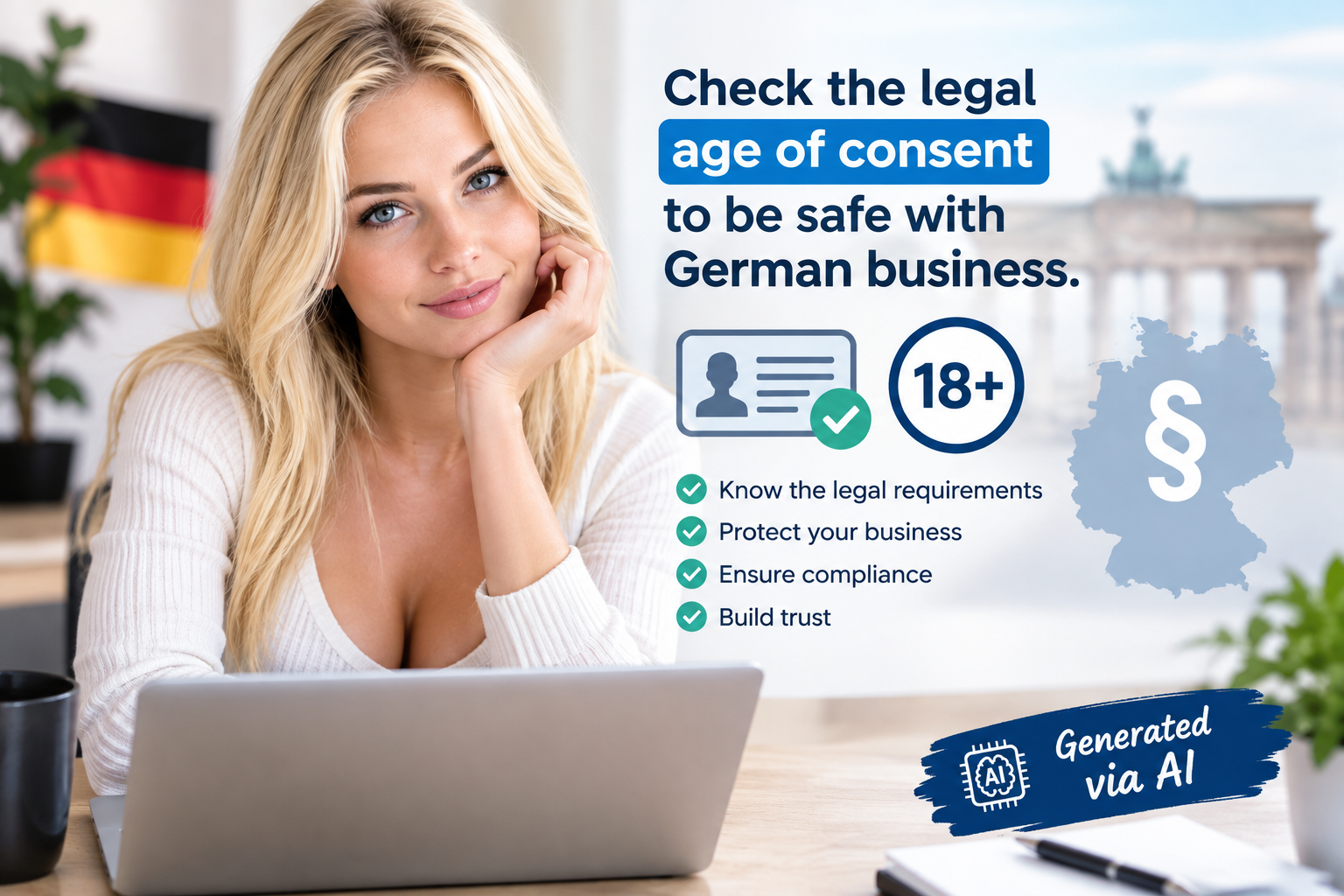
For many companies, particularly adult websites and platforms distributing explicit content, the age of 18 is the critical operational threshold.
German youth media protection rules impose restrictions on access to content that may endanger the development of children and adolescents. Pornographic content is subject to particularly strict requirements.
According to guidance from the media authorities in North Rhine-Westphalia, pornographic content must be made accessible exclusively to adults through closed user groups supported by a suitable age-verification system.
This has direct implications for companies providing adult services to German users.
A website that displays an age confirmation button asking visitors to click “I am 18 or older” should not assume that this alone satisfies all applicable legal requirements.
Depending on the content and service, businesses may need a more robust process that verifies a user's age and restricts access to an appropriate protected environment.
Relevant requirements should be assessed against the current version of the Interstate Treaty on the Protection of Minors in the Media and the particular service being operated.
The official treaty and regulatory information can be found through the German media authorities.
For businesses, the practical message is straightforward: the legal age applicable to a service must be determined before selecting an age-checking solution.
Age Verification Is More Than a Checkbox
Age verification has become a key element of digital compliance. Yet companies use different methods, and these methods provide different levels of assurance.
Understanding the differences helps organizations choose a suitable solution.
Self-declared age
A basic registration form asks users to enter their date of birth or confirm that they are adults.
This method is inexpensive and easy to implement. However, it depends entirely on the information supplied by the user.
A minor can enter an incorrect birth date, and the platform may have no independent evidence that the declared age is accurate.
Self-declaration may serve certain administrative or preliminary purposes, but it should not automatically be regarded as sufficient for services subject to stronger age-verification requirements.
AI-powered age estimation
AI age estimation uses technical analysis to estimate a person's approximate age from a facial image or other permitted input.
Such technology may help identify cases in which a person appears likely to be below a relevant age threshold. Depending on the system and its deployment, it can support risk screening or help determine whether additional verification is necessary.
However, age estimation is not the same as verifying a person's actual date of birth.
An estimated age can be incorrect. Results can be affected by image quality, lighting, camera angle, facial presentation, and differences in model performance across populations.
A responsible business should therefore avoid treating a facial age estimate as definitive proof of legal adulthood unless the method has been specifically assessed and is legally suitable for the intended purpose.
Identity-document verification
Another approach is to verify information from an identity document, such as an identity card or passport, using a suitable verification process.
Depending on the solution, checks may examine document validity, security features, consistency of information, and signs of manipulation.
Document verification can provide stronger evidence than a simple self-declaration, but it also has limitations. Documents may be counterfeit, stolen, expired, or associated with someone other than the person using the service.
Consequently, the process must be designed around the required assurance level and the applicable legal framework.
Layered age verification
A layered process combines suitable methods according to the risks associated with the service.
For example, a platform may use preliminary age screening, an appropriate verification process, and risk-based additional checks where necessary.
The important point is not to use the greatest possible amount of personal information. It is to establish a process that reliably addresses the legal requirement while minimizing unnecessary data collection.
How German Businesses Can Use AI for Age Checks
Artificial intelligence can support age-verification workflows by automating selected analytical tasks and helping identify cases that require further examination.
For businesses handling large numbers of registrations or content uploads, automation can improve processing efficiency and consistency.
Automated age estimation
An AI model may estimate whether a person's apparent age falls above or below a defined threshold.
The platform can use this result as one input in its risk assessment, subject to appropriate validation and safeguards.
For example, an uncertain result could trigger a request for another verification method rather than an automatic rejection.
This approach can help reduce the consequences of estimation errors, although its suitability depends on the service and legal requirements.
Detection of suspicious documents
AI-assisted document analysis can identify features that warrant additional inspection, including possible alterations, inconsistencies, or visual anomalies.
These checks can support a broader identity-verification process. They do not, by themselves, establish that a document is genuine.
A robust system should evaluate the available evidence and escalate suspicious cases when necessary.
Fraud prevention
Age verification can be undermined if users repeatedly create accounts, reuse another person's credentials, or attempt to bypass controls.
Businesses can combine verification results with appropriate fraud-prevention measures, such as duplicate-account indicators, device-related risk signals, and monitoring of repeated failed checks.
Such techniques must be proportionate, transparent where required, and consistent with applicable data protection obligations.
Human oversight
Automated systems should not be treated as infallible.
Where a decision has a significant impact on a user, organizations should consider human review, clear explanations, and an effective process for challenging an incorrect result.
This is particularly important when age-estimation technology produces uncertain or inconsistent outputs.
Age Verification and Adult Websites in Germany
Adult websites face specific challenges because they may need to prevent minors from accessing pornographic material while providing a straightforward experience for legitimate adult users.
A suitable compliance strategy should address the entire user journey rather than focusing only on the registration page.
Access restrictions
Businesses should assess how access to protected content is controlled and whether the selected approach satisfies applicable German requirements.
A simple age declaration should not be assumed to provide the necessary assurance for pornographic content.
Verification before access
Where required, the verification process should occur at an appropriate point before access to restricted material is granted.
The platform should ensure that the result is connected to the relevant access decision and cannot be trivially bypassed through an unprotected alternative route.
Secure account management
If a platform relies on verified accounts, it should protect the association between an account and its verification status.
Businesses should consider account takeover, credential sharing, fraudulent registrations, and other ways that verified access might be misused.
Protection of sensitive information
Age checks may involve identity documents, facial images, or other personal data. Such information requires careful handling.
Companies should restrict access to verification data, apply suitable security measures, establish retention policies, and avoid storing information that is not necessary for the stated purpose.
A well-designed verification service should aim to establish that a person meets the relevant age requirement without unnecessarily exposing the person's identity to the website or its employees.
Whether this can be achieved through an independent provider, an age token, or another mechanism depends on the technology and the applicable requirements.
Why Dating Platforms and Online Communities Also Need Age Controls
Age verification is not relevant only to adult websites.
Dating platforms, social networks, creator communities, and other digital services may impose minimum-age requirements or provide features subject to age-related restrictions.
Businesses should distinguish between verifying that someone meets the platform's minimum registration age and determining whether access to a particular feature or category of content is legally permitted.
For example, a platform may have a general minimum age for account creation while imposing additional restrictions on specific content or interactions.
AI-based profile analysis can help flag suspicious accounts, including profiles that appear inconsistent with their declared ages. Image similarity checks may also identify repeated use of the same photographs across multiple accounts.
Nevertheless, a profile photograph alone is not reliable proof of identity or age.
A blonde adult-looking person in a profile image may be younger than they appear, and a genuine photograph may have been taken from another person's account. Automated systems must therefore avoid making definitive identity or age claims based solely on visual appearance.
Platforms should combine proportionate verification methods with reporting tools, moderation procedures, and clear policies for handling suspected impersonation.
GDPR and Privacy: Building Trust Through Responsible Verification
Age verification should protect minors without creating unnecessary privacy risks for adult users.
The General Data Protection Regulation (GDPR) is particularly relevant when businesses process personal data during verification.
Organizations should identify an appropriate lawful basis for processing, explain the purpose of the check, limit data collection, secure the information, and establish appropriate retention periods.
Where biometric data is processed for the purpose of uniquely identifying a person, additional requirements may apply. Not every facial image or facial age-estimation process automatically constitutes processing of special-category biometric data; the specific technical purpose and method matter.
Businesses should also assess whether a data protection impact assessment is necessary, particularly where processing is likely to result in a high risk to individuals' rights and freedoms.
Practical privacy measures include:
- Collecting only the information necessary for the verification purpose.
- Avoiding unnecessary retention of identity documents or facial images.
- Restricting access to sensitive verification records.
- Separating age-confirmation results from unrelated user-profile information where feasible.
- Establishing procedures for handling data-subject requests and security incidents.
- Reviewing the privacy and security practices of external verification providers.
Privacy-preserving age assurance can be particularly valuable for adult services. A platform may need reliable evidence that a user is an adult without needing to know every detail contained in an identity document.
The exact design should be assessed against the relevant legal requirements rather than assuming that a particular technical architecture automatically guarantees compliance.
Common Mistakes Companies Should Avoid
Businesses can expose themselves to unnecessary legal and operational risks when they treat age verification as a simple technical feature.
Mistake 1: Confusing age of consent with the adult-content age limit.
These concepts serve different legal purposes. Companies must identify the specific threshold that applies to their activity.
Mistake 2: Relying exclusively on a date-of-birth field.
A self-declared age may not provide adequate assurance where stronger age verification is required.
Mistake 3: Treating AI age estimation as proof of age.
An estimated age is not necessarily an accurate or legally sufficient determination of a person's actual age.
Mistake 4: Assuming an identity document is always genuine.
Document checks need suitable validation procedures, and verification should be proportionate to the relevant risk.
Mistake 5: Ignoring the user experience.
An overly complicated process can frustrate legitimate users and encourage attempts to bypass controls. Businesses should seek a balance between effective safeguards, accessibility, privacy, and convenience.
Mistake 6: Failing to review the process regularly.
Fraud techniques, AI capabilities, technical standards, and legal requirements change. Verification systems should be monitored and reassessed accordingly.
Mistake 7: Treating software installation as complete compliance.
Technology can support a compliance program, but it cannot replace legal assessment, internal policies, employee training, incident response, or appropriate oversight.
A Practical Age-Verification Checklist for German Businesses
Companies can use the following checklist as a starting point for reviewing their procedures.
- Identify the relevant legal minimum age for the specific service.
- Distinguish sexual-consent rules from adult-content access restrictions.
- Review the applicable German youth protection and criminal law provisions.
- Determine whether self-declaration is sufficient or stronger age verification is required.
- Evaluate age-estimation and identity-verification technology for the intended use.
- Test accuracy and error rates under realistic operating conditions.
- Establish procedures for uncertain results and manual review.
- Protect personal data and minimize unnecessary collection.
- Review external service providers and their security controls.
- Document verification procedures, responsibilities, and escalation paths.
- Provide a process for users to challenge incorrect decisions.
- Reassess the system when regulations, risks, or technology change.
This checklist is not a substitute for legal advice. Its purpose is to help businesses identify the main areas that require attention before implementing or reviewing an age-verification system.
How Businesses Can Prepare for the Future of Age Assurance
Age assurance is likely to become an increasingly important component of digital services as regulators, customers, and business partners expect stronger protection for minors.
At the same time, organizations must avoid collecting excessive personal information or creating unnecessary barriers for legitimate adult users.
Future systems may combine privacy-preserving credentials, document verification, age estimation, and other signals to provide appropriate levels of assurance for different services.
The most effective approach will depend on the risk involved. A general social platform, a dating service, and a website distributing pornographic material do not necessarily have identical obligations.
Businesses should therefore choose technology based on their specific legal and operational requirements rather than adopting a solution simply because it uses AI.
It is also important to distinguish between a technology's advertised capabilities and its demonstrated performance. Providers should be able to explain how their systems are tested, how uncertainty is handled, what information is retained, and which limitations apply.
A reliable age-verification strategy should be measurable, auditable, privacy-conscious, and adaptable to changes in the regulatory environment.
Conclusion: Legal Age Verification Is a Business Responsibility
Understanding the legal age of consent in Germany is an important first step for companies operating in sectors where age restrictions apply. However, businesses must recognize that the age of consent for sexual activity and the minimum age for accessing pornographic content are separate legal questions.
For adult websites, the age of 18 is a particularly important operational threshold because German youth media protection rules restrict access to pornographic content by minors.
AI-powered age estimation, identity-document verification, and other age-assurance technologies can help businesses implement appropriate safeguards. Their suitability depends on their accuracy, the intended use, the applicable law, and the way the overall process is designed.
No single technology should be assumed to provide universal proof of adulthood or automatic legal compliance.
Companies should combine appropriate technical controls with data protection, clear policies, human oversight, and regular legal reviews. With airisident.com and also airisprotect.com you can combine identificationd and image, video, tect moderation to act the right way.
For businesses serving German customers, a responsible approach to age verification can help reduce risk, strengthen customer trust, protect minors, and support sustainable digital operations.
Ultimately, the goal is not simply to check a date of birth. It is to establish a reliable and proportionate process that protects users while allowing businesses to operate responsibly within Germany's legal framework.
Official sources for publication
- German Criminal Code (StGB): Official English translation — includes provisions on sexual self-determination and the protection of minors.
- Section 176 StGB: Sexual abuse of children — statutory protection for children under 14.
- Section 182 StGB: Sexual abuse of juveniles — additional protections for adolescents in specified circumstances.
- German youth protection framework: Interstate Treaty on the Protection of Minors in the Media.
- Media Authority of North Rhine-Westphalia: Youth media protection guidance — information about age verification and access restrictions for pornographic content.